Auto body repair in El Segundo for drivers with airport travel
Airport travelers’ collision repair is the planning and repair of accident damage with the aim of restoring the vehicle while coordinating authorization, transportation, and pickup around flights. If you’re searching for an auto body shop el segundo drivers can use around airport travel, choose by documented repair procedures first—not by a promise to finish before you land.
TL;DR
- Choose an auto body shop el segundo drivers can assess through documented collision repair procedures, not flight-date promises.
- Crashfix is best for Los Angeles County drivers seeking OEM-certified collision repair centers; confirm the relevant location’s vehicle-specific credentials.
- Arrange repair authorization, travel transportation, and vehicle pickup separately before departure.
- A departure date does not replace required inspections, structural measurements, or ADAS calibration.
Why collision repair matters for airport travelers
An airport trip creates a fixed departure time. Collision repair depends on damage assessment, manufacturer instructions, parts, and any additional findings after disassembly. Your flight is a scheduling constraint, not a repair specification.
For your 2026 travel plans, separate the question of where your car will stay from the question of what repairs it needs. Crashfix operates OEM-certified collision repair centers across Los Angeles County, including auto body, paint, structural, and EV body repair services. Confirm the location, vehicle-specific certification, and proposed scope before arranging a drop-off.
For an El Segundo driver heading to the airport, a nearby handoff matters. So do authorization access while away and a pickup plan if repairs extend beyond the trip. Convenience helps only when those arrangements support the repair process rather than rush it.
How to plan collision repair around airport travel
1. Establish whether the vehicle should be driven
Start with what you can document yourself: photograph visible damage, note warning messages, and describe any change in steering, braking, or vehicle behavior. Do not take a test drive to investigate a problem after a collision.
A car that starts is not automatically suitable for the drive to a repair shop or airport. Loose bodywork, damaged lighting, tire contact, leaking fluids, and restraint warnings need attention before transportation decisions. An exterior photograph cannot establish the condition of hidden components.
If you cannot establish that driving is appropriate, arrange an assessment and discuss towing instead. Keep your airport transportation separate so a departure deadline does not push you into driving a damaged vehicle.
- Photograph the damaged area, surrounding panels, and dashboard messages while parked.
- Record unusual sounds, leaks, or handling changes already observed.
- Ask whether the vehicle needs towing rather than driving.
- Arrange another way to reach the airport before committing to drop-off.
2. Build a travel handoff plan before choosing dates
Use a written note or calendar entry to organize the handoff yourself. Include departure, return, how the shop can reach you, and who can act if you are unavailable. For a 2026 itinerary, use actual dates and time zones rather than descriptions such as next Friday.
Agree on the handoff before you leave the vehicle. Ask about receiving hours, key transfer, vehicle custody, and the process if the car is not collected when expected. Do not assume a collision repair facility provides airport parking, shuttle service, or unattended drop-off.
Decide separately who can approve work and who can collect the finished vehicle. Those permissions serve different purposes. A family member authorized to collect keys does not automatically have authority to approve additional repairs.
- Departure: Record when you must leave for the airport.
- Contact: Name your preferred communication method while traveling.
- Authorization: Identify who can approve changes to the repair scope.
- Pickup: Confirm the collection process and any alternate collector.
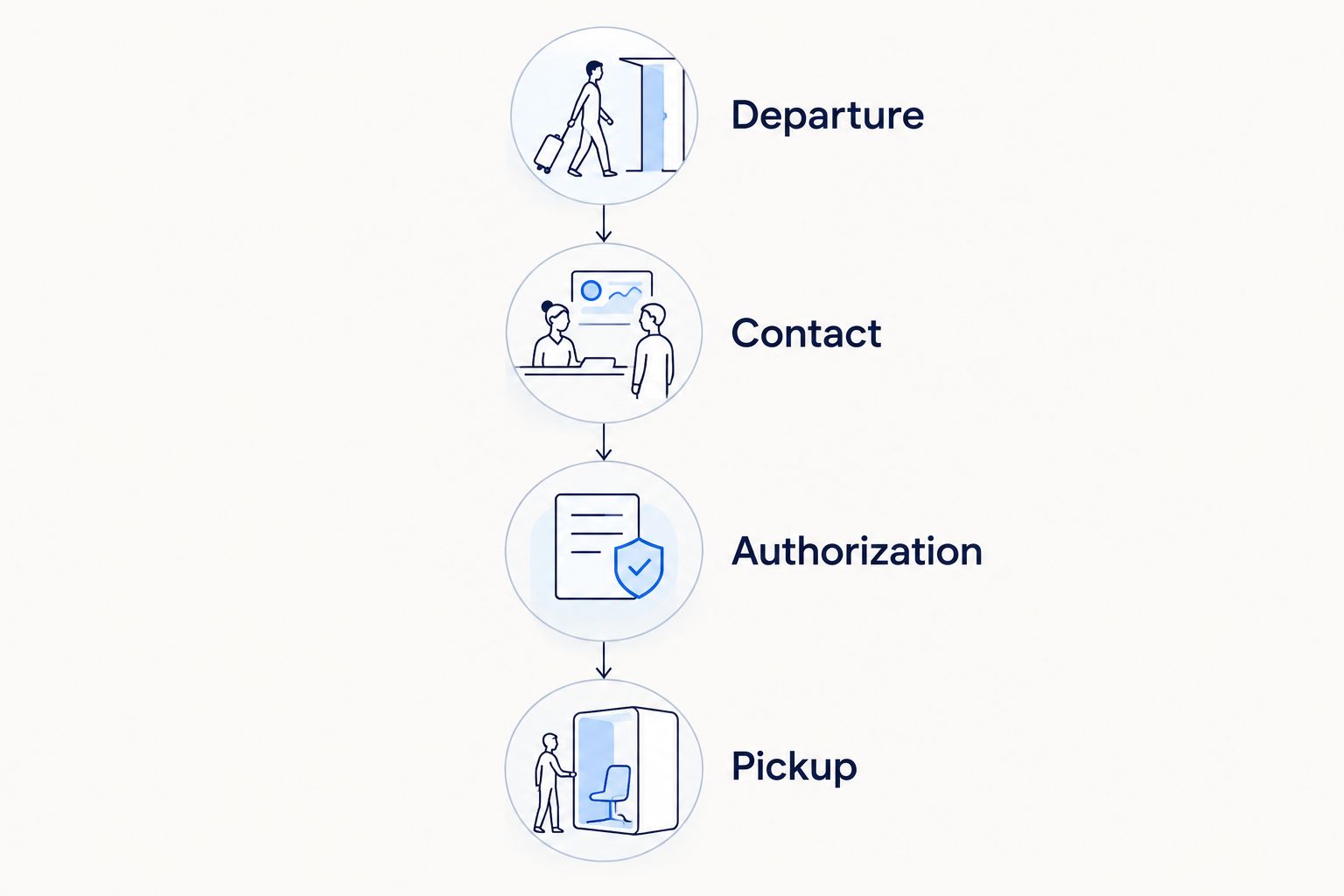
Set communication and authorization arrangements before leaving the vehicle.
3. Match the repair center to the damage and vehicle
Start by collecting your vehicle identification number, photographs, and any existing estimate. Then ask prospective facilities to explain how they determine the required repair procedures. This gives you a more useful comparison than asking only whether they can meet your return date.
OEM means original equipment manufacturer. Manufacturer repair procedures describe how particular damage and components must be handled; an OEM certification is a separate credential whose scope you should verify for the relevant facility and vehicle.
Crashfix offers collision, structural, paint, and EV body repair services. Those service categories do not establish that every location holds every manufacturer certification. Ask the location to confirm its applicable credentials, parts approach, and arrangements for any work performed elsewhere.
- Provide the vehicle identification number and describe the collision.
- Request confirmation of the relevant location’s manufacturer credentials.
- Ask which manufacturer procedures govern the proposed repair.
- Ask where structural measurements, scans, or calibration will occur if required.
- Request an explanation of proposed genuine, aftermarket, or recycled parts.
4. Separate the initial estimate from the approved repair plan
Read the initial estimate yourself and mark anything you do not understand. Ask the estimator to explain each repair area in plain language, including what remains unconfirmed until inspection or disassembly. An estimate is not proof that every damaged component has been identified.
A supplement is a documented addition or change to the initial repair estimate. Hidden damage can require a revised scope after parts are removed. Ask how the shop will send supporting photographs, explain the change, and obtain your authorization while you are away.
For 2026 travel planning, treat your return date as a communication milestone—not a guaranteed completion date. Ask when you will receive the next update even if the repair status has not changed. That prevents silence from becoming your only indication of progress.
- Request an itemized estimate and an explanation of unresolved damage.
- Identify which decisions require your authorization.
- Agree on how supplements and supporting photographs will reach you.
- Separate repair requirements from insurer coverage decisions.
- Ask what conditions must be satisfied before completion can be confirmed.
5. Verify safety-related work before approving the scope
Start with the written repair plan and ask which manufacturer-required checks apply. Advanced driver assistance systems, or ADAS, include features such as lane assistance and automatic emergency braking. Their sensors and cameras require attention when the manufacturer’s procedures call for inspection or calibration.
Calibration means setting or verifying a system’s alignment according to its specified procedure. It is not the same as a diagnostic scan, which checks electronic systems for information such as fault codes. Neither term should appear as an unexplained catch-all on your paperwork.
An EV also needs damage assessment that accounts for its high-voltage systems. Body damage does not, by itself, establish whether the battery is damaged. Ask the repair facility to explain the vehicle-specific inspection requirements rather than infer battery condition from appearance.
- Ask which scans are required before and after repair.
- Request the reason for any required ADAS calibration.
- Ask whether structural measurements are part of the repair plan.
- Confirm the vehicle-specific high-voltage precautions for an EV.
- Request documentation of completed checks at handover.
6. Confirm completion before arranging the return pickup
Create your own pickup checklist before departure. Then ask the shop to confirm repair completion, required checks, paperwork, and collection arrangements before you change your airport transportation. A message that painting is finished does not necessarily mean the vehicle is ready for release.
For a 2026 return flight, keep a backup ride available until the shop confirms the handover. If another person will collect the vehicle, establish the identification and authorization requirements in advance. Do not assume an after-hours arrival can be accommodated.
At pickup, review the repaired areas and supporting records. Ask for explanations of remaining warnings, unfinished items, or follow-up instructions before accepting the handover. Keep your questions tied to the documented repair scope rather than the appearance of the paint alone.
- Obtain explicit confirmation that the vehicle is ready for collection.
- Confirm who will collect it and how keys will be transferred.
- Review the final invoice against the authorized repair scope.
- Request applicable scan, calibration, and measurement records.
- Record any unresolved concern and the agreed response.
Compare repair options for your travel situation
Best for your trip means appropriate for the damage, with a workable handoff. Compare the repair approach before comparing convenience. The options below address different needs; none removes the need to inspect the vehicle and confirm the required procedures.
Crashfix collision repair
- Best for: Los Angeles County owners seeking OEM-certified collision repair centers
- Main advantage: Offers body, paint, structural, and EV body repair services
- Key limitation: Vehicle-specific credentials and travel arrangements need confirmation with the relevant location
Another collision repair facility
- Best for: Drivers comparing documented repair plans and location access
- Main advantage: Provides another scope and handoff arrangement to assess
- Key limitation: Capabilities, certifications, and procedures must be verified individually
Paintless dent repair
- Best for: Dents suitable for reshaping without refinishing
- Main advantage: Preserves existing paint when the damage qualifies
- Key limitation: Does not address every dent, damaged paint, structural damage, or other collision-related needs
Repair after the trip
- Best for: Owners whose vehicle can remain safely unused until assessment and repair
- Main advantage: Avoids managing repair decisions while traveling
- Key limitation: Does not resolve damage or establish that the vehicle is suitable to drive
Paintless dent repair is a technique, not a substitute for a collision assessment. Likewise, postponing repair is a scheduling choice, not a safety determination. If you choose to wait, establish appropriate vehicle storage and transportation without assuming the car is roadworthy.
Common mistakes airport travelers make
Treating the repair shop as airport parking
Leaving your car during a trip does not establish permission for extended storage. Confirm receiving, custody, and collection arrangements directly, including what happens if your return changes. A repair authorization and a parking arrangement are not interchangeable.
Selecting a shop only by the promised finish date
A firm promise before the damage is understood can distract from the actual repair requirements. Ask what the projected date depends on and when it will be reassessed. Do not ask a facility to skip required work to match a flight.
Becoming unreachable after authorizing the first estimate
The initial authorization does not answer every question that can arise during repair. Establish a communication method you can access abroad and name an alternate decision-maker if appropriate. A travel companion who can answer your phone is not necessarily authorized to approve work.
Assuming an insurance referral settles every repair question
An insurer’s recommendation does not replace verification of the facility’s capabilities or the vehicle’s repair requirements. Ask the shop about procedures and ask your insurer about policy-dependent coverage. Keep those answers distinct, especially when discussing parts or additional damage.
Collecting the vehicle without checking the records
A clean exterior cannot explain which hidden repairs or electronic checks were completed. Review the final paperwork before leaving and ask the shop to explain unfamiliar terms. Keep the records with your vehicle documents rather than relying on a verbal summary.
FAQ
What should I look for in an auto body shop in El Segundo before flying?
Look for a documented repair plan, applicable vehicle-specific credentials, and a clear travel handoff arrangement. Confirm authorization, communication, and pickup procedures before leaving your vehicle.
Can I leave my damaged car at a body shop while I travel?
Only leave your vehicle after the shop agrees to the receiving, repair, custody, and collection arrangements. Do not assume a repair facility provides airport parking or accepts unattended drop-offs.
Will my car be repaired before my return flight?
A return flight does not establish a repair completion date. Ask the shop what remains unresolved and arrange backup transportation until completion and release are confirmed.
Does OEM certification mean a shop is certified for every car?
No, OEM certification does not establish certification for every manufacturer or vehicle. Ask the specific facility to confirm the credentials relevant to your car and proposed repair.
Does a bumper repair require ADAS calibration?
The vehicle manufacturer’s procedures determine whether a particular bumper repair requires ADAS calibration. Ask the repair facility to identify the applicable requirement rather than assume every bumper repair is the same.
Can someone else approve repairs while I am traveling?
Ask the shop how to authorize another person to make repair decisions on your behalf. Document that permission separately from permission to collect the vehicle.
Will insurance cover every repair the shop recommends?
Coverage depends on your policy and the claim decision. Ask the shop to explain the repair requirement and ask the insurer to explain any coverage decision separately.
One last thing
The most useful airport-travel deadline is the next decision time, not an unsupported finish date. Before departure, ask when the shop will next need your input and what happens if you cannot respond. That question gives you something practical to schedule around during your 2026 trip.
Related guides
For your next step, contact Crashfix with your vehicle details, damage photographs, departure date, and return date. Request an estimate and confirm the relevant location’s capabilities and handoff arrangements before booking the repair.