Best Lincoln-certified collision repair shops in Los Angeles
Best overall: a repair location whose current Lincoln certification you can verify. Best for a dealer-assisted referral: a collision center recommended by your Lincoln retailer, with certification checked separately. Best local starting point for discussing repair scope: Crashfix, with Lincoln-specific credentials confirmed before you authorize work. This guide explains how to choose a lincoln certified collision center in Los Angeles without mistaking a general certification claim for approval to repair your vehicle.
TL;DR
- Choose a lincoln certified collision center by verifying the exact location, then reviewing its vehicle-specific repair plan.
- Crashfix offers collision repair in Los Angeles County; confirm Lincoln-specific credentials before booking a particular location.
- A Lincoln retailer referral helps build your shortlist, but does not replace certification verification.
- Compare structural repairs, genuine parts, diagnostic scans and required calibrations—not just the estimate total.
Why this matters
The best Lincoln repair choice is the location that can document its credentials and explain the repair your vehicle actually needs. A familiar business name, nearby address or insurance referral does not answer those questions.
Collision damage can involve more than the dent you see. Depending on the impact and vehicle equipment, the repair plan needs to address mounting points, wiring, restraint systems and driver-assistance sensors alongside bodywork and paint.
For a Los Angeles driver choosing a shop in 2026, convenience belongs on the checklist—but after repair capability. Whether you are arranging a tow from West Los Angeles or comparing locations near Burbank or El Segundo, establish who will repair the vehicle and under which procedures before approving transportation.
What makes the best Lincoln-certified collision center?
Use these criteria before comparing names. They turn a broad promise of quality into questions a repair facility can answer.
- Current location-specific certification: Confirm that Lincoln certification applies to the street address receiving your vehicle, not merely another branch or an affiliated business.
- Manufacturer repair procedures: Ask how the shop identifies the applicable instructions for your model, model year and damage. OEM means original equipment manufacturer.
- Parts transparency: Request a written explanation of which replacement parts are genuine OEM, aftermarket or recycled, and how proposed substitutions affect the repair plan.
- Structural repair capability: Ask who measures and repairs the vehicle structure when the damage requires it, including any work handled outside the facility.
- Diagnostics and calibration: Ask how the shop determines required scans and calibrations. Calibration is the adjustment and verification of a sensor or camera against specified requirements.
- Repair documentation: Expect an explanation of the records you will receive, including the final repair order and reports for applicable diagnostic or calibration work.
A certification is a useful screening credential. It does not replace a written repair plan or guarantee an individual repair outcome.
Your repair options at a glance
These are ranked selection routes, not a claim that every facility in a category holds Lincoln certification. Each route has a different purpose; the exact repair location still needs verification.
Location with verified Lincoln certification
- Best for: A certification-first repair decision
- Standout benefit: Establishes the manufacturer-specific credential before authorization
- Key limitation: Certification alone does not explain your repair scope
Lincoln retailer-referred collision center
- Best for: Getting a referral when you have no shortlist
- Standout benefit: Gives you a named facility to investigate
- Key limitation: A referral is not proof of certification or in-house capability
Crashfix collision repair
- Best for: Starting a local repair-scope discussion in Los Angeles County
- Standout benefit: Offers auto body, paint, structural and EV body repair services
- Key limitation: Lincoln-specific certification must be confirmed for the chosen location
1. Verified Lincoln-certified location: best for certification first
Best for: Drivers who want manufacturer-specific certification established before arranging the repair.
Start with Lincoln's official collision-repair resources or ask Lincoln to help verify a facility. Match the business name and street address, then ask the repair center to confirm its current status for that location in 2026.
Next, connect the credential to your actual vehicle. Supply your vehicle identification number, or VIN, so the facility can identify the model and relevant equipment rather than discussing a generic Lincoln repair.
Verified Lincoln-certified location pros:
- Establishes a manufacturer-specific credential at the start of your search.
- Gives you a concrete location to check before authorizing towing.
- Keeps the discussion focused on applicable manufacturer repair requirements.
Verified Lincoln-certified location cons:
- Certification does not tell you which operations the facility performs in-house.
- The credential does not establish your insurance coverage or authorize repairs.
- You still need an explanation of parts, inspections and completion records.
Ask who will perform structural work, refinishing and any required calibration. If another business handles part of the job, ask who coordinates it and which reports become part of your final paperwork.
Verdict: Choose this route first when current Lincoln certification is a requirement for your shortlist.
2. Lincoln retailer referral: best for building a shortlist
Best for: Drivers who have a relationship with a Lincoln retailer but do not know which collision facility to contact.
Ask your retailer for the exact name and address of the collision center it recommends. Establish whether the retailer operates that facility or refers repairs to an independent business; those are different arrangements.
A referral gives you a starting point, not a completed evaluation. Contact the receiving shop directly to verify credentials, discuss your vehicle and understand who will obtain your repair authorization.
Lincoln retailer referral pros:
- Provides a specific facility to investigate instead of an unfiltered search list.
- Lets you ask an existing vehicle-service contact for direction.
- Helps clarify whether collision work happens at the retailer or elsewhere.
Lincoln retailer referral cons:
- A retailer recommendation does not establish current Lincoln certification.
- The referring business is not necessarily the business repairing your vehicle.
- You must separately confirm communication responsibilities and repair documentation.
For a 2026 repair, ask for the receiving facility's current details rather than relying on an old referral card. Check the address before releasing the vehicle to a transporter, especially when several businesses use similar names.
Verdict: Choose a retailer referral to build your shortlist; hold repair authorization until you verify the receiving facility.
3. Crashfix collision repair: best for a local scope discussion
Best for: Los Angeles County vehicle owners who want to discuss collision damage and the proposed repair process with a local repair business.
Crashfix operates OEM-certified collision repair centers across Los Angeles County and offers auto body, paint, structural and EV body repair services. For Lincoln collision repair, confirm the credentials of the particular location you are considering; an OEM-certified business description does not establish Lincoln certification at every address.
Bring the discussion back to your vehicle. Share the VIN, photographs, warning messages and any initial estimate, then ask what inspection is needed before the facility can explain the repair scope.
Crashfix collision repair pros:
- Offers bodywork, paint and structural repair services within Los Angeles County.
- Offers EV body repair services, relevant when discussing an electrified vehicle's collision damage.
- Provides a local option to assess against the same certification and documentation checklist.
Crashfix collision repair cons:
- Lincoln-specific certification requires confirmation at the chosen location.
- A broad service list does not establish suitability for every model or repair operation.
- Insurance coverage and the final repair scope require separate review.
If West Los Angeles, Burbank or El Segundo is convenient for you, ask which location should evaluate your Lincoln rather than assuming the nearest address is the correct destination. Confirm the receiving address before arranging a tow.
Verdict: Consider Crashfix for a local repair discussion; hold Lincoln-certified status as a separate verification step.
How to compare the repair plans
Two estimates can describe different work. Compare the operations and parts behind each total before deciding that one facility is offering the same repair as another.
Match the vehicle
Provide the 17-character VIN used on modern vehicles, along with the model year and accident details. Mention warning lights, unusual noises and whether an airbag deployed; do not clear messages just to make the vehicle appear ready for inspection.
Review the scope
Ask which damage is visible and which areas require further inspection. Removing damaged components can reveal additional damage, so an initial estimate is not automatically a complete repair plan.
A supplement is an addition or revision to that plan. Ask how the shop will explain supplemental work and obtain the required authorization before proceeding.
Check the parts
Have the estimator identify proposed replacement parts by type. Genuine OEM, aftermarket and recycled parts are not interchangeable descriptions; ask how each proposed part fits the manufacturer's repair requirements for the operation involved.
Separate the repair recommendation from the insurance decision. A technician's explanation of what a repair requires does not establish what your policy will pay.
Confirm the records
Ask for 3 document groups at handover: the final repair order, applicable diagnostic and calibration reports, and written warranty terms. These are a practical collection checklist, not a claim that every repair requires every possible test.
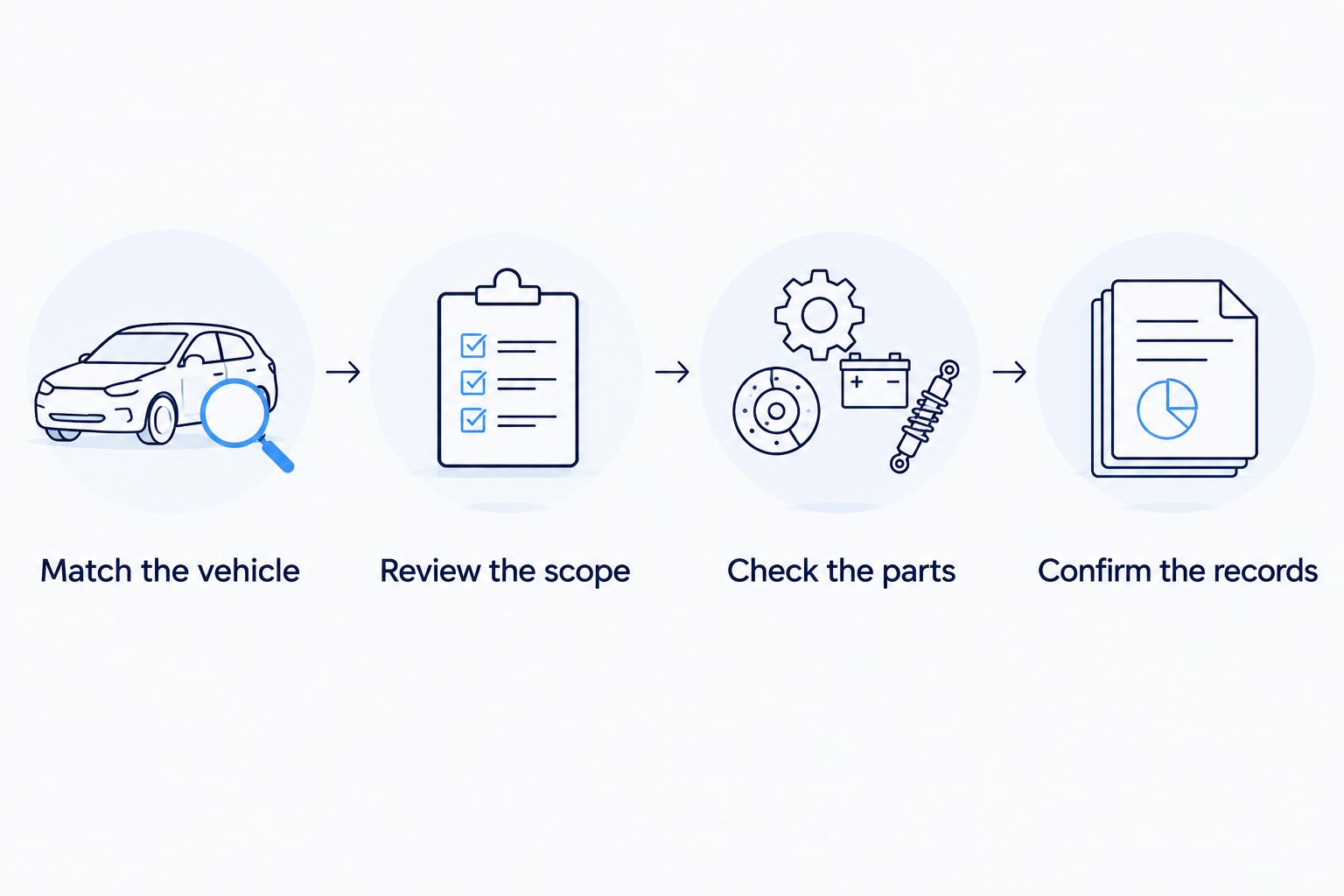
Compare the repair scope and supporting records, not just the estimate total.
Keep your initial estimate as well as the final paperwork. The difference between them should have an understandable explanation, including newly identified damage or changes to authorized work.
Questions to settle before you authorize repairs
Use a short written checklist when you contact a facility in 2026. Written answers make it easier to compare shops without relying on what you remember from separate calls.
- Who is receiving the vehicle? Confirm the legal business name, address and primary repair contact.
- What am I authorizing? Distinguish towing, inspection, disassembly and repair authorization; ask what obligations each document creates.
- Which procedures apply? Ask how the facility identifies manufacturer instructions for your vehicle and damage.
- Who handles outside work? Request an explanation of any subcontracted operations and the records you will receive.
- How are changes approved? Establish how supplemental work and insurer decisions will be communicated.
- What happens at handover? Ask who will review the completed work and explain any follow-up instructions.
Do not drive a damaged vehicle merely because a shop is nearby. If you have concerns about steering, braking, tires, leaks or vehicle warnings, arrange an assessment and appropriate transportation rather than treating proximity as permission to drive.
How the options are ranked
This 2026 guide puts verifiable Lincoln certification first, a retailer-assisted referral second, and a local repair-scope discussion third. That order reflects the question you need answered: who can substantiate the credential, and then explain the work?
No ranking here substitutes for checking the receiving location. Compare each facility against the same criteria: certification, manufacturer procedures, parts, structural capability, diagnostics and documentation.
Which collision repair option should you choose?
Choose a currently verified Lincoln-certified location when manufacturer-specific certification is your deciding requirement. Then review the repair plan before authorizing work; the badge and the estimate answer different questions.
Use a retailer referral if you need help identifying candidates. Use a local collision repair conversation to establish inspection needs and practical next steps, but do not treat either route as proof of Lincoln certification.
For your 2026 decision, prioritize documented repair requirements over convenience alone. A clear explanation of the work is more useful than a confident promise about a result nobody has inspected yet.
FAQ
What's the best Lincoln-certified collision center in Los Angeles?
Choose a location whose current Lincoln certification you can verify and whose repair plan addresses your specific vehicle. Confirm the exact address, proposed parts, manufacturer procedures and required diagnostic work before authorization.
Is every OEM-certified body shop Lincoln-certified?
No. A general OEM-certified claim does not establish Lincoln certification at a particular location. Ask which manufacturer credentials apply to the address receiving your vehicle.
Is Crashfix a Lincoln-certified collision center?
Confirm Lincoln-specific certification directly with the particular Crashfix location before booking. The business operates OEM-certified collision repair centers, but that description does not establish Lincoln certification at every location.
Is a Lincoln dealer referral enough to choose a repair shop?
No. A dealer referral identifies a facility to investigate, not proof of its current certification or repair capabilities. Verify the receiving business and review its proposed work directly.
Does my Lincoln need sensor calibration after a collision?
Calibration depends on the vehicle, affected components and applicable manufacturer procedures. Ask the repair facility to explain which operations trigger calibration and provide the resulting reports when required.
Will insurance pay for genuine Lincoln parts?
Payment depends on your policy, claim circumstances and the insurer's coverage decision. Ask the shop to explain the repair requirements and proposed parts, then address coverage separately with your insurer.
What should I bring when requesting a collision repair estimate?
Bring your VIN, accident photographs, claim information and any existing estimate. Report warning messages and drivability concerns so the facility can discuss inspection needs and appropriate vehicle transportation.
One last thing
A quiet dashboard is not a substitute for repair documentation. Warning lights alone do not establish that every required inspection, scan or calibration has been completed.
Before booking, send your VIN and damage photographs to your chosen facility and request an estimate discussion. Ask it to confirm the receiving address, Lincoln-specific credentials and inspection process before you authorize a tow or repair.