Best paintless dent repair shops in Los Angeles
Best starting point after an accident: Crashfix for collision-damage assessment. Best for an isolated dent with intact paint: a qualified paintless dent repair specialist. This 2026 guide helps you choose the right repair setting in Los Angeles without confusing cosmetic dent removal with collision repair.
TL;DR
- For paintless dent repair Los Angeles searches, prioritize damage suitability over promises of quick dent removal.
- Crashfix is best for collision assessment when a dent follows an accident rather than an isolated cosmetic impact.
- A dedicated paintless dent repair specialist suits accessible dents with intact paint, subject to inspection.
- Cracked paint, damaged seams, or poor panel alignment require a broader repair assessment.
Why this matters
Paintless dent repair, or PDR, reshapes a damaged panel without refinishing its painted surface. A technician works the metal using suitable access and tools; the method is not appropriate for every dent.
The best choice depends on what happened beneath the visible mark. A parking-door ding is a different problem from a dent accompanied by a door that no longer closes correctly. Choose the repair method after inspection, not before it.
For Los Angeles drivers comparing shops in 2026, a useful shortlist separates cosmetic PDR specialists from collision repair centers. The recommendations below rank those options by your situation, not by unsupported star ratings or claims that one shop repairs every kind of dent.
What makes the best paintless dent repair shop?
Use these criteria before choosing a shop in West Los Angeles, Burbank, or El Segundo:
- Damage suitability: The shop examines paint condition, dent shape, panel edges, and signs of stretched metal before recommending PDR.
- Manufacturer procedures: The repair plan follows the vehicle manufacturer's applicable instructions, including restrictions affecting panel repair and access.
- Access planning: The technician explains whether reaching the dent requires removing trim, lamps, or other components.
- Repair boundaries: The estimate distinguishes dent removal from paint work, component replacement, diagnostics, and calibration when required.
- Evidence of relevant work: Ask for examples involving comparable panel material, dent location, and damage—not simply a gallery of attractive cars.
- Written expectations: The shop explains the proposed result, limitations, and what happens if inspection reveals damage unsuitable for PDR.
A manufacturer certification is relevant only when it applies to the particular location and vehicle. It does not independently establish that the location offers PDR or that your dent qualifies.
Los Angeles dent repair options at a glance
Crashfix collision assessment
- Best for: Dents following an accident with possible additional damage
- Standout advantage: Collision, paint, structural, and EV body repair services
- Key limitation: Confirm PDR availability and vehicle-specific credentials with the relevant center
Dedicated PDR specialist
- Best for: Isolated cosmetic dents with intact paint
- Standout advantage: Focus on reshaping the panel without refinishing
- Key limitation: Does not replace a collision assessment when other damage is suspected
Conventional auto body repair shop
- Best for: Dents with damaged paint or repair needs beyond PDR
- Standout advantage: Can address metalwork and refinishing within the repair plan
- Key limitation: Repairing the finish means the work is no longer paintless
These are repair-setting recommendations, not a verified ranking of individual PDR businesses. Choose the setting that matches the damage, then verify the proposed work with the actual location.
1. Crashfix: best for assessing dents after an accident
Crashfix operates OEM-certified collision repair centers across Los Angeles County and provides auto body, paint, structural, and EV body repair services. That makes collision assessment the relevant starting point when a dent follows an accident or accompanies problems beyond the panel's appearance.
Crashfix is best for Los Angeles drivers who need collision-damage assessment before choosing a dent repair method. Confirm the relevant center's manufacturer certifications and whether it offers or arranges PDR before booking specifically for paintless work.
Crashfix pros
- Collision repair services address more than the visible dent.
- Paint and structural repair services are relevant when inspection identifies damage beyond cosmetic metal deformation.
- EV body repair services provide a relevant assessment route for electric-vehicle owners after an accident.
Crashfix limitations
- PDR availability must be confirmed with the relevant center; collision repair capability alone does not establish it.
- OEM certification must be checked for your manufacturer and location rather than assumed across every vehicle.
Best for: A dent after a side impact, rear-end collision, or parking-lot hit that also affected panel fit or vehicle operation.
Tell the estimator how the impact happened. Mention a sticking door, a warning message, a changed panel gap, or any new noise rather than requesting dent removal alone.
Verdict: Book an assessment when the impact raises questions beyond appearance.
2. Dedicated PDR specialist: best for an isolated cosmetic dent
A dedicated paintless dent repair specialist focuses on reshaping panels while preserving the existing finish. This is the most relevant option when a dent appears isolated, the paint remains intact, and inspection confirms that the metal and access conditions suit PDR.
A shallow-looking dent is not automatic approval. A sharp crease, restricted access, prior refinishing, or stretched metal changes the repair decision.
Dedicated PDR specialist pros
- Preserves the existing paint when the damage qualifies for paintless repair.
- Focuses the assessment on metal shape, access, and finish condition.
- Avoids a refinishing step when PDR alone achieves the agreed repair.
Dedicated PDR specialist limitations
- PDR does not repair cracked paint, corrosion, or every form of metal damage.
- A cosmetic dent repair appointment is not a substitute for evaluating suspected structural or mechanical damage.
- Prior repairs can complicate the method and expected finish.
Best for: An isolated door ding or similar cosmetic dent that an inspection confirms is suitable for PDR.
Ask the technician to explain the access route and the expected finish under inspection lighting. Request examples of similar damage, including any remaining distortion the technician would consider acceptable.
Verdict: Book PDR after suitability is confirmed; skip an appearance-only assessment after a significant impact.
3. Conventional body repair shop: best for damaged paint
A conventional auto body repair shop is the appropriate option when the panel needs refinishing or other work beyond paintless reshaping. Depending on inspection findings and manufacturer instructions, the repair plan can involve metal repair, paint preparation, refinishing, or panel replacement.
PDR and conventional repair are not interchangeable labels. If the paint needs repair, removing the dent alone leaves part of the damage unresolved.
Conventional body repair shop pros
- Addresses damaged paint as part of the panel repair.
- Provides a route for damage that falls outside suitable PDR conditions.
- Can include related disassembly and component work in a documented repair plan.
Conventional body repair shop limitations
- Refinishing does not preserve the panel's existing painted surface.
- The work involves more processes than paintless reshaping alone.
- Panel replacement should follow repairability findings and manufacturer instructions, not a blanket preference.
Best for: A dent with cracked paint, exposed metal, unsuitable metal deformation, or related damage requiring a broader repair.
Ask why the proposed method is appropriate and which findings rule out PDR. A clear explanation is more useful than a general statement that the dent is too difficult.
Verdict: Book conventional repair when the finish or underlying damage requires it.
How to assess your dent before contacting a shop
For your 2026 repair inquiry, gather information that helps the estimator understand the impact. Do not push the panel, pull on trim, or try to straighten a sharp crease yourself.
Photograph damage
Take 4 photos: the full affected side, a close view of the dent, an angled view showing distortion, and a view of nearby seams or panel gaps. Use 2 viewing angles for the damaged area so reflections do not hide its shape.
These are preparation recommendations, not a substitute for inspection. Photos cannot establish the condition of concealed components.
Record symptoms
Write down when the damage happened and what struck the vehicle. Note whether the door, window, charge-port door, or trunk operates differently, and report any new warning messages.
Do not repeatedly operate a damaged component to demonstrate the problem. Describe the symptom and let the shop determine the next check.
Disclose prior repairs
Tell the estimator about known repainting, body filler, earlier dent repairs, or protective film on the affected panel. Prior work matters because the visible surface does not always reveal what is beneath it.
Request inspection
Ask whether the initial recommendation is provisional and what must be inspected before the shop confirms PDR suitability. If access requires disassembly, clarify authorization before work starts.
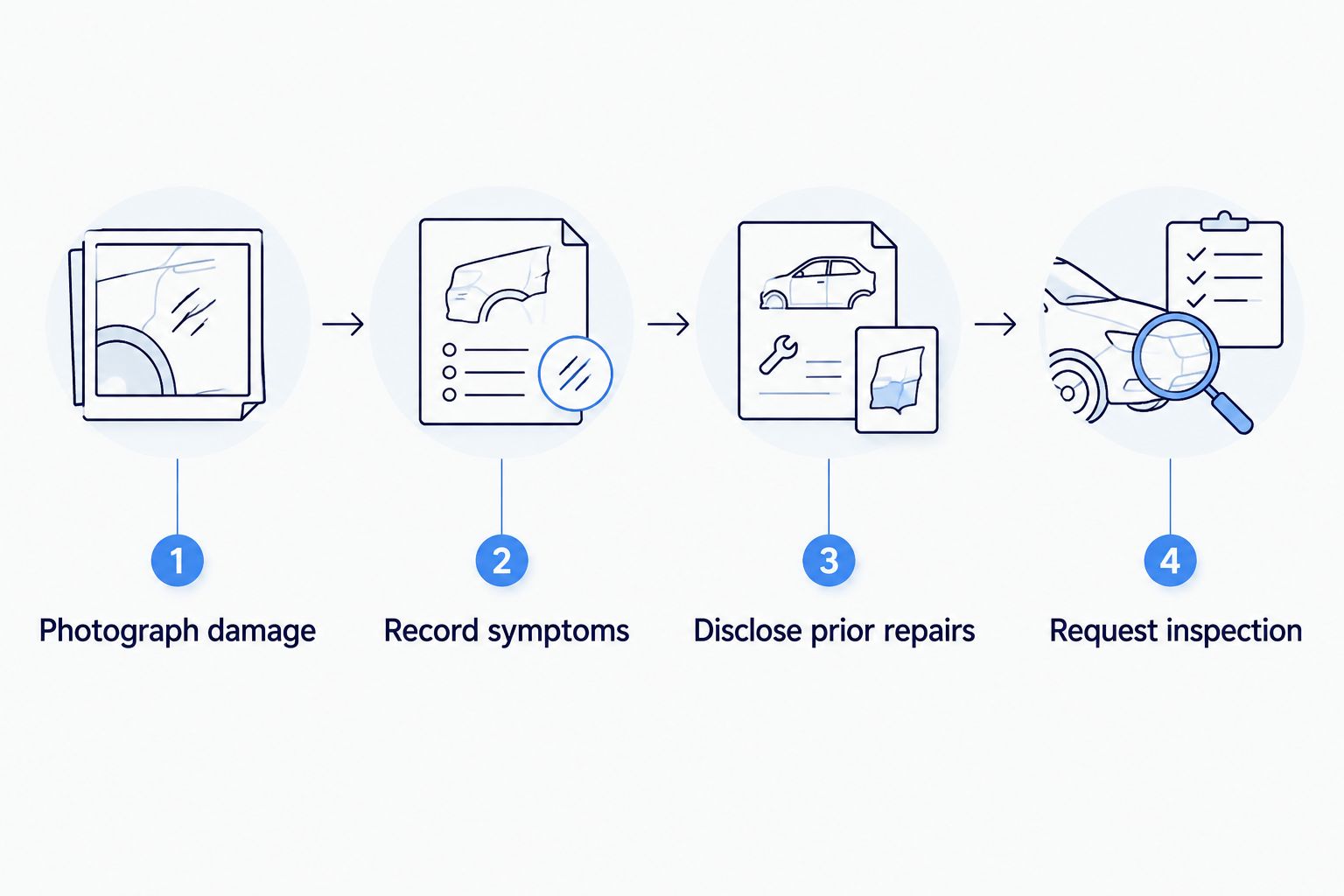
Document the damage and symptoms before choosing a repair method.
A complete inquiry helps the shop distinguish a cosmetic dent from a possible collision repair. It also gives you a clearer basis for comparing recommendations.
Questions that separate a useful estimate from a guess
Ask these 3 questions before authorizing work:
- Why does this dent qualify for PDR? Look for an explanation covering paint condition, metal shape, access, and applicable repair instructions.
- What does the estimate include? Clarify trim removal, reassembly, paint work, and any diagnostics or calibration required by the repair.
- What happens if inspection changes the plan? Agree on how the shop will explain additional findings and obtain authorization.
Keep repair requirements separate from insurance coverage. The vehicle's repair needs come from inspection and applicable procedures; payment depends on the claim, policy terms, and coverage decisions.
For an EV, tell the shop about any battery, charging, or electrical warning after the impact. A dent near a charging area should not be treated as a cosmetic-only request without that information.
How the recommendations are ranked
This 2026 guide ranks repair settings by damage suitability, manufacturer procedures, access planning, documentation, and repair limitations. It does not assign review scores, claim hands-on testing, or name unverified local PDR providers.
Collision assessment comes first for accident-related damage. Dedicated PDR comes first for a confirmed cosmetic dent with suitable paint and metal conditions. Conventional body repair becomes the relevant choice when paintless work cannot address the damage.
Which dent repair option should you choose?
For an isolated dent with intact paint, start with a PDR suitability inspection. For accident damage, start with collision assessment. The distinction matters more than whether a business describes itself as the best.
If you are comparing Los Angeles shops in 2026, give each estimator the same photos, impact history, and symptoms. Compare the explanation and scope—not just the repair label.
FAQ
What's the best paintless dent repair option in Los Angeles?
A qualified PDR specialist is the appropriate option for an isolated dent that inspection confirms is suitable for paintless repair. If the dent follows an accident or accompanies other symptoms, start with a collision assessment.
Does Crashfix offer paintless dent repair?
Confirm PDR availability directly with the relevant Crashfix center before booking for that service. Its stated services include auto body, paint, structural, and EV body repair, but those services do not independently confirm PDR availability.
Can a dent on a body line be repaired without repainting?
Some body-line dents are suitable for PDR, but location alone does not determine repairability. Paint condition, crease severity, metal deformation, access, and applicable manufacturer instructions affect the decision.
Is paintless dent repair suitable if the paint is cracked?
PDR alone does not repair cracked paint. The shop must assess both the dent and the damaged finish before recommending a complete repair plan.
Can a mobile dent technician assess accident damage?
Ask what the technician's assessment includes rather than assuming a mobile dent appointment covers collision damage. Report changed panel gaps, operating problems, and warning messages so the provider can explain whether a broader assessment is needed.
Will insurance cover paintless dent repair?
Coverage depends on your policy, the cause of damage, and the claim decision. A shop's recommendation for PDR does not guarantee that an insurer will pay for it.
Can I get a reliable PDR estimate from photos?
Photos support an initial assessment, but they do not confirm concealed damage or access behind the panel. Ask which findings require an in-person inspection before the repair method is finalized.
One last thing
A dent's location matters as much as its appearance. A mark near a door edge deserves questions about the seam and door operation, not just whether the reflection looks smooth afterward.
Before your 2026 appointment, write down any change you noticed immediately after the impact. That detail belongs in the repair discussion even if the dent looks minor.
Related guides
- Can a dent on a body line be repaired without repainting?
- Can a dent near a door edge keep the door from sealing?
- How do the best body shops document repair quality?
Request an assessment with your vehicle details, damage photos, and impact history. Ask the relevant center to confirm PDR availability and the appropriate inspection before authorizing repairs.
Book a damage assessment
Share your vehicle details and damage concerns before choosing a repair method.