Can a Los Angeles auto body shop repair a leased car?
Yes. A Los Angeles auto body shop can repair a leased car; the shop does not have to be the selling dealership simply because you lease the vehicle. Before authorizing work, check your lease agreement for repair, parts and notification requirements, and confirm that the shop can follow your vehicle manufacturer’s procedures. Completing a collision repair does not automatically resolve lease-return obligations or establish what insurance will cover.
TL;DR
- A leased car can receive collision repairs outside the selling dealership, subject to applicable lease requirements.
- Choose an auto body shop Los Angeles drivers can evaluate through documented repair procedures, not price alone.
- CrashFix serves Los Angeles County drivers seeking OEM-certified collision repair; confirm credentials for your vehicle and location.
- Keep the final invoice, parts details and applicable calibration records for your lease-return file.
Can a Los Angeles auto body shop repair a leased car?
Yes—choose the repair facility by its capabilities and your lease requirements, not by the dealership name on your paperwork. Leasing changes your contractual obligations, but it does not change the need for a repair plan specific to the vehicle and damage.
CrashFix operates OEM-certified collision repair centers across Los Angeles County. Confirm the relevant location’s manufacturer credentials before booking; certification for one manufacturer does not establish certification for another.
Use these 4 checkpoints before authorizing a leased-car repair in 2026:
- Read the lease. Find the provisions covering accident damage, required notifications, replacement parts, repairs and return condition.
- Contact the lessor. Ask the company named on your lease to clarify requirements you cannot resolve from the agreement. Request written guidance.
- Confirm the repair plan. Ask the shop how it will identify manufacturer procedures, select parts and document required inspections or calibrations.
- Separate repair authorization from coverage. Confirm what work you are approving and ask your insurer which expenses your policy covers.
These checks answer different questions. A shop’s ability to repair the vehicle does not establish insurance coverage, and an insurer’s approval does not establish compliance with your lease.
Why this matters before you approve repairs
A leased vehicle eventually faces a return, purchase or other contract-defined decision. Repairing visible damage is only part of preparing for that decision: you also need records explaining what happened and what work was completed.
Manufacturer procedures address how the vehicle should be repaired. Your lease addresses your obligations to the lessor, while your insurance policy addresses coverage. Keep those three sources separate instead of treating one approval as permission for everything.
For a Los Angeles driver arranging repairs in 2026, that means asking practical questions before the vehicle enters production. Who must receive notice? Which parts are specified? What documentation will leave with the car? Answers in writing are more useful than a general assurance that the shop handles leased vehicles.
Do you need the dealership or an independent body shop?
A dealership relationship and collision-repair capability are different things. Ask who will actually perform the work, where the repair will happen and which manufacturer credentials apply at that facility.
Neither category is automatically the right choice. Compare the proposed repair process rather than assuming a dealership must handle the job or an independent facility cannot.
Dealership-arranged repair
- Best for: Drivers who want the selling dealer involved
- Useful feature: Provides a route to discuss vehicle-specific questions with the dealer
- Limitation to check: The dealer relationship alone does not confirm who performs body repairs or holds relevant certification
Independent collision repair center
- Best for: Drivers choosing a facility directly
- Useful feature: Lets you assess the actual repair location and its documented process
- Limitation to check: Manufacturer credentials and equipment must be confirmed for the vehicle and location
CrashFix is a fit for Los Angeles County drivers seeking OEM-certified collision repair. That does not replace a vehicle-specific review: ask the intended location to confirm its relevant credentials, proposed procedures and documentation before authorizing work.
For West Los Angeles, Burbank or El Segundo, choose a practical location only after confirming those requirements. Convenient drop-off matters, but it should not decide whether the facility can perform the required repair.
What changes between cosmetic and structural lease repairs?
The appearance of damage does not establish the full repair scope. A scraped bumper, displaced panel or damaged mounting point needs assessment before anyone promises that refinishing alone will resolve it.
Cosmetic damage
- What the assessment should address: Finish condition, surface damage and whether repair or replacement is appropriate
- What you should not assume: A visible scratch always requires only paint
Panel damage
- What the assessment should address: Panel repairability, replacement procedures and affected attachments
- What you should not assume: A matching exterior appearance proves the underlying repair is complete
Structural damage
- What the assessment should address: Measurements, repair limits and manufacturer joining procedures
- What you should not assume: Straightening is permitted for every damaged component
Damage near driver-assistance equipment
- What the assessment should address: Sensor condition, mounting points and applicable calibration requirements
- What you should not assume: No dashboard warning means no inspection or calibration is needed
Ask the shop to explain the category in plain language. A structural component helps carry loads through the vehicle; it is not simply an exterior panel. Calibration is a procedure used to establish specified operating references for certain vehicle systems.
For an electric vehicle, also ask whether the damage calls for high-voltage precautions or assessment under manufacturer procedures. Do not treat an apparently cosmetic impact as proof that nearby systems are unaffected.
Why leased-car repair requirements vary
There is no single repair checklist that covers every leased vehicle. In 2026, your agreement, vehicle and actual damage remain the starting points—not a generic promise that a repair is lease-approved.
The main factors are:
- Lease terms. The agreement determines your contractual notification, maintenance, repair and return obligations.
- Vehicle manufacturer. Repair instructions, material restrictions and replacement procedures differ by vehicle.
- Damage location. Damage involving attachment points, structural components or sensor areas changes what needs assessment.
- Replacement parts. The repair plan must account for applicable manufacturer procedures and any requirements in your lease.
- Insurance policy. Coverage, deductibles and parts provisions depend on your policy and claim circumstances.
- Return requirements. The lessor’s applicable return standards determine how it evaluates the vehicle at handback.
Ask each party to explain its own requirements. Your repairer should explain the repair method; your insurer should explain coverage; your lessor should explain the contract and return process.
Are genuine OEM parts required on a leased car?
Genuine OEM parts are parts supplied through the vehicle manufacturer’s parts system. Whether your repair requires a particular part depends on the manufacturer procedure, the damage and any applicable lease requirement; do not assume every lease uses identical language.
Ask the shop to identify proposed replacement parts on the estimate. If a part description is unclear, request clarification before authorization rather than waiting until the final invoice.
A repair requirement and an insurance payment decision are separate issues. If the proposed part, manufacturer instruction and insurer’s position differ, ask for the difference to be explained in writing. Confirm your responsibility for any unresolved amount before approving the work.
Avoid accepting a blanket statement that all replacement parts are equivalent. The useful question is narrower: does the proposed part and installation method meet the requirements for this vehicle and repair?
What should you authorize before work starts?
Before signing, make sure the estimate identifies the known damage and proposed work. Ask how the shop will contact you if disassembly reveals additional damage, and how approval for additional work will be documented.
Keep 2 decisions distinct: authorization to inspect or disassemble the vehicle, and authorization to perform repairs. Read what the actual document permits rather than relying on its title.
Ask these questions before handing over the keys:
- What work does this authorization permit today?
- How will you explain additional damage or changes to the repair plan?
- Which manufacturer procedures apply to the proposed work?
- Which replacement parts are listed, and how are they identified?
- What inspections, scans or calibrations does the repair require?
- Which documents will I receive when the vehicle is ready for collection?
You do not need to diagnose the damage yourself. You need a clear explanation of the work, the approval process and the records you will receive.
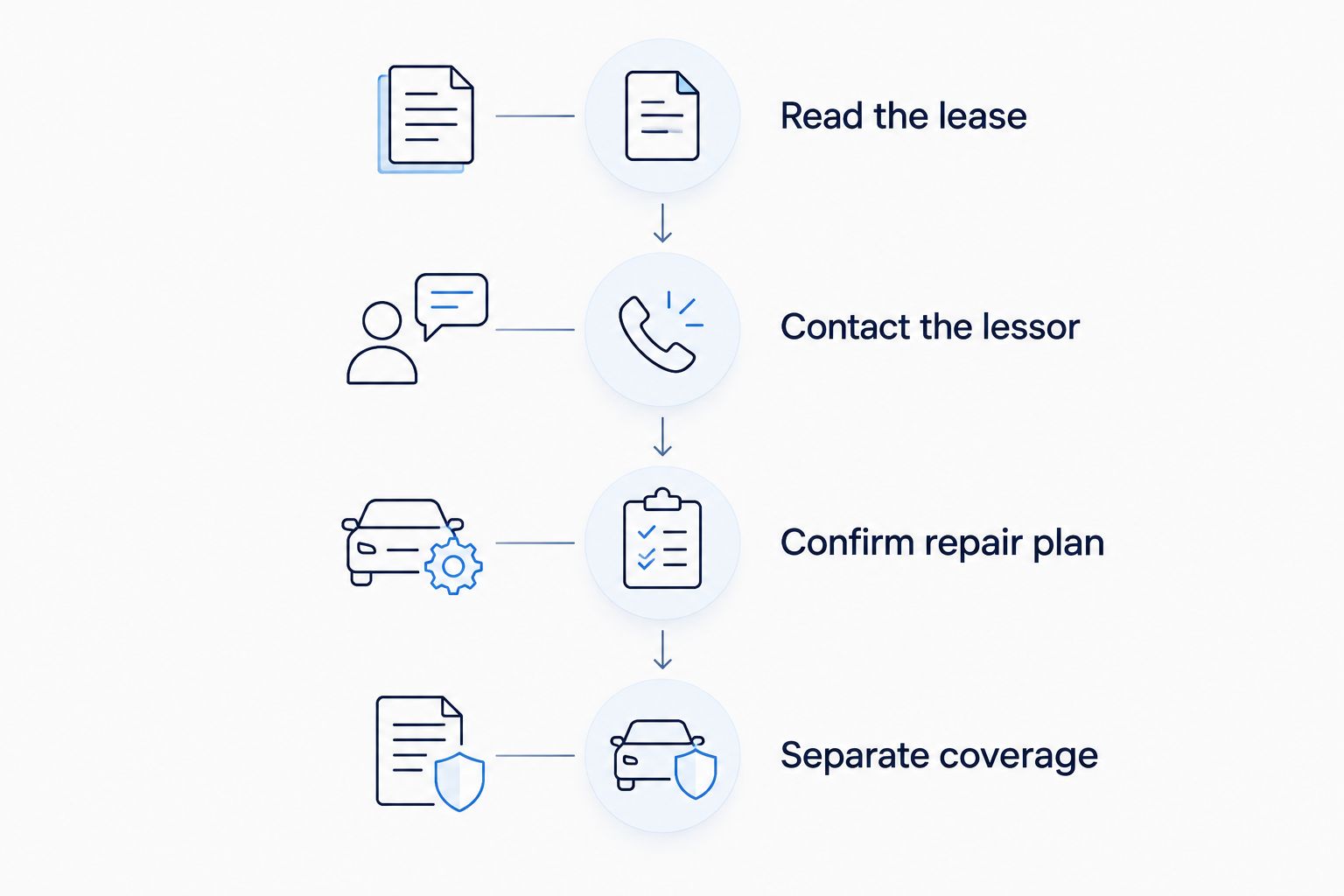
Check the contract, repair method and coverage separately before authorizing work.
What records should you keep after the repair?
Build your 2026 repair file around 3 document groups: the final repair invoice, applicable inspection and calibration records, and correspondence about lease requirements. Save readable copies somewhere you can access when the vehicle is returned.
The final invoice should let you identify the vehicle, repair facility and work performed. Ask for replacement-part descriptions and clarification of unfamiliar line items rather than accepting an unexplained total as the complete record.
Where the repair requires scans, measurements or calibration, ask which completion records are available and what they document. A diagnostic scan reads information from vehicle systems; calibration performs a different task. Do not treat the terms as interchangeable.
Keep written lessor guidance alongside the repair paperwork. That makes it easier to connect an instruction with the work performed, without claiming the documents guarantee a particular lease-return outcome.
Will repairing the damage prevent lease-return charges?
Repairing damage does not guarantee that the lessor will assess no charges. The return decision depends on the agreement, applicable standards and the vehicle’s condition when inspected.
Ask the lessor how it handles previously repaired collision damage and what supporting records it requests. Do this before repair authorization when possible, not only when the lease ends.
If your 2026 return date is approaching, tell the shop and lessor about it. Ask what inspections and paperwork remain necessary without assuming that a requested date guarantees repair completion or return acceptance.
Can you return a leased car without fixing accident damage?
Check the lease and ask the lessor before deciding to return a damaged vehicle. Do not assume that an insurance claim, a completed estimate or a decision not to repair removes your contractual responsibility.
Ask how unrepaired damage is evaluated and what steps apply to your situation. Keep that response with your lease records so you are comparing actual requirements rather than advice intended for a different leasing company.
FAQ
Can I take my leased car to an independent auto body shop in Los Angeles?
Yes, an independent auto body shop can repair a leased car, subject to applicable lease requirements. Confirm the facility’s capabilities, relevant manufacturer credentials and proposed repair procedures before authorizing work.
Do I have to tell my leasing company about an accident?
Check your lease for accident-reporting and notification requirements. Ask the lessor for written clarification if the agreement does not clearly answer your situation.
Does OEM certification mean a shop is certified for every car?
No, manufacturer certification is not universal across vehicle brands or repair locations. Confirm the certification relevant to your vehicle at the facility that will perform the work.
Will insurance pay for genuine OEM parts on my leased car?
Coverage for genuine OEM parts depends on your policy and claim circumstances. Ask your insurer to explain its position separately from the repairer’s explanation of manufacturer and lease requirements.
Does a leased car need calibration after collision repair?
Calibration is required when the applicable manufacturer procedure calls for it. Ask the shop to explain which affected systems require inspection or calibration and which completion records you will receive.
Will a repaired accident affect my lease return?
A repaired accident does not automatically settle every lease-return obligation. Ask the lessor how it evaluates prior collision repairs and retain the final invoice and applicable supporting records.
What should I bring to a leased-car repair estimate?
Bring your vehicle information, relevant lease requirements, claim details if applicable and any written lessor instructions. Tell the shop about warning messages, symptoms and any approaching lease-return date.
Related guides
One last thing: ask about handover before drop-off
Ask what documentation you will receive before you authorize the repair. That question connects the repair plan to your lease-return file and exposes unclear expectations while there is still time to resolve them.
For a 2026 repair inquiry, have your vehicle details, damage photos, relevant lease instructions and claim information ready. Contact CrashFix to request an estimate and confirm the appropriate location’s manufacturer credentials, repair process and documentation for your leased vehicle.