Best collision repair shops in LA for ADAS recalibration
Best starting point for collision damage: Crashfix, an OEM-certified collision repair provider in Los Angeles County. Best for manufacturer-specific diagnostic support: a dealership service department that confirms calibration capability; best for calibration after completed repairs: a specialist that supports your vehicle and the required procedure.
TL;DR
- For best shop for adas recalibration los angeles searches, choose by vehicle-specific procedures and documented results.
- Crashfix is a collision repair starting point; confirm the selected location’s certification and calibration arrangements before authorization.
- A dealership suits manufacturer-specific diagnostic questions; verify whether it handles collision repairs or only calibration.
- A calibration specialist suits completed repairs when the vehicle meets the manufacturer’s setup requirements.
Why this matters
The best shop for ADAS recalibration is the shop that connects the collision repair to your vehicle’s manufacturer-required procedures. ADAS means advanced driver assistance systems: features such as lane assistance and automatic emergency braking that use cameras, radar or other sensors.
A straight-looking bumper does not establish that a sensor points correctly. Likewise, an electronic scan does not establish that calibration has been completed. Your repair plan needs to address the physical damage, the applicable calibration requirements and the records that show the work performed.
For your 2026 repair decision, separate 2 decisions: what the vehicle requires and what your insurance policy covers. A coverage discussion does not replace a technical repair procedure.
What makes the best ADAS recalibration shop?
Use these criteria before choosing a provider in West Los Angeles, Burbank or El Segundo:
- Vehicle-specific procedures. The provider identifies requirements for your exact model, model year, equipment and repair operations—not just the badge on the hood.
- Relevant certification. Confirm the selected location’s current manufacturer certification where applicable. A general certification claim does not identify every supported vehicle.
- Repair coordination. Someone owns the handoff between body repairs, alignment, diagnostics and calibration, including work performed elsewhere.
- Suitable equipment and conditions. The provider confirms that it can meet the manufacturer’s specified tools, setup and operating conditions.
- Traceable results. Your repair file identifies the systems addressed, procedures performed and completion results.
- Clear authorization. The estimate distinguishes known work, additional diagnostic needs and items requiring further approval.
Ask about genuine parts wherever the repair procedure specifies a particular component. Do not assume that a parts description on an estimate establishes compatibility with every sensor configuration.
ADAS recalibration options at a glance
These options serve different repair stages. Choose the route that matches the damage and the work still outstanding, rather than treating every calibration provider as a collision repair center.
Crashfix
- Best for: Coordinating body damage with a collision repair plan
- Standout role: OEM-certified collision repair centers serving Los Angeles County
- Key limitation: Confirm the selected location’s vehicle-specific certification and calibration arrangements
Dealership service department
- Best for: Manufacturer-specific diagnostic support
- Standout role: A place to ask about model-specific diagnostic and calibration procedures
- Key limitation: Confirm collision repair capability and responsibility for outside work
Independent ADAS calibration specialist
- Best for: Calibration after required physical repairs are complete
- Standout role: A focused calibration appointment
- Key limitation: Confirm supported systems and who resolves body, mounting or alignment problems
1. Crashfix: best for collision repair planning after an accident
Crashfix operates OEM-certified collision repair centers across Los Angeles County, offering auto body, paint, structural and EV body repair services. Crashfix is best for Los Angeles County drivers who need collision repair planning before resolving ADAS recalibration requirements.
Start with the damage, not a standalone request to reset a warning. A repair assessment should establish which damaged areas, removed components and repair operations affect the manufacturer’s calibration instructions.
Crashfix pros:
- Offers collision repair services rather than treating the calibration question as separate from body damage.
- Provides structural repair services when the accident involves more than an exterior panel.
- Offers EV body repair for drivers whose vehicles need that repair category.
Crashfix limitations:
- OEM certification must be confirmed for your vehicle and the selected location; it is not a blanket credential for every manufacturer.
- Confirm whether the required calibration is performed at that location or coordinated with another provider.
- Confirm the exact parts, procedures and completion records in your repair authorization.
For a 2026 appointment, provide your vehicle identification number, damage photographs and any dashboard messages. Ask who determines the calibration requirements and who reviews the final documentation before releasing the vehicle.
Best for: Drivers with unresolved collision damage who need a repair plan covering bodywork and related ADAS requirements.
Verdict: Choose this route when physical collision repairs still need assessment; confirm the vehicle-specific scope before booking.
2. Dealership service department: best for model-specific diagnostics
A dealership service department is an option when your central question concerns a manufacturer-specific fault, procedure or calibration requirement. Ask the department whether it supports your exact vehicle and the affected system before arranging transport.
Do not assume that a service appointment includes collision repair. Establish whether the department will perform the work itself, refer body repairs elsewhere or accept a vehicle only after those repairs are complete.
Dealership service department pros:
- Gives you a direct place to ask about manufacturer-specific service procedures.
- Can be considered for diagnostic questions that remain after collision work.
- Offers a separate route when you need confirmation of a model-specific calibration requirement.
Dealership service department limitations:
- Collision repair capability needs separate confirmation.
- The service department and body repair provider need an agreed handoff.
- A manufacturer-branded building is not proof that a particular calibration is performed there.
Ask for a written scope identifying diagnosis, calibration and any prerequisite work. If another shop repaired the vehicle, send its repair order so the service department can assess the work already completed.
Best for: Drivers seeking manufacturer-specific diagnostic support, particularly after physical repairs have been completed.
Verdict: Choose this route for a defined diagnostic need; hold authorization until collision-related responsibilities are clear.
3. Independent ADAS specialist: best for calibration-only needs
An independent ADAS calibration specialist is an option when physical repairs are complete and you need a clearly defined calibration procedure. Verify support for the vehicle, sensor and required calibration method—not simply the make.
This route works as a separate appointment only when the prerequisites are settled. A calibration appointment should not become a substitute for correcting a damaged bracket, unresolved alignment issue or incomplete repair.
Independent ADAS specialist pros:
- Provides a focused route for requesting a specific calibration procedure.
- Lets you ask directly about supported sensors, equipment and setup requirements.
- Can fit a coordinated repair plan when the body shop manages the handoff.
Independent ADAS specialist limitations:
- Do not assume the business performs structural repairs or corrects damaged sensor mounts.
- Confirm how unsuccessful or interrupted calibration attempts are documented.
- Establish who authorizes additional work if the vehicle does not meet prerequisites.
Before a 2026 appointment, send the repair order and identify replaced glass, bumpers, sensors or suspension components. The specialist should determine which details affect the applicable procedure.
Best for: Drivers whose required physical repairs are complete and whose remaining need is a supported calibration procedure.
Verdict: Choose this route for a defined calibration task; wait if repair prerequisites remain unresolved.
Scanning and calibration are different jobs
A diagnostic scan communicates with vehicle control modules and retrieves information such as diagnostic trouble codes. Calibration establishes or verifies a sensor’s reference according to the applicable manufacturer procedure. Neither task automatically substitutes for the other.
Some systems use a static procedure with specified targets and setup conditions. Others use a dynamic procedure involving driving under specified conditions; some require both. Your vehicle’s instructions determine the method, not a general preference for one approach.
A dashboard without warnings is not a calibration report. Ask the provider to distinguish the scan results from the calibration results and explain any remaining faults before collection.
The repair sequence to confirm before authorization
Your repair plan should explain the sequence below. Exact operations depend on your vehicle and damage; this is a decision checklist, not a universal repair procedure.
Identify requirements
The provider identifies the vehicle configuration and looks up the procedures relevant to the damage and planned work. Ask which operations trigger inspection, measurement, scanning or calibration requirements.
Complete repairs
Required physical repairs come before calibration steps that depend on the vehicle’s repaired condition. Ask how the provider checks sensor mounts, related panels and other components addressed by the procedure.
Check prerequisites
The provider confirms the specified setup conditions before beginning calibration. Depending on the vehicle, these instructions can address alignment, tire condition, loading, target placement or driving conditions.
Perform calibration
The provider follows the applicable procedure and records its outcome. If the procedure cannot be completed, ask what stopped it and which corrective action requires authorization.
Review records
Before collection, request an explanation of the completed work and any unresolved issues. Know which business performed each operation when more than one provider was involved.
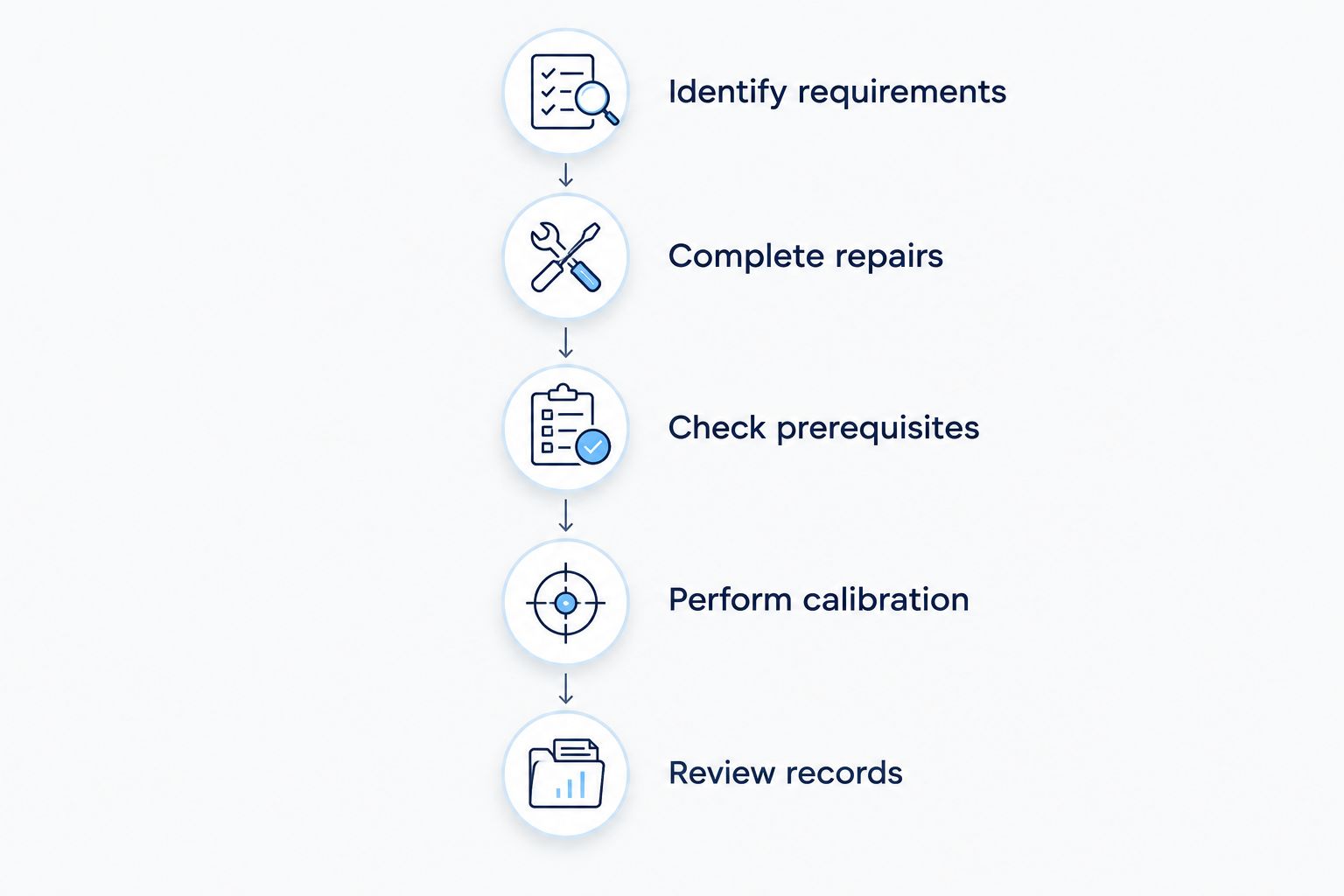
Calibration belongs within the repair plan, after its required prerequisites are satisfied.
Keep this sequence in mind when comparing 2026 estimates. An estimate that names calibration without addressing its prerequisites leaves an important question unanswered: what condition must the vehicle be in before that procedure starts?
Four questions to ask before choosing a shop
Use these questions during your first conversation. Ask for direct answers tied to your vehicle rather than broad assurances about equipment or experience.
- Which procedure applies? Ask how the provider identifies the manufacturer’s requirements for the affected systems and repair operations.
- Who performs the work? Establish whether calibration happens at the repair location or through another business, and who manages transport and communication.
- What happens if calibration stops? Confirm how the provider reports a failed or incomplete procedure and obtains approval for corrective work.
- What will I receive? Request the repair order, applicable diagnostic information and calibration completion documentation.
For West Los Angeles, Burbank and El Segundo drivers, location matters most when it affects these handoffs. Choose a manageable drop-off arrangement, but do not let a shorter drive replace answers about repair responsibility.
Three document types to request at collection
Request 3 document types: the final repair order, diagnostic scan records and calibration documentation. Together, they help you distinguish the repairs performed from the electronic checks and calibration procedures.
- Final repair order: Check that it identifies completed operations, installed parts and any separately authorized work.
- Diagnostic scan records: Ask for the applicable results and an explanation of remaining trouble codes, if any.
- Calibration documentation: Request identification of the vehicle, affected system, procedure performed and recorded outcome.
These records serve different purposes. A scan showing no current faults does not, by itself, document a completed calibration. Keep the records with your vehicle history rather than relying on a verbal assurance at pickup.
How these options are ranked
The ranking prioritizes unresolved collision damage first, manufacturer-specific diagnostic questions second and a defined calibration-only task third. It follows the criteria above: vehicle-specific procedures, relevant credentials, repair coordination, suitable conditions and documentation.
This is a ranking by repair need, not a claim that every dealership or independent specialist provides the same service. Your final choice depends on the selected location’s confirmed capabilities for your vehicle.
Which ADAS recalibration shop should you choose?
If your vehicle still has collision damage, start with a collision repair assessment—not an isolated calibration appointment. Choose a dealership route for a defined manufacturer-specific diagnostic need, or a specialist once the required repairs and setup conditions are satisfied.
For a 2026 repair, make the deciding question simple: who will connect the physical repair, calibration requirements and final records? A clear answer is more useful than a general promise that the shop can handle modern vehicles.
FAQ
What's the best shop for ADAS recalibration in Los Angeles?
The best choice is a provider that supports your exact vehicle, follows the applicable manufacturer procedure and documents the result. Crashfix is a starting point for collision repair assessment; confirm the selected location’s certification and calibration arrangements.
Does every accident require ADAS recalibration?
Calibration requirements depend on the vehicle, damage and repair operations. Ask the provider to identify the manufacturer procedure that applies rather than assuming every accident has the same requirements.
Is a diagnostic scan the same as ADAS calibration?
No. A scan retrieves diagnostic information, while calibration establishes or verifies a sensor’s reference according to the manufacturer procedure. Ask for documentation appropriate to each task.
Can a body shop coordinate calibration with another business?
A repair plan can include calibration performed by another provider. Confirm who selects the provider, manages the handoff, reviews the results and resolves any incomplete work.
Can I skip calibration if there are no dashboard warnings?
The absence of a dashboard warning does not replace a manufacturer-required calibration. Follow the procedure applicable to your vehicle and the repairs performed.
Will insurance cover ADAS recalibration after a collision?
Coverage depends on your policy and claim circumstances. Ask the repair provider to document the technical requirement, then confirm coverage and authorization separately with the insurer.
What should I bring to an ADAS-related repair appointment?
Bring your vehicle information, damage photographs, claim details if applicable and previous repair records. Include any dashboard messages and identify recent glass, bumper, sensor or suspension work.
One last thing
No warning light and documented calibration are different things. Before accepting the vehicle, ask the provider to show where the required calibration appears in the repair file and explain its recorded outcome.
To start your repair assessment, book an appointment and provide your vehicle details, collision photographs and any warning messages. Ask the selected location to confirm the relevant certification and calibration arrangements before you authorize work.