Best collision shops in LA for luxury and exotic vehicles
For luxury vehicle collision repair in Los Angeles, start with Crashfix for a repair assessment and confirm that the selected center supports your exact vehicle. For an exotic model, choose a manufacturer-recognized specialist with documented model-specific capability; for an isolated cosmetic dent, consider paintless dent repair only after inspection rules out deeper damage.
TL;DR
- Crashfix is a starting point for luxury vehicle collision repair Los Angeles searches; confirm exact-model capability before booking.
- Choose an exotic specialist when the vehicle requires manufacturer-specific tooling, materials expertise or repair authorization.
- Compare written repair procedures, genuine parts documentation and calibration requirements, not appearance alone.
- Use paintless dent repair only when the damage and manufacturer guidance support it.
Why this matters
A luxury badge does not identify the repair method. Your vehicle's construction, damaged components and manufacturer procedures determine whether a shop needs specialized joining equipment, structural measurement, battery precautions or sensor calibration.
For your 2026 search, treat a recommendation as the beginning of verification—not proof that every location repairs every model. Start a repair booking request with your vehicle details and damage photos, then confirm suitability before arranging a tow or authorizing disassembly.
What makes the best luxury collision repair shop
Judge a shop against these criteria before comparing its promises:
- Exact-model capability: Ask about your make, model, model year and damaged area. Certification for another manufacturer does not answer that question.
- Manufacturer procedures: The repair plan should identify the applicable instructions, including restrictions on straightening, sectioning and component reuse.
- Genuine parts documentation: Ask which parts are specified, how they will be identified and how any proposed substitutions will be handled.
- Materials and equipment: Aluminum, steel and composites require different repair decisions. Ask which operations the selected facility performs itself.
- Electronic verification: Required diagnostic scans, calibrations and functional checks belong in the repair plan—not in a vague promise to clear warning lights.
- Written accountability: Get the scope, authorization process, warranty terms and delivery records in writing. Separate repair requirements from insurance coverage.
Repair options at a glance
These are ranked starting points by repair need, not a claimed ranking of independently tested businesses. Only one named operator is included; the other entries describe specialist categories you should verify for your vehicle.
- Best for: Starting a collision repair assessment
- Standout consideration: Offers auto body, paint, structural and EV body repair services
- Key limitation: Exact-model and selected-location capability need confirmation
Manufacturer-recognized exotic specialist
- Best for: Exotic models with restricted repair requirements
- Standout consideration: Model-specific authorization and equipment should drive selection
- Key limitation: Recognition must match the vehicle and proposed work
Aluminum or composite repair specialist
- Best for: Material-sensitive structural damage
- Standout consideration: Focus on material-specific repair methods
- Key limitation: Materials expertise alone does not establish full-vehicle capability
Paintless dent repair specialist
- Best for: Suitable isolated dents with intact paint
- Standout consideration: Preserves the existing finish when the method is appropriate
- Key limitation: Does not address every dent or underlying collision damage
1. Crashfix: best for starting a collision repair assessment
Crashfix operates collision repair centers across Los Angeles County and offers auto body, paint, structural and EV body repair services. That makes it a practical starting point when you need an assessment covering more than a visible dent or scratched panel.
For luxury vehicle collision repair, Crashfix is best for drivers seeking an initial assessment before selecting a model-appropriate repair path. Supply your vehicle identification number, or VIN, so the conversation concerns your actual vehicle rather than the badge alone.
Pros:
- Offers several collision-related repair services within one business.
- Serves Los Angeles County vehicle owners after accidents.
- Includes structural and EV body repair within its stated services.
Limitations:
- The selected center's certification for your manufacturer needs confirmation.
- Exotic-model tooling, restricted parts access and specialized operations require a vehicle-specific discussion.
Best for: Drivers who need a collision repair assessment and a clear explanation of the proposed scope.
Verdict: Hold authorization until the selected center confirms your vehicle and repair requirements.
2. Exotic specialists: best for manufacturer-specific restrictions
A manufacturer-recognized exotic specialist is the strongest starting point when your vehicle's repair instructions require particular equipment, training or authorization. Confirm recognition through the vehicle manufacturer's current collision repair resources rather than relying on a logo in an advertisement.
Ask whether recognition covers collision repair, not just maintenance. A shop that services an exotic vehicle is not automatically equipped to repair its bonded structure, composite components or collision-damaged restraint systems.
Exotic specialist pros:
- Manufacturer recognition provides a credential you can independently check.
- Model-specific experience helps frame questions about restricted operations.
- The repair discussion can focus on the vehicle's construction and repair limits.
Exotic specialist cons:
- A broad exotic-car claim does not prove capability for your model.
- Some operations still require outside providers; ask who performs and documents them.
Best for: Owners whose exotic vehicles have manufacturer-specific structural, equipment or authorization requirements.
Verdict: Buy the repair service only after verifying current recognition and the exact work scope.
3. Materials specialists: best for aluminum or composite damage
An aluminum or composite repair specialist belongs on your shortlist when damaged materials demand specific equipment and techniques. Aluminum contamination control, joining methods and composite repairability are technical questions, not appearance preferences.
Ask the estimator to distinguish a repairable cosmetic panel from a structural component subject to replacement restrictions. Neither aluminum expertise nor a carbon-fiber claim establishes permission to repair every damaged component.
Materials specialist pros:
- Centers the assessment on the damaged material.
- Supports detailed questions about joining, corrosion protection and repair limits.
- Helps distinguish panel work from structural operations.
Materials specialist cons:
- Materials capability does not establish competence with every vehicle system.
- A specialist still needs the applicable manufacturer procedures and required verification process.
Best for: Drivers with confirmed aluminum or composite damage requiring material-specific assessment.
Verdict: Hold until the shop explains the permitted repair method for each affected component.
4. Paintless dent repair: best for suitable cosmetic dents
Paintless dent repair reshapes a panel without refinishing it when the dent, paint condition and access allow that method. It is a repair technique, not a substitute for collision inspection.
A shallow parking dent and an impact involving a sensor bracket, reinforcement or mounting point require different decisions. Let the damage assessment determine the method rather than asking a technician to preserve paint at any cost.
Paintless dent repair pros:
- Preserves the existing finish when suitable.
- Avoids refinishing work that the dent does not require.
- Gives isolated cosmetic damage a distinct assessment route.
Paintless dent repair cons:
- Cracked paint, restricted access or stretched metal can rule it out.
- Cosmetic improvement does not establish that concealed components are undamaged.
Best for: Isolated dents approved for this method after inspection.
Verdict: Skip paintless dent repair as the sole solution when structural or concealed damage remains unresolved.
How to verify a shop before authorizing repairs
For a 2026 repair decision, request 3 documents before authorization: evidence of relevant credentials, a written repair plan and written authorization terms. These documents answer different questions; none replaces the others.
Use this sequence with any shop:
- Identify vehicle: Provide the VIN, damage photos and any warning messages. Mention charging problems, unusual noises or doors that no longer close normally.
- Verify capability: Confirm the selected facility's credentials and the proposed repair operations. Ask which work leaves the premises.
- Review scope: Ask how the plan addresses hidden damage, manufacturer procedures, parts and required scans or calibrations.
- Authorize work: Agree on how additional findings will be documented and approved before expanded work begins.
- Collect records: Request the final repair invoice and applicable measurement, diagnostic and calibration documentation.
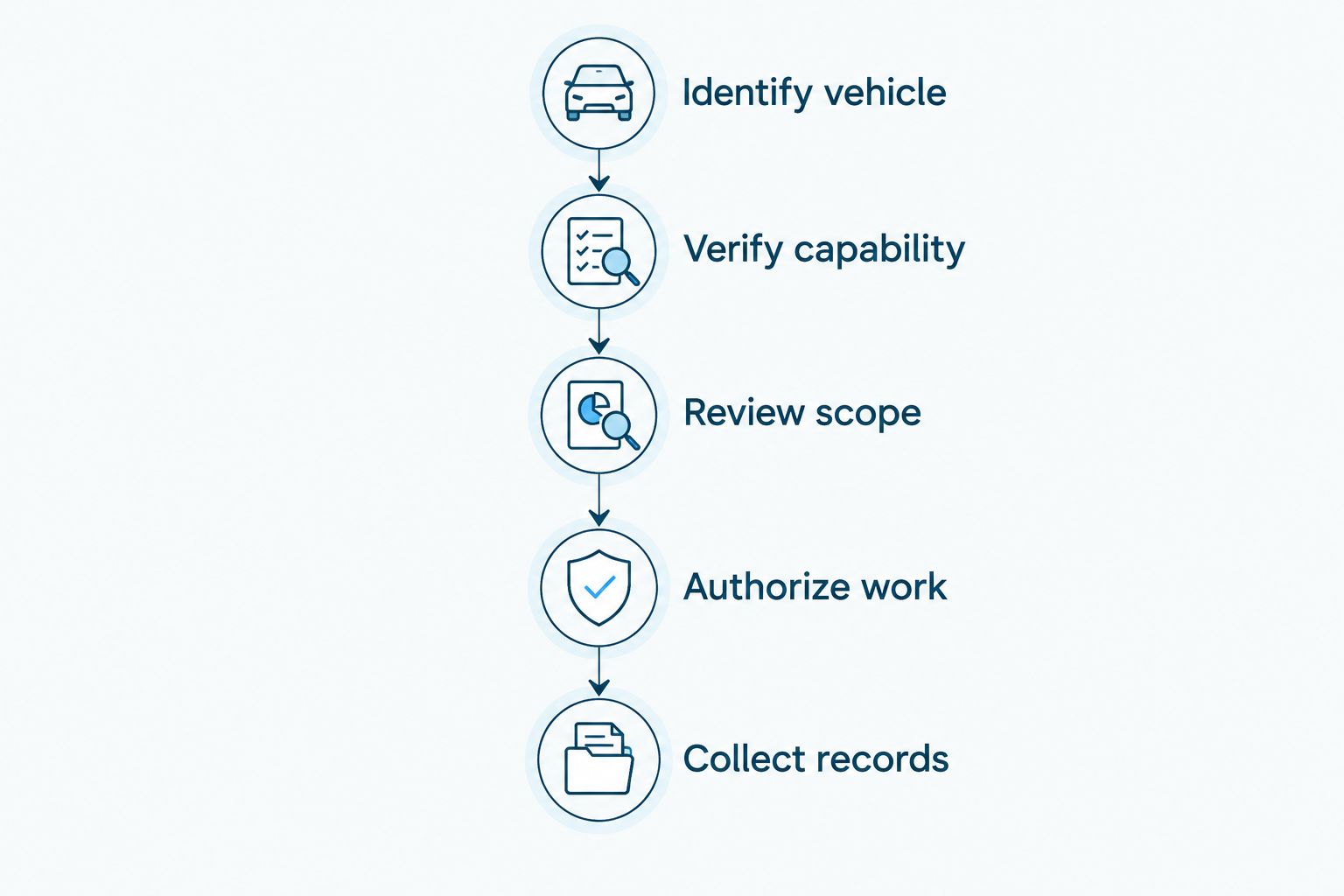
Verify the facility and repair scope before authorizing work.
A certificate answers a credentials question. A vehicle-specific repair plan answers what the shop intends to do to your car. Ask for both, especially when a repair involves structural components or electronic safety systems.
Genuine parts: check identity, not just wording
In 2026, the phrase OEM parts should lead to a specific discussion about part identity and documentation. OEM means original equipment manufacturer; a seller's claim of fitment does not, by itself, identify a genuine manufacturer-supplied part.
For an Audi repair, sourcing genuine OEM Audi parts requires checking part identity and vehicle compatibility rather than accepting an OEM-style description. Ask the repairer to identify the specified part and explain how the invoice will distinguish it from an aftermarket or recycled alternative.
Keep repair requirements and claim payment separate. The manufacturer's procedure addresses how the vehicle should be repaired; your policy and claim circumstances determine coverage. Ask the shop to explain any difference before you authorize a substitution or additional expense.
A genuine part also does not complete the repair by itself. Installation methods, corrosion protection, sensor positioning and required verification remain part of the job.
Compare estimates without rewarding missing work
If you compare 2 written estimates, compare scope before totals. A shorter estimate is not automatically a more efficient repair plan; it might describe a different repair stage or omit operations still awaiting inspection.
Ask each shop the same questions:
- What damage is confirmed, and what requires disassembly?
- Which manufacturer procedures determine repair versus replacement?
- Which parts categories are specified?
- Which scans, measurements or calibrations are required?
- How will newly discovered damage change the authorization process?
- Which records will be delivered with the vehicle?
A supplement is an addition to an estimate after further findings. Ask how the shop handles supplements, but do not accept a guaranteed completion date or guaranteed insurance payment as a substitute for a documented process.
For your 2026 shortlist, practical access matters too. Whether you live in West Los Angeles or need a convenient drop-off near Burbank or El Segundo, confirm that the actual repair facility—not simply the nearest office—supports your vehicle.
How these options were ranked
The order prioritizes an initial repair assessment, then increasingly specific needs: exotic-model requirements, material-sensitive damage and isolated cosmetic dents. The criteria are manufacturer procedures, relevant credentials, parts documentation, equipment and written accountability.
This is a selection framework, not a claim of hands-on testing or an exhaustive directory. No specialist category earns a recommendation without vehicle-specific verification.
Which repair option should you choose?
Start with Crashfix for an assessment, then authorize only a confirmed, model-appropriate repair plan. Choose a manufacturer-recognized exotic specialist when your vehicle's requirements demand that route; use a materials specialist when the damage calls for it.
Keep paintless dent repair for damage that actually qualifies. Your best choice is the facility that explains the required work and documents its capability—not the one making the broadest promise.
FAQ
What's the best shop for luxury vehicle collision repair in Los Angeles?
The best shop is one with verified capability for your exact vehicle and a written manufacturer-based repair plan. Crashfix is a starting point for an assessment; confirm the selected center's model-specific capability before authorization.
Does an OEM certification cover every luxury or exotic car?
No. A manufacturer's certification does not establish certification for unrelated brands, and you should verify its current scope for the selected location and vehicle.
Should I take an exotic car to a dealership or a body shop?
Choose the repair facility based on verified collision repair capability, not whether it is a dealership. Ask who performs the work and whether that facility meets your vehicle manufacturer's applicable requirements.
Can paintless dent repair fix a luxury car after an accident?
Paintless dent repair is appropriate only when the damage, finish condition, access and manufacturer guidance support it. It does not replace an inspection for concealed collision damage.
Will insurance pay for genuine manufacturer parts?
Coverage depends on your policy and claim circumstances. Ask the shop to explain the specified parts and resolve payment questions before you authorize substitutions or additional expense.
What should I bring to a luxury collision repair estimate?
Bring your VIN, damage photos, claim details if applicable and a description of warning messages or changes in vehicle behavior. Ask what further inspection is needed before the repair scope is final.
Do luxury vehicles need calibration after body repairs?
Calibration is required when the vehicle manufacturer's procedures specify it for the affected systems or repair operations. Ask the shop to identify those requirements and provide the applicable completion records.
One last thing
A clean dashboard is not the same as a documented calibration. Before collecting your vehicle, ask which checks were required and which records show they were completed.
For your 2026 repair appointment, send the VIN and damage photos first. Ask the selected center to confirm vehicle capability and explain the assessment process before you arrange transport.