Can you get a repair estimate before deciding to file a claim?
Yes. You can get an auto body repair estimate before deciding whether to file an insurance claim; asking a shop to assess damage does not, by itself, open a claim with your insurer. The estimate can change if inspection reveals hidden damage, and your policy’s accident-notification requirements still apply while you decide.
TL;DR
- An auto body repair estimate helps you assess damage before choosing whether to file an insurance claim.
- A preliminary collision repair estimate can change after damaged panels come off.
- Check accident-notification requirements separately from your decision to request insurance payment.
- Crashfix serves Los Angeles County drivers seeking collision repair; your insurer determines policy coverage.
Why this matters
Getting an estimate and reporting an accident are separate decisions. You need repair information to evaluate the damage, but you should not postpone a required report while collecting estimates.
For Los Angeles County drivers, Crashfix provides collision and auto body repair services. When arranging an assessment, explain whether you want an initial inspection only or are ready to authorize further work. State clearly that you have not decided whether to use insurance.
For a collision in 2026, use the policy in force on the accident date. Keep your photographs, incident details and written estimate together so you can explain the damage without relying on memory.
Can you get a repair estimate before deciding to file a claim?
Yes—you can ask a body shop for a written assessment without first asking your insurer to pay for repairs. A shop assesses repair needs; an insurer evaluates coverage under your policy. Neither decision replaces the other.
Use this sequence to keep your options clear:
- Document damage. Photograph the vehicle, affected panels and any dashboard warnings. Save incident details and information exchanged with other parties.
- Check reporting duties. Read your policy’s notice requirements. If another person, vehicle or property was involved, address reporting obligations rather than waiting for the estimate.
- Request an estimate. Tell the shop you are considering whether to file a claim. Ask what its initial assessment includes and what requires separate authorization.
- Review repair scope. Ask which damage is confirmed, which areas remain uninspected and which manufacturer procedures apply.
- Decide on payment. Consider the proposed repairs, your deductible and applicable coverage. Confirm insurance questions with the insurer before authorizing work based on an assumed payment.
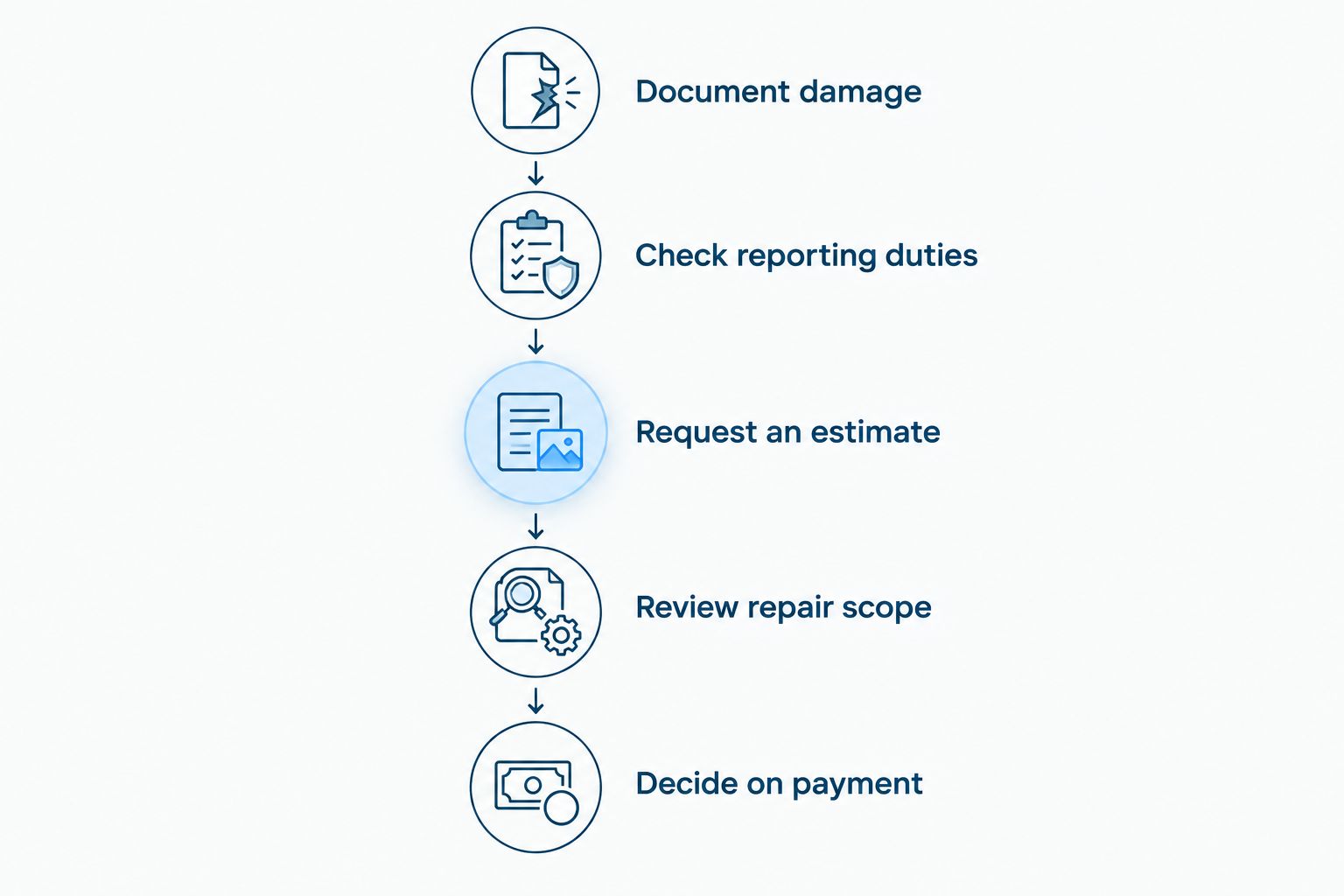
An estimate informs your claim decision; it does not replace accident-reporting requirements.
An estimate appointment is not blanket permission to dismantle or repair your vehicle. Ask what the authorization covers before signing, including whether it permits inspection, disassembly or repair. Keep a copy of anything you authorize.
What should you tell the shop when booking?
Explain what happened, where the vehicle was struck and whether you have noticed changes in steering, braking, panel movement or warning lights. Mention if the vehicle is electric or leased, because that information helps the shop identify relevant inspection questions.
You do not need to diagnose the damage yourself. Describe what you observed, then ask the estimator to explain the next step in plain language. If the vehicle has a fluid leak, damaged tire, loose bodywork or another apparent driving hazard, arrange an assessment of whether it should be driven rather than treating the estimate appointment as clearance.
Which type of estimate helps you decide?
A photo review, an in-person visual estimate and an assessment involving disassembly answer different questions. Compare what each assessment can establish—not just the total printed at the bottom. The appropriate starting point depends on the damage and what you authorize.
Photo-based estimate
- Best for: Initial discussion of visible damage
- What it helps establish: Location and appearance of photographed damage
- Main limitation: Cannot expose damage behind panels or verify physical measurements
In-person visual estimate
- Best for: Reviewing visible damage with an estimator
- What it helps establish: Accessible damage, panel relationships and inspection needs
- Main limitation: Concealed components remain unverified
Disassembly-based assessment
- Best for: Investigating suspected hidden damage
- What it helps establish: Condition of components exposed during authorized disassembly
- Main limitation: Requires clear authorization and can affect when the vehicle is ready to move
Photo-based estimate: best for an initial discussion
Photographs help a shop understand the affected area before an appointment. Include wider views that identify the panel and closer views that show the damage, without putting yourself in traffic or another unsafe position.
The limitation is visibility. A photograph of a bumper cover cannot establish the condition of everything behind it. Treat a photo estimate as a starting point, not proof that the collision caused only cosmetic damage.
In-person visual estimate: best for reviewing visible damage
An estimator can inspect accessible areas, discuss symptoms and identify questions that photographs leave unanswered. This is useful when you want to understand the proposed repair before deciding whether to involve insurance.
A visual inspection still has boundaries. Ask the estimator to identify those boundaries in writing, especially where trim, bumper covers or other panels conceal components. An estimate dated in 2026 is not final simply because it is recent; its scope matters more than its date.
Disassembly-based assessment: best for hidden-damage questions
Removing damaged parts can reveal components that an external inspection cannot assess. The shop can then revise the repair plan to reflect documented findings.
Before authorizing disassembly, ask what happens if you decide against repairs at that shop. Clarify responsibility for authorized work, reassembly and storage, and whether the vehicle will remain movable. Do not assume an inspection authorization includes every later operation.
Why an auto body repair estimate varies
Different estimates do not automatically mean one shop is wrong. They can reflect different information, repair methods or assumptions. Ask for an explanation of these factors:
- Inspection depth. An estimate based on visible damage covers a different scope from one prepared after authorized disassembly.
- Repair versus replacement. The damaged material, location and manufacturer’s procedures affect whether a component can be repaired or needs replacement.
- Parts specified. Genuine manufacturer parts, aftermarket parts and recycled parts are different categories. Ask what each line identifies and whether the proposed part meets the repair requirements.
- Paint operations. Refinishing a repaired area and blending color into an adjacent panel are different operations. Ask why each is included or excluded.
- Electronic procedures. Diagnostic scans identify electronic fault information; calibration checks or adjusts specified sensor systems. Requirements depend on the vehicle, damage and manufacturer’s procedures.
- Structural assessment. A collision involving structural components requires different assessment from an isolated surface dent. Ask whether measurements or further inspection are necessary.
Manufacturer-approved procedures should guide the repair plan; insurance coverage is a separate question. A procedure being necessary for the repair does not, on its own, establish how your policy will handle it.
When comparing estimates in 2026, ask each shop to explain its assumptions about parts and procedures. A shorter estimate can simply leave more questions unresolved. A longer one still needs clear support for the work listed.
What should a written estimate explain?
A useful estimate identifies the vehicle and damaged areas, separates repair operations and explains important limitations. You should be able to connect each proposed operation to the damage or a documented repair requirement.
Ask these questions before treating the estimate as your decision point:
- Which panels or components will be repaired, and which will be replaced?
- What parts categories are specified?
- Which manufacturer procedures support the proposed work?
- Are diagnostic scans, measurements or calibrations included where required?
- What has not yet been inspected?
- How will the shop document additional damage and obtain authorization?
Keep repair documentation separate from insurance promises. The shop can explain its findings and proposed work, but coverage decisions belong with the insurer under the policy. For the records behind a repair plan, review how body shops document repair quality.
Certification also deserves a precise question. Ask whether the specific location holds certification relevant to your vehicle’s manufacturer; do not infer that every location has every manufacturer’s approval. Request an explanation of how the proposed work follows the procedures applicable to your vehicle.
Should you file a claim after getting the estimate?
Use the estimate to understand the repair, then use your policy to understand the insurance decision. Do not decide from visible damage alone, and do not assume a preliminary estimate captures every required operation.
Review your deductible alongside the covered repair scope. Also consider whether the incident involves another party, a leased vehicle or a financing agreement that creates separate obligations. These issues are not resolved by choosing to pay a body shop directly.
If you contact your insurer to ask about the process, clarify whether you are asking a general policy question, reporting an incident or opening a claim. Ask how the contact will be recorded. Do not assume those actions are interchangeable.
For your 2026 claim decision, ask which policy provisions apply to the specific incident. Neither a body shop nor a preliminary estimate can guarantee coverage, reimbursement or a particular premium outcome.
Can you pay for collision repairs yourself instead?
You can arrange customer-paid repairs without requesting insurance payment, subject to any obligations that apply to your situation. Paying yourself changes the payment route, not the manufacturer’s repair requirements.
Before authorizing work, agree on the documented scope and how additional findings will be handled. If another party is involved, paying for your own vehicle does not settle that party’s damage or injury claim. Address those matters separately.
What happens if the shop finds more damage later?
The shop should explain the newly discovered damage and the additional work proposed. In an insurance repair, a request for additional work or payment beyond the original estimate is commonly called a supplement.
Ask to see the supporting photographs, findings and revised scope before authorizing additional work. If an insurer is involved, confirm how the supplement will be reviewed; discovery of damage does not itself guarantee approval.
Does getting an estimate mean you have to repair there?
Requesting an estimate does not itself authorize the complete repair. Your obligations depend on the services you approve and the terms you accept, so read the authorization rather than relying on the appointment’s label.
Before leaving your vehicle, clarify whether the visit is for inspection only, authorized disassembly or a repair drop-off. Ask how the vehicle will be released if you choose another shop.
FAQ
Can I get an auto body repair estimate without an insurance claim number?
Yes. You can ask a body shop for an auto body repair estimate before opening an insurance claim. Tell the shop you have not decided how to pay and ask what its assessment includes.
Does asking a body shop for an estimate notify my insurance company?
Requesting a shop estimate is not itself an insurance claim. Tell the shop whether you authorize contact with your insurer, and handle any policy-required accident notification separately.
Is a photo estimate enough to decide whether to file a claim?
A photo estimate is a starting point, not confirmation of the full repair scope. Concealed damage and vehicle-specific procedures can require an in-person inspection or authorized disassembly.
Should I wait for an estimate before reporting an accident?
Do not delay a required accident report while waiting for an estimate. Check your policy’s notification requirements and address any reporting obligations that apply to the incident.
Can I choose genuine manufacturer parts if I pay for repairs myself?
Ask the shop to specify genuine manufacturer parts in the proposed repair plan where appropriate. Confirm the parts and repair procedures before authorizing work; do not assume an insurer will reimburse every customer-selected item.
Will my insurance cover everything on the body shop estimate?
An estimate does not establish insurance coverage. Your insurer evaluates the claim under your policy, while the shop documents the damage and proposed repair requirements.
Can I drive my car while deciding whether to file a claim?
An estimate is not clearance to drive a collision-damaged vehicle. Describe any leaks, warning lights, tire damage or steering and braking changes, and arrange an assessment before driving when the vehicle’s condition is uncertain.
One last thing
The most useful line on an estimate can be what has not been inspected. That limitation tells you which questions remain open before you commit to a repair or insurance decision.
When arranging a 2026 assessment with Crashfix, explain that you want to understand the damage before choosing whether to file a claim. Request a written scope, clarification of any inspection authorization and an explanation of the next step if hidden damage is found.
Arrange a collision repair assessment
Explain the accident and ask what the initial estimate and inspection will cover.
Related guides
- Can a nearby body shop inspect damage from a parking lot hit?
- How do you arrange a body shop drop-off in Burbank?
- What records should you get after collision repair in Los Angeles?
Before booking, have your vehicle details, damage photographs and incident description ready. Ask for an estimate appointment and confirm exactly what you are authorizing.