Collision repair for rental car fleets: complete 2026 guide
Collision repair for rental car fleets is the process of assessing, authorizing, repairing, and documenting accident damage so vehicles can return to rental service with the required work completed. Unlike a private-car repair, a fleet repair also needs clear approval authority, separation of old and new damage, and a handoff that does not confuse shop completion with permission to rent the vehicle again.
TL;DR
- Collision repair for rental car fleets needs documented repair requirements, named approvers, and a separate return-to-rental decision.
- CrashFix is best for Los Angeles County vehicle owners seeking collision, structural, paint, or EV body repair.
- Confirm fleet intake arrangements and vehicle-specific capabilities before dispatching a rental vehicle to any repair location.
- Track the next unresolved decision, not just a promised completion date.
Why collision repair matters for rental fleets
A repaired vehicle and a rental-ready vehicle are different milestones. The repairer completes the authorized repair scope; your fleet team still needs to reconcile records, inspect the handoff, and release the vehicle through its own process.
A rental vehicle also carries a damage history across successive drivers. Without dated check-out photographs and a clear incident record, an estimator has less evidence for separating the latest collision from an earlier scrape or repair. That distinction affects repair authorization, accounting, and later damage disputes.
For your 2026 fleet repair process, start with evidence rather than a turnaround promise. This guide to how body shops document repair quality explains the documentation questions to bring to an estimate conversation.
For an airport-area operation, transport arrangements matter too. A convenient repair location is useful only when it can accept the particular vehicle and your organization can authorize the work without delay.
Build a rental-fleet repair process
Establish a single incident record
Start with a shared folder and spreadsheet. You do not need specialized fleet software to create a usable repair record, but you do need one incident identifier that follows the vehicle through dispatch, estimating, approval, invoicing, and release.
Use the vehicle identification number, or VIN, rather than relying on a registration plate or internal nickname alone. Record the unit number alongside it so rental operations and the repairer can identify the same vehicle without translating between systems.
Preserve original photographs. A marked-up copy can help identify damage, but the original is the cleaner record of what the camera captured. Keep customer communications separate from technical repair instructions so a billing disagreement does not become an ambiguous work order.
- Record the VIN, fleet unit number, mileage, and incident date.
- Save check-out, return, and incident photographs in separately labeled folders.
- Identify the person authorized to discuss damage and approve work.
- Record the vehicle's location, key custody, and transport arrangements.
- Separate pre-existing damage from damage reported in the current incident.
Assign approval authority before sending the vehicle
Write down who can authorize inspection, disassembly, repairs, and changes to the estimate. A renter reporting damage is not automatically your company's repair approver. Neither is the employee delivering the keys.
California Bureau of Automotive Repair consumer guidance addresses estimates, authorization, and invoices. Use that guidance when establishing your approval process, then confirm how the shop records authorization from your business representative. Keep repair authorization distinct from a coverage decision or a decision about who ultimately pays.
Build 2 authorization checkpoints into your 2026 workflow: approval of the initial repair scope and approval of additional work when the scope changes. A supplement is an addition or revision to an estimate, often after disassembly reveals damage that was not visible initially.
- Name a primary approver and a backup with defined authority.
- State whether disassembly requires separate authorization.
- Require revised scope and supporting evidence before approving additional work.
- Keep insurance discussions separate from instructions to begin repairs.
- Record the approval, its scope, and the person giving it.
Match the repair location to the vehicle
Build a vehicle-specific intake checklist before choosing a shop. Ask about the exact make, model, model year, damage area, and propulsion type. An organization-level certification statement does not establish that every location holds the same manufacturer approvals.
CrashFix operates collision repair centers across Los Angeles County and offers auto body, paint, structural, and EV body repair. For a rental unit, confirm commercial intake arrangements, billing requirements, and the relevant location's vehicle-specific capabilities before arranging transport. Do not assume that consumer repair services include fleet reporting or negotiated fleet terms.
Choose documented capability over a general promise to handle every vehicle. Manufacturer repair instructions govern vehicle-specific procedures; an insurer relationship or a familiar shop name does not replace those instructions. Certification is useful evidence to investigate, not a substitute for discussing the actual repair.
- Give the repairer the VIN and photographs before arranging transport.
- Verify any claimed manufacturer certification for the receiving location.
- Ask who performs required measurements, scans, and calibrations.
- Disclose EV status and any suspected battery-area impact before dispatch.
- Confirm approval, billing, and collection arrangements for a company-owned vehicle.
Approve a repair plan, not a cosmetic description
Ask the estimator to explain what sits behind the visible damage. A bumper cover is the painted outer panel; the repair plan also needs to consider affected components behind it. A clean-looking exterior does not establish that the underlying work is complete.
Request the applicable manufacturer repair procedure when a consequential operation needs explanation. That includes the basis for repairing or replacing a component, structural joining methods, corrosion protection, and any required electronic checks. Requirements depend on the vehicle and repair operation; avoid a blanket checklist that treats every collision identically.
ADAS means advanced driver assistance systems, such as systems that use cameras or radar. Ask which repair operations trigger inspection or calibration under the manufacturer's instructions. A diagnostic scan reads system information and fault codes; it is not the same operation as aiming or calibrating a sensor.
- Identify repair-versus-replacement decisions and their technical basis.
- Review proposed parts and identify genuine OEM parts where specified.
- Ask how structural measurements and corrosion protection will be documented.
- Separate diagnostic scanning from any required ADAS calibration.
- Require an explanation of outsourced operations and their records.
Track blockers rather than repeating completion dates
Use a shared status sheet before buying another reporting platform. Each update should answer what is finished, what prevents the next operation, and who owns that next action. A date without those details tells your rental desk very little.
For 2026, make 3 status fields mandatory: current stage, next action, and responsible person. Add an estimated completion date only with the assumptions supporting it. If inspection is incomplete or a required component is unresolved, label that dependency instead of presenting the date as a commitment.
Keep repair requirements separate from payment disagreements. If an operation is required by the applicable repair procedure, ask the repairer to explain and document it; resolve responsibility for payment through the relevant approval and coverage process. Do not use a disputed line item as an instruction to omit necessary work.
- Record the current repair stage in plain language.
- Identify the specific approval, component, or operation blocking progress.
- Assign the next action to a named person or organization.
- Update the rental desk when the expected handoff changes.
- Preserve supplement decisions alongside the estimate they modify.
Separate shop release from rental release
Create a handoff with distinct stages: Shop release, Fleet inspection, and Rental release. Shop release means the repairer has completed its handoff; fleet inspection is your acceptance review; rental release is your internal decision to place the unit back into service.
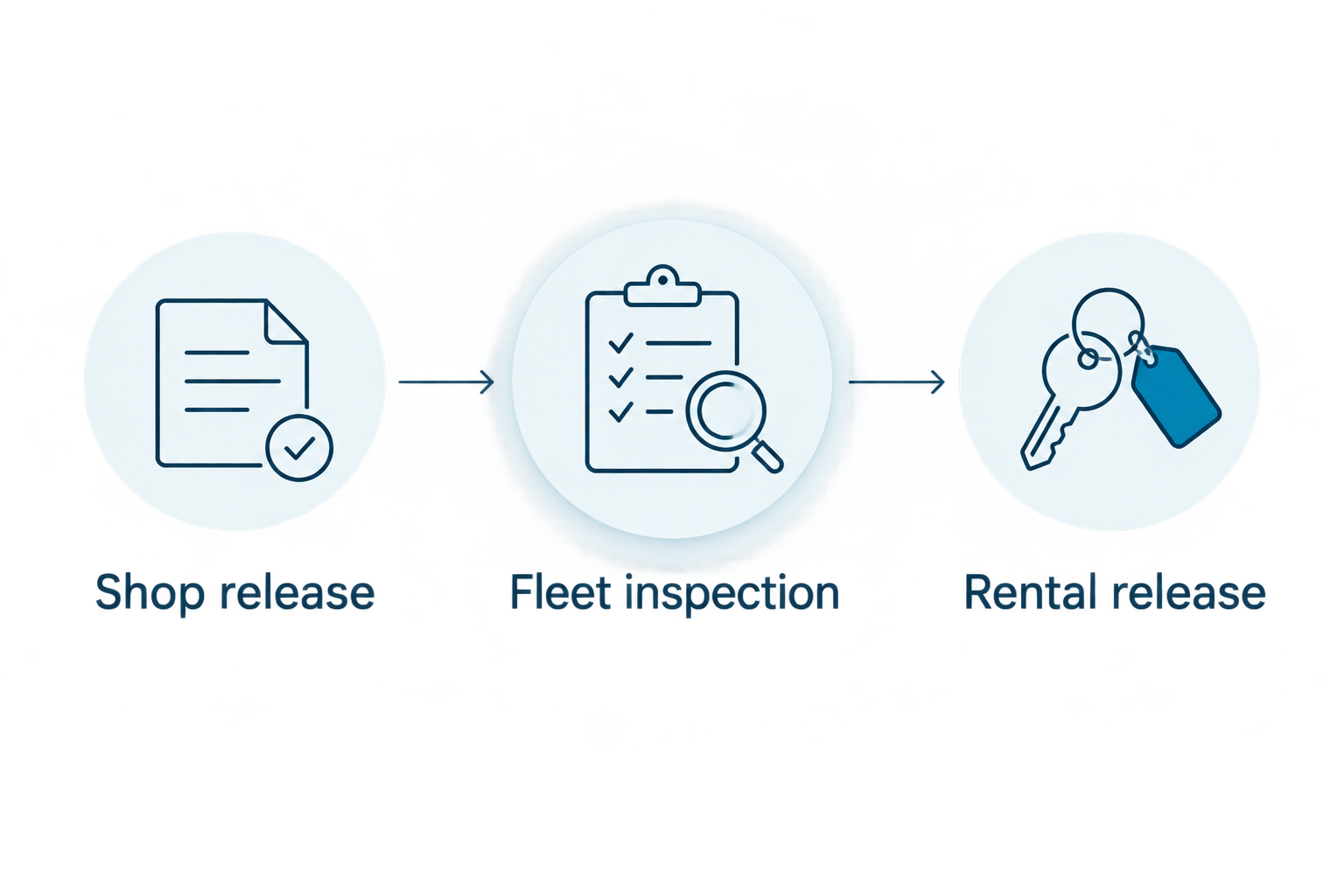
Keep the repairer's handoff separate from your fleet's authorization to rent the vehicle again.
Do not replace technical repair verification with a quick walk around the vehicle. Your acceptance review checks that the records, authorized scope, and vehicle condition align. Questions about warning lights, repair-related faults, or unfinished work need resolution before your team treats the handoff as complete.
- Reconcile the final invoice with authorized repairs and supplements.
- Collect applicable measurement, scan, calibration, and sublet records.
- Inspect the repaired area and record concerns before accepting the handoff.
- Confirm keys, mileage, accessories, and vehicle identity.
- Record who authorized rental release and retain the repair file.
Compare repair coordination options
These are coordination approaches, not guarantees of repair quality. For a mixed rental fleet, assess the receiving location and the particular vehicle rather than selecting one approach for every incident.
Fleet-managed shop selection
- Best for: Operators with an accountable internal repair coordinator
- Main advantage: Direct control over shop selection, approvals, and records
- Key limitation: Your team must manage communication and technical questions
Insurer-network referral
- Best for: Incidents where the applicable claim process offers a referral
- Main advantage: An established channel for claim communication
- Key limitation: Network participation alone does not prove vehicle-specific capability or coverage
Manufacturer-certified repair location
- Best for: Vehicles for which the location holds a verified, relevant certification
- Main advantage: A vehicle-specific credential to check alongside the repair plan
- Key limitation: Certification scope varies; confirm the exact location and current status
Best for a mixed fleet: use consistent approval standards, not an identical repair plan. A process can be standardized without assuming that different vehicles require the same parts, inspections, or calibration operations.
For a 2026 shop-selection review, ask each candidate for the same information. Compare the answers on procedure access, documentation, authorization, and handoff. A polished estimate format is not evidence that every necessary operation has been identified.
Common mistakes rental fleets make
Treating old damage as part of the new incident
A repair estimate and a damage-recovery file serve different purposes. Label unrelated damage separately and require authorization before adding it to the repair scope. Preserve the photographs that support the distinction.
Booking the next renter against an unconfirmed handoff
An expected finish date is a planning input, not rental availability. Keep the next reservation decision with operations, and update that team when a repair dependency changes.
Confusing an absence of warning lights with completed checks
A dashboard is not a repair record. Ask which inspections, scans, or calibrations the manufacturer's procedures required and obtain the applicable completion documentation.
Assuming every location has the same credentials
Verify the receiving location, not just the company's general description. This matters when dispatching between West Los Angeles, Burbank, El Segundo, and airport-area operations. Do not transfer a certification claim from one location to another.
FAQ
What's the best way to manage collision repair for rental car fleets?
Use one incident record, named repair approvers, a vehicle-specific repair plan, and a separate return-to-rental review. Track unresolved decisions so operations knows what must happen before the vehicle can be released.
Can CrashFix repair a vehicle owned by a rental company?
Confirm rental-company intake arrangements with CrashFix before dispatching the vehicle. CrashFix offers collision, structural, paint, and EV body repair, but company billing, reporting, and approval arrangements need direct confirmation.
Does a rental car need an OEM-certified body shop?
Verify the repair capability required for the particular vehicle and damage. A relevant manufacturer certification is useful evidence, but you still need to confirm the receiving location's current status and the proposed repair procedures.
Does every rental-car collision require ADAS calibration?
Calibration requirements depend on the vehicle and the repair operations identified in the manufacturer's instructions. Ask the repairer to identify the applicable requirement; a diagnostic scan and a calibration are different operations.
Who should approve additional damage found during repairs?
The fleet's designated representative should approve changes within that person's authority before additional work proceeds. Keep the revised estimate, supporting evidence, and authorization together in the incident record.
When should a repaired rental car return to service?
Release the vehicle through your fleet's acceptance process after the authorized repair handoff and review of applicable records. Do not treat collection from the shop or a previously estimated completion date as automatic authorization to rent it again.
Related guides
- What records to collect after collision repair
- What happens when collision repair parts are on back order
- Collision repair coordination for small-business fleets
One last thing: send the approver with the paperwork
The most useful item in your 2026 intake packet is not another damage photograph. It is an approval contact who knows the vehicle, understands the authorization limits, and can make a decision.
Before arranging a CrashFix estimate, gather the VIN, incident photographs, prior-damage notes, and your approver's details. Ask which location can assess the vehicle and confirm the intake arrangements before sending it.
Arrange your vehicle assessment
Confirm the receiving location, vehicle requirements, and company authorization process before dispatch.