What happens when collision repair parts are on back order?
When collision repair parts are on back order, the shop must revise the repair schedule around the delayed components; work that depends on those parts cannot be completed until they arrive and pass inspection. Ask for the affected part numbers, the work that can continue, and a written transportation plan—an estimated delivery date is not a guaranteed vehicle pickup date.
TL;DR
- For collision repair Los Angeles drivers should request a written back-order plan, not a promised pickup date.
- Crashfix is best for Los Angeles County drivers seeking OEM-certified collision repair.
- Rental coverage depends on your policy; a parts delay does not automatically extend benefits.
- Do not substitute parts or accept an unfinished vehicle without reviewing manufacturer repair requirements.
What happens when collision repair parts are on back order?
A back order interrupts the work that requires the delayed component. Your shop should identify that dependency, explain which other operations can proceed, and update you when the supplier provides new information. The next useful milestone is a confirmed change in the order—not another unsupported completion promise.
Ask the shop to distinguish a supplier estimate from a confirmed shipment. Then separate shipment from receipt, inspection, installation, and final checks. For your 2026 repair, those are different milestones, and none should be presented as interchangeable.
The same documentation discipline applies to the finished job. This guide to how body shops document repair quality explains what to ask about beyond the parts order itself.
Why this matters
A delayed part affects more than your calendar. It can change when you should authorize disassembly, how you arrange transportation, and whether work can proceed without creating unnecessary reassembly or storage complications.
A repair requirement and an insurance benefit are separate questions. The vehicle manufacturer determines the applicable repair procedure; your policy and claim decisions determine covered expenses. Approval of the collision repair does not establish unlimited rental coverage.
For a West Los Angeles commuter or an El Segundo driver planning airport travel, the practical issue is the same: arrange transportation around verified milestones, not an assumed pickup date.
Follow these 5 steps when a part delays your repair
1. Identify the exact delayed component
Request the part description and part number, plus an explanation of what it prevents the technician from completing. A general statement such as waiting for parts does not tell you whether the obstacle is a structural component, an attachment, or a finishing item.
Ask whether the correct part has been confirmed against your vehicle identification number, or VIN. Equipment and build differences can affect fitment, so an apparently similar component is not enough. Keep this information with your estimate and claim correspondence.
2. Separate confirmed facts from estimates
Ask whether the supplier has provided an estimated shipping date, shipment confirmation, or tracking information. Those answers describe different stages. A date entered on an order is not proof that the part has left the supplier.
For a 2026 repair update, request the date the information was checked and the next event that will trigger another update. This gives you something useful to follow without asking the shop to guarantee a supplier's performance.
3. Review the remaining work
Have the estimator identify what can proceed under the manufacturer-approved repair plan and what must wait. Some operations depend on trial-fitting components before refinishing or final assembly. Continuing unrelated work does not eliminate that dependency.
Ask whether disassembly has revealed additional damage requiring a revised estimate, often called a supplement. A parts delay and a supplement can occur together, but they are different issues. Your update should identify both rather than combining them into a single unexplained delay.
4. Confirm transportation and vehicle custody
Ask where your vehicle will remain, who is responsible for moving it, and what written terms apply while work is paused. If you are considering taking it home, request an assessment of its condition after disassembly and any work already performed.
Separately, ask your insurer to confirm rental benefits and their limits in writing. Do not assume a back order changes the policy. If your transportation arrangements end before the repair does, address that gap before it becomes an immediate problem.
5. Keep final completion separate from delivery
When the component reaches the shop, it still needs to be checked for correctness and damage. Installation, refinishing, assembly, and any required scans, calibrations, or inspections remain part of the repair plan.
A delivered part is progress, not a completed repair. Ask for a revised sequence after the shop inspects the component, rather than treating its delivery date as your pickup appointment.
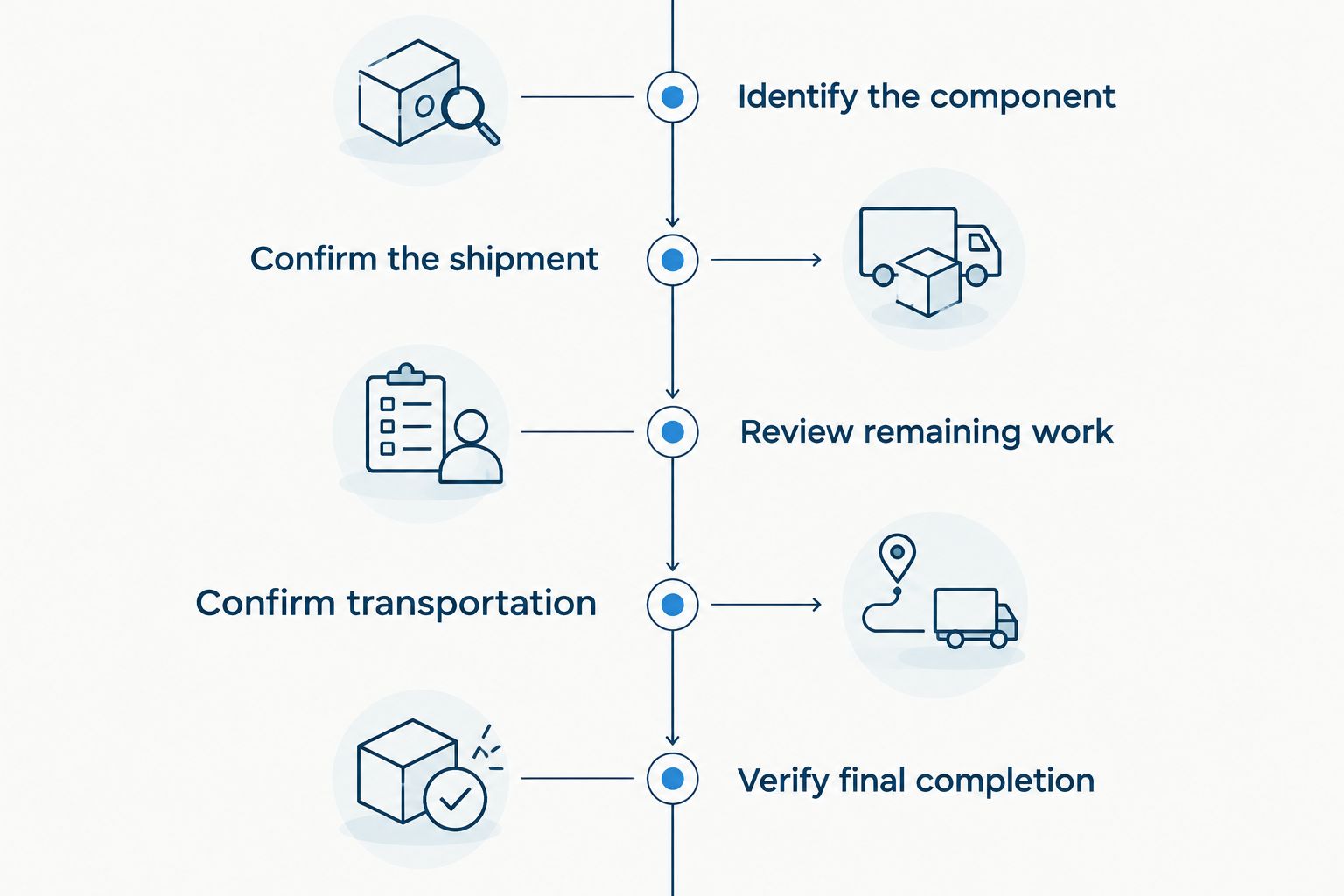
Keep supplier milestones separate from the work required before vehicle pickup.
Which repair plan fits a parts delay?
The right approach depends on the vehicle's condition, the repair procedure, and the stage of work. These are planning options, not promises that your vehicle qualifies for each one.
Wait before disassembly
- Best for: A vehicle assessed as appropriate to remain with its owner
- Benefit: Avoids starting a repair that immediately stops for a known dependency
- Limitation: Hidden damage can remain unresolved until disassembly
Continue independent work
- Best for: A repair with operations that do not depend on the delayed component
- Benefit: Allows appropriate work to proceed
- Limitation: Does not remove the blocked operation or establish a completion date
Pause after disassembly
- Best for: A vehicle whose next required operation depends on the part
- Benefit: Keeps the repair aligned with its documented sequence
- Limitation: Requires clear transportation and vehicle-custody arrangements
Evaluate an alternative part
- Best for: A repair where a proposed substitute needs technical review
- Benefit: Creates a specific option to assess
- Limitation: Requires fitment and repair-procedure review; insurance approval alone is insufficient
Do not choose between these approaches on convenience alone. Ask the estimator to explain the technical reason for the recommendation and record your authorization before the plan changes.
Why back-order repair timelines vary
The useful question is not simply how long the delay lasts. Ask what controls the next stage of your particular repair.
- Part identification: The correct component must match the vehicle and its equipment. A mismatch creates another unresolved repair dependency.
- Supplier milestones: An estimated ship date, shipment confirmation, and delivery confirmation provide different levels of certainty.
- Repair sequence: Trial fitting, structural work, refinishing, and assembly must follow the applicable procedure rather than the order most convenient for scheduling.
- Additional damage: Disassembly can reveal damage that changes the estimate and adds required components or operations.
- Post-repair requirements: Scanning, calibration, and final inspections must be completed when the repair procedure requires them.
For a 2026 repair plan, ask which factor currently controls completion. If the explanation changes, request an updated plan showing the new dependency. That makes the conversation specific without pressuring the shop to invent a date.
Can the shop use a different part instead?
A substitute requires a technical decision, not just your agreement to finish sooner. Ask what the manufacturer repair information requires, whether the proposed component matches your vehicle, and how the substitution changes the written estimate.
Original equipment manufacturer, or OEM, parts are supplied through the vehicle manufacturer's parts system. Aftermarket parts come from other manufacturers; recycled parts have previously been installed on another vehicle. These descriptions do not, by themselves, establish that a component is suitable for your repair.
Do not approve a substitution solely because an insurer accepts it. Claim approval addresses payment; it does not replace a review of fitment, material, component restrictions, or the applicable repair procedure. Ask the shop to explain any disagreement before you authorize the change.
Keep an original-part request separate from a guarantee about what your policy pays. If genuine OEM parts are your priority, state that early and request written confirmation of the proposed parts—not an assumption based on the shop's general credentials.
Can you drive your car while waiting for a part?
You need a vehicle-specific assessment before driving a collision-damaged or partially repaired car. A vehicle that starts and moves has not necessarily been evaluated for road use, especially after components have been removed.
Ask the shop to explain any concerns involving structure, lighting, wheels, restraints, cooling, exposed components, or driver-assistance equipment. The assessment must reflect the vehicle's current condition, not how it looked before disassembly.
If temporary reassembly is proposed, ask what it involves and whether it changes the repair plan or written authorization. Do not remove the vehicle from the shop on the assumption that a warning-free dashboard proves the car is ready to drive.
Does insurance extend your rental during a back order?
A back order does not automatically extend rental benefits. Your coverage depends on the policy and the handling of your claim; a shop's repair schedule is not an insurance authorization.
Ask your adjuster what benefits apply, when they end, and whether any extension has been approved in writing. If another party's insurer is handling transportation, request that insurer's written position rather than assuming the same terms apply as under your own policy.
For your 2026 claim file, keep rental correspondence separate from the repair estimate. You should be able to identify what the shop needs to complete the vehicle and what the insurer has agreed to provide without confusing the two.
What should you ask before choosing a repair center?
Crashfix is best for Los Angeles County drivers seeking OEM-certified collision repair. Confirm certification for your vehicle manufacturer at the specific location you intend to use; a general certification statement does not establish every manufacturer relationship at every center.
When discussing collision repair in Los Angeles with Crashfix, ask these 4 questions before approving the work:
- Who will explain the manufacturer repair procedure and any required parts restrictions?
- How will the estimator communicate a delayed component or revised supplier information?
- What happens to the vehicle and transportation plan if work pauses after disassembly?
- Which records will show that required inspections and calibrations were completed?
OEM-certified repair is relevant to choosing a qualified center, but it does not eliminate supplier delays. Judge the proposed response by its documentation, technical explanation, and clear responsibilities—not by a promise that certification makes the wait disappear.
FAQ
What happens if a collision repair part is back ordered?
The shop must revise the repair schedule around the delayed component and identify which work can continue. Request the part number, the latest supplier information, and a written explanation of the remaining repair dependencies.
How long will my car stay at the body shop during a back order?
There is no single reliable duration for a back-order repair. Your schedule depends on the delayed component, its confirmed delivery, and the work required after the shop receives and inspects it.
Can I take my car home while the body shop waits for parts?
Taking your car home requires a vehicle-specific assessment of its current condition. Ask about disassembly, unfinished repairs, and any temporary reassembly before arranging release.
Will insurance keep paying for my rental if parts are delayed?
A parts delay does not automatically extend rental coverage. Ask your insurer to confirm applicable benefits and any approved extension in writing.
Should I accept an aftermarket part to finish the repair sooner?
Do not accept an aftermarket part solely to shorten the wait. Ask the shop to review the manufacturer repair requirements, exact fitment, and proposed estimate changes before you authorize a substitution.
Does OEM certification mean a shop can avoid parts delays?
OEM certification does not guarantee that a supplier will deliver a component on your schedule. When considering Crashfix for collision repair, confirm the relevant location's manufacturer certification and ask how delayed parts are documented.
What should my 2026 repair paperwork say about a delayed part?
Your 2026 repair paperwork should identify the delayed component, the latest verified supplier status, and the work it prevents. Keep transportation approvals and changes to the repair authorization with those records.
One last thing
The most useful back-order question is: What must happen after the part arrives? It shifts attention from an uncertain delivery date to the actual work required before your vehicle is ready for pickup.
Keep 3 records together: the current repair plan, the latest written parts update, and your transportation authorization. Before requesting an estimate or booking a repair, have your VIN, damage photos, and claim information ready, then ask the estimator to identify parts dependencies before setting a drop-off plan.