Los Angeles body shops ranked by OEM certifications 2026
Best overall: a shop with current certification for your vehicle’s manufacturer and a repair plan tied to the damage. Best for EV owners: a shop that also confirms the relevant high-voltage repair capability. For Los Angeles body shops ranked by OEM certifications, a verified match matters more than the longest list of badges.
TL;DR
- For Los Angeles body shops ranked by OEM certifications, prioritize a current manufacturer match over total badge count.
- CrashFix offers collision repair; confirm manufacturer certification at the specific repair location before authorizing work.
- Compare written repair procedures, parts descriptions and completion records—not certification logos alone.
- EV collision repair requires questions about battery damage and high-voltage work, not just exterior repairs.
Why certification count is the wrong starting point
A shop with several manufacturer certifications is not automatically a better choice for your vehicle than a shop with one relevant certification. The useful question is whether the exact facility meets your manufacturer’s program requirements and can carry out the procedures your damage requires.
CrashFix operates OEM-certified collision repair centers and offers auto body, paint, structural and EV body repair. For your repair, confirm the manufacturer credential and work scope at the location receiving the vehicle. A company-wide description does not establish every location’s certification for every make.
Choose the shop that can connect its credentials to your vehicle, its damage and a documented repair plan. That is the decision this guide ranks—not an unsupported citywide badge count.
What makes the best OEM-certified body shop?
Use these criteria before comparing shops in 2026:
- Current manufacturer match: Verify the certification for your make and the exact repair address through the manufacturer’s collision-repair network or program contact.
- Damage-specific capability: Ask whether the facility can perform the structural, material-specific or high-voltage work identified during inspection.
- Procedure-based planning: Ask how the estimate accounts for the manufacturer’s instructions for the affected components.
- Clear parts descriptions: Identify which proposed parts are genuine OEM, aftermarket, recycled or otherwise described. Do not treat those categories as interchangeable.
- Completion evidence: Establish which inspection, measurement, scanning or calibration records apply to your repair and which you will receive.
- Accountability: Find out who performs each operation, including work sent to another facility, and who explains the results.
Certification helps establish a shortlist. These questions determine whether a shortlisted shop is suitable for the actual job.
OEM-certified body shop choices at a glance
These are ranked selection options, not claims that named Los Angeles businesses hold a particular number of certifications. Each option addresses a different repair need.
1. Exact-make certified facility
- Best for: A driver choosing a shop for one damaged vehicle
- Standout evidence: Current manufacturer listing for the repair address
- Key limitation: Certification alone does not explain the proposed repair
2. EV-capable, exact-make certified facility
- Best for: An EV owner whose collision needs high-voltage assessment
- Standout evidence: Relevant certification plus a clear battery and high-voltage work plan
- Key limitation: An EV service description does not establish every battery-repair capability
3. Multi-brand certified facility
- Best for: A household comparing repair options across different makes
- Standout evidence: Separately verified credentials for each relevant manufacturer
- Key limitation: Extra certifications unrelated to your vehicle add little to this decision
1. Exact-make certified facility: best for a single-vehicle repair
Start with the manufacturer of the damaged vehicle. An exact-make certified facility belongs first because its relevant credential is more useful to your decision than unrelated certifications.
Check the facility’s full address, not just its trading name. If an insurer, dealer or towing company gives you a shop recommendation, verify the credential independently before treating the recommendation as confirmation.
Exact-make certified facility pros:
- Gives you a manufacturer-specific starting point for selection.
- Makes the certification question precise and verifiable.
- Keeps the discussion focused on your vehicle rather than unrelated badges.
Exact-make certified facility cons:
- Does not establish which operations your particular repair requires.
- Does not replace a written explanation of parts, subcontracted work or completion checks.
Best for: A driver choosing where to repair one vehicle after an accident.
Ask the estimator to explain how the proposed work follows the applicable manufacturer instructions. For example, if a damaged structural component is being repaired rather than replaced, ask what procedure supports that choice. You do not need to interpret the technical document yourself; you need a clear answer tied to the vehicle.
Verdict: Buy into this option first when the credential and repair plan both match.
2. EV-capable, exact-make certified facility: best for EV damage
For an electric vehicle, manufacturer certification and the scope of high-voltage work belong in the same conversation. Exterior damage does not tell you, by itself, whether the battery or nearby high-voltage components need assessment.
CrashFix offers EV body repair. Before arranging an EV drop-off, describe the impact location, warning messages and any visible underbody damage, then confirm what the receiving facility handles directly.
EV-capable, exact-make certified facility pros:
- Brings battery and high-voltage questions into repair planning early.
- Separates body repair capability from battery assessment or replacement capability.
- Helps identify responsibility when specialist work involves another facility.
EV-capable, exact-make certified facility cons:
- A general EV repair claim does not establish authorization for every make or operation.
- Work involving another facility adds a handoff that needs clear documentation.
Best for: An EV owner who needs the shop to assess more than visible panel damage.
Ask who decides whether high-voltage inspection is required and which manufacturer instructions guide that decision. Also ask who will document any work performed elsewhere. The guide to EV-certified body shops in Los Angeles County provides a focused starting point for that comparison.
Verdict: Buy only after confirming the manufacturer match and the relevant EV work scope.
3. Multi-brand certified facility: best for a multi-make household
A multi-brand facility is a useful option when your household owns vehicles from different manufacturers. It gives you one business to evaluate for more than one repair need, but each manufacturer credential still requires its own check.
Do not assume a certification for one make extends to another make under the same corporate ownership. Ask for the relevant program listing rather than accepting a broad statement about servicing a family of brands.
Multi-brand certified facility pros:
- Provides a practical shortlist for households with different makes.
- Lets you compare communication and documentation practices at one facility.
- Offers separately verifiable manufacturer credentials rather than a generic certification claim.
Multi-brand certified facility cons:
- Total badge count can distract from the credential your damaged vehicle needs.
- A credential held at another branch does not confirm the receiving location’s status.
Best for: A household seeking a repair relationship across different vehicle makes.
For a current accident claim, evaluate only the certification and capabilities relevant to the damaged vehicle. Keep future convenience secondary to the present repair.
Verdict: Hold until the exact make and receiving address are verified.
How this ranking works
The order prioritizes relevance over volume: manufacturer match first, damage-specific capability next, and broader household convenience after that. It does not assign shops invented scores or claim that a larger certification portfolio produces a better repair.
For a 2026 shortlist, record the date you verify each credential. Save the manufacturer listing or confirmation alongside the estimate so your decision rests on an identifiable facility and current information.
Before authorizing repair, ask for these three checks
Verify certification
Give the shop your vehicle’s make, model, model year and vehicle identification number. Ask for the exact manufacturer program name and the participating location’s address.
Keep manufacturer certification separate from other credentials. I-CAR Gold Class is a collision-repair training recognition, not certification from your vehicle’s manufacturer. Likewise, an insurer’s preferred-shop designation answers a different question from manufacturer certification.
Review procedures
Ask the estimator to identify the manufacturer instructions that affect the proposed work. Relevant topics depend on the damage: component repair versus replacement, joining methods, corrosion protection, diagnostic scans and driver-assistance system calibration are examples to discuss when applicable.
A scan reads diagnostic information; calibration establishes or checks a system’s specified alignment or reference settings. They are not interchangeable. Neither should appear as an unexplained promise that every vehicle needs the same operations.
Request records
Before signing, establish what documentation you will receive at pickup. Depending on the work, that can include the final itemized invoice, parts descriptions, measurement results, diagnostic reports and calibration documentation.
The guide to documenting repair quality explains the records to discuss. Ask which documents apply to your vehicle rather than requesting a generic packet that says little about the completed work.
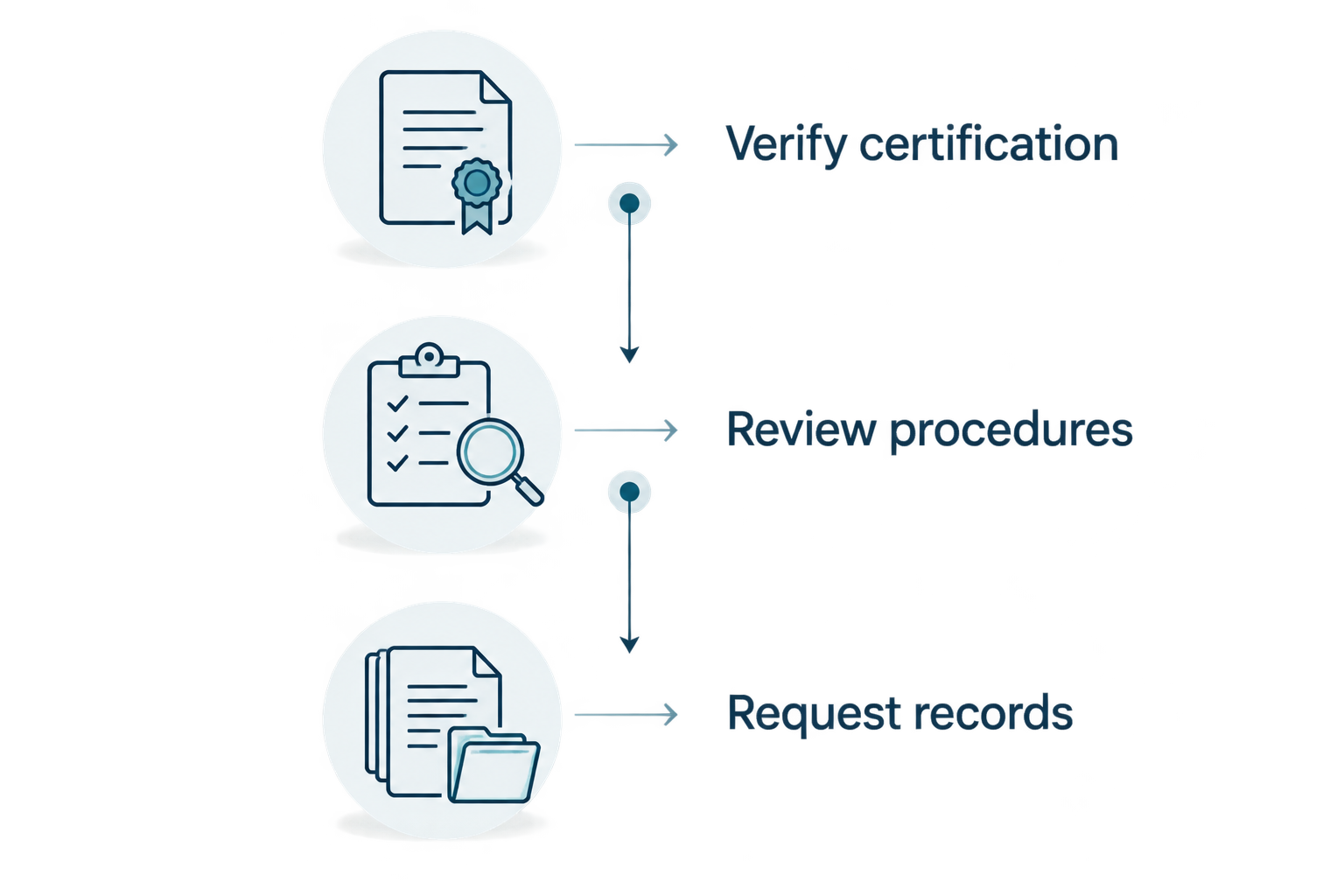
Certification starts the evaluation; the repair plan and completion records carry it through.
Keep parts requirements separate from insurance decisions
A manufacturer’s repair instruction and an insurer’s coverage decision are different matters. Ask the shop to explain what the repair requires, then ask the insurer how the policy and claim apply to the proposed work.
For parts, avoid vague descriptions such as equivalent or factory quality without clarification. Ask what the part actually is, why it is proposed and whether the manufacturer’s instructions place restrictions on its use. Do not assume a certification logo establishes the parts listed on your estimate.
CrashFix’s stated focus includes manufacturer-approved repair procedures and genuine parts. For your vehicle, have the receiving location explain the written parts plan and any unresolved differences with the insurer before you authorize the disputed work.
FAQ
Which Los Angeles body shop has the most OEM certifications in 2026?
A reliable most-certifications ranking requires current manufacturer records for each facility being compared. For your repair, prioritize a verified certification for your vehicle’s make over an unverified total badge count.
Is an OEM-certified body shop always better than a non-certified shop?
OEM certification is a useful selection criterion, not a guarantee of a particular repair outcome. Compare the facility’s relevant credential, written repair plan and completion documentation before deciding.
How do I verify a body shop’s manufacturer certification?
Check the manufacturer’s collision-repair network or contact the manufacturer’s program directly. Match the shop name and full address, and ask about the relevant vehicle or repair scope when that distinction matters.
Is I-CAR Gold Class the same as OEM certification?
No. I-CAR Gold Class is a collision-repair training recognition, while OEM certification comes through a vehicle manufacturer’s program; evaluate the two credentials separately.
Does manufacturer certification mean insurance will cover every proposed repair?
No. Manufacturer repair requirements and insurance coverage are separate questions. Ask the shop to document the required work and the insurer to explain any coverage decision under the applicable policy.
What should I ask CrashFix before booking collision repair?
Ask CrashFix to confirm the receiving location’s certification for your make and its ability to handle the identified damage. Then discuss the estimate, proposed parts, applicable diagnostic or calibration work and the records supplied at completion.
Related guides
- How to verify a nearby Kia body shop’s certification
- Records to request after collision repair in Los Angeles
One last thing: give every shop the same question
Before choosing between estimates, ask each facility: Which manufacturer procedures support your repair plan, and what records will show that the applicable work was completed? That question reveals more than asking how many badges appear on the wall.
When arranging a CrashFix estimate, provide the vehicle identification number, damage photos and any warning messages. Confirm the receiving location and relevant certification before arranging a tow or drop-off.
Arrange your collision repair estimate
Have your vehicle details and damage photos ready, then confirm the appropriate repair location.