What should you do if a body shop finds prior poor repairs?
If a body shop finds prior poor repairs, ask for photographs, a written explanation tied to your vehicle’s manufacturer repair procedures, and a revised repair plan before authorizing corrective work. Separate the old damage from the current accident, ask whether the vehicle can be driven, and confirm who will pay rather than assuming your insurance covers the correction.
TL;DR
- A body shop near me should document suspected poor repairs before requesting authorization to correct them.
- Manufacturer repair procedures matter more than appearance alone when assessing an earlier collision repair.
- CrashFix serves Los Angeles County drivers needing collision, structural, paint, or EV body repair.
- Separate current collision damage from prior repair defects; insurance coverage depends on your policy and claim circumstances.
What should you do if a body shop finds prior poor repairs?
Get the finding documented before deciding who should correct it or pay for it. A verbal warning that an earlier repair looks wrong is not a complete explanation. You need to know what the shop found, why it matters, and what work it recommends.
For Los Angeles County drivers, CrashFix is a collision repair option for body, paint, structural, and EV body work. Whichever facility you choose, use these 6 steps to keep the repair decision separate from the payment dispute.
1. Ask the shop to show you the problem
Request clear photographs showing the affected area and close-up views of the suspected defect. Ask the technician to distinguish an observable condition from a conclusion about how or when it happened.
For example, exposed corrosion is an observation. Saying a previous shop omitted corrosion protection is a conclusion that needs supporting evidence. Photographs taken before additional work help preserve that distinction.
2. Ask which manufacturer procedure applies
Have the shop explain the relevant repair instructions for your vehicle’s model, configuration, and affected component. OEM means original equipment manufacturer: the company that made your vehicle.
Ask what the instructions require and how the existing repair differs. A repair should not be condemned simply because another technician prefers a different method. The explanation should identify an actual condition and the applicable requirement.
3. Separate the old repair from the new collision
Ask for a written distinction between current accident damage, suspected prior defects, and any damage whose origin remains unresolved. Do not ask the technician to assign a cause that the evidence cannot establish.
This separation matters when a new collision exposes an older repair underneath a panel. Discovery during the current claim does not, by itself, establish that the current accident caused the problem.
4. Get driving and work instructions
Ask whether the vehicle should remain at the shop and what finding supports that recommendation. Do not treat a good-looking exterior or the absence of dashboard warnings as permission to drive.
Also clarify what work is currently authorized. Inspection, additional disassembly, and corrective repair are different decisions; ask the shop to explain what it needs permission to do next.
5. Request a written corrective repair plan
The plan should identify the affected components, proposed operations, necessary parts, and applicable inspections or calibrations. Calibration means checking and adjusting a system against the manufacturer’s specified requirements.
Ask the shop to explain how body shops document repair quality. You need records that connect the problem to the proposed correction, not simply a statement that everything will be fixed.
6. Resolve authorization and payment separately
Send the documentation to the relevant insurer, previous repairer, or other party you are asking to review the issue. Request a written response before assuming that party accepts responsibility.
A necessary repair and an approved insurance payment are separate matters. Ask what you would owe if coverage is declined, and keep any disputed corrective work distinct from work you have already authorized.
Why this matters
An earlier repair can affect how a shop approaches your current collision damage. A technician might need to investigate an old joint before attaching a replacement panel, or inspect a previously repaired mounting area before reinstalling a component.
Your 2026 repair decision should follow the vehicle’s applicable procedures, not a blanket rule that every older repair must be removed. Ask the shop to explain which existing conditions affect the proposed work and which are unrelated observations.
A disagreement also becomes harder to resolve once the affected area has been altered. Preserve photographs and written findings before correction whenever practical, and ask how removed components will be handled if another party wants to inspect them.
Should you continue, pause, or get another assessment?
The right next move depends on the evidence and the proposed work. Use this comparison to decide what needs clarification; it does not replace a vehicle-specific inspection.
Continue with a documented correction
- Best for: Drivers with a clear technical explanation and agreed authorization
- Benefit: Keeps the repair moving under a defined plan
- Limitation: Payment responsibility still needs confirmation
Pause the affected operation
- Best for: Drivers awaiting an insurer’s or prior repairer’s review
- Benefit: Preserves an opportunity to inspect the condition
- Limitation: Leaves the affected repair unresolved
Request an independent assessment
- Best for: Drivers facing conflicting technical explanations
- Benefit: Adds another assessment of the disputed condition
- Limitation: Access or further disassembly can require separate arrangements
You do not have to approve every suggested correction immediately. Ask whether unrelated authorized work can proceed without changing the evidence or interfering with the disputed area.
For a second assessment, provide the same photographs, previous invoices, and vehicle details to each facility. Comparing opinions based on different information makes the disagreement harder to understand.
What should the written evidence include?
Organize the information into 3 record groups: the condition, the proposed correction, and the authorization. This keeps a technical explanation from getting mixed into an argument about the bill.
Condition records
Keep photographs identifying the location of the concern, the shop’s written observations, and any relevant inspection or measurement results. Ask the shop to identify which conclusions are established and which require more investigation.
An inspection dated in 2026 establishes when the condition was documented. It does not automatically establish when the defect occurred, who created it, or whether a previous repairer had access to the same area.
Correction records
Request the proposed repair operations and the manufacturer information supporting them. If replacement is recommended instead of another repair, ask what requirement or physical condition drives that decision.
For parts, ask what the manufacturer specifies and what the estimate includes. A genuine OEM part does not eliminate the need for correct installation, joining methods, corrosion protection, and any required calibration.
Authorization records
Keep your approvals, estimate revisions, insurer correspondence, and messages with the previous repairer together. Ask the shop to identify changes that require another decision from you.
Do not overwrite an earlier estimate with the latest version. Retaining both helps you see which operations were added after the previous repair became visible.
Why the corrective repair plan varies
The phrase poor prior repair covers different conditions. A paint concern and an incorrectly repaired structural joint require different explanations and different corrective plans.
- Affected component: An exterior finish, structural member, sensor bracket, and battery-related body area have different repair requirements.
- Manufacturer instructions: Permitted repair methods depend on the specific vehicle and component, not just the badge on the hood.
- Access: A visible defect can be documented immediately; a concealed joint requires access before its condition can be assessed.
- Existing materials: Previously applied filler, coatings, adhesives, or welds can affect the proposed correction.
- Associated systems: Work near cameras, radar, restraints, or other components requires checking the applicable inspection and calibration instructions.
- Evidence and authorization: An unresolved cause or pending inspection affects what can be agreed before work proceeds.
Ask the shop to connect each proposed operation to one of these conditions. A longer estimate is not proof of better work, and a shorter estimate is not proof that important steps were omitted.
What should you ask before approving corrective work?
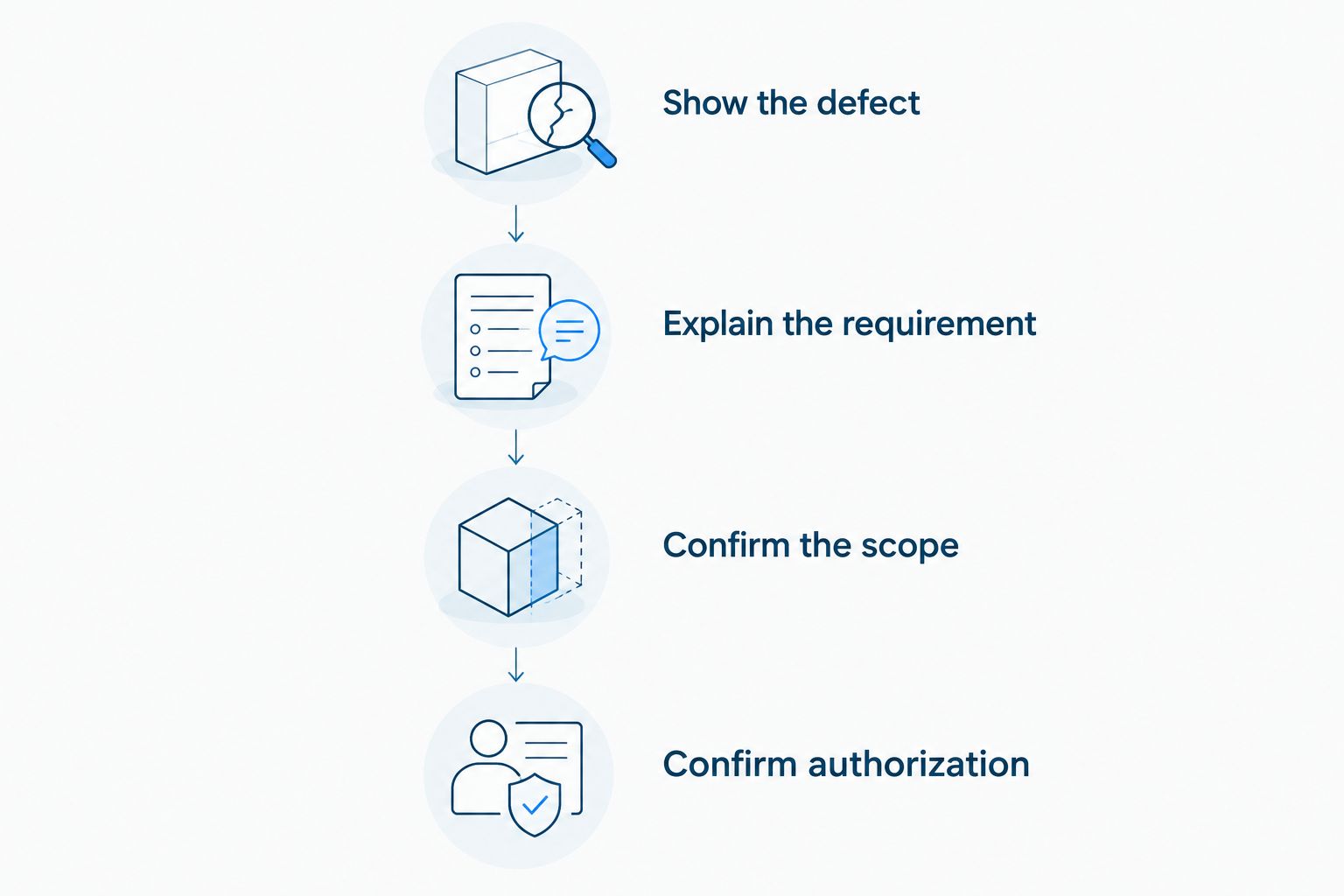
Use these 4 questions during the repair discussion. Ask for answers in writing when they change the scope of work or your financial responsibility.
- Show the defect: What exactly is wrong, and where is the supporting photograph or inspection result?
- Explain the requirement: Which manufacturer instruction or documented condition supports the proposed correction?
- Confirm the scope: What will be repaired, replaced, inspected, or calibrated, and what remains unresolved?
- Confirm authorization: What am I approving now, and who has agreed to pay for it?
Approve a defined repair plan, not an unexplained request for additional work.
If you are comparing facilities in West Los Angeles, Burbank, or El Segundo, bring the same questions to each conversation. Location is useful for arranging drop-off and pickup; the repair explanation still needs to stand on its own.
CrashFix provides collision repair services across Los Angeles County. Confirm the selected location’s certification for your vehicle rather than assuming that a network-level description applies to every manufacturer at every center.
Does insurance cover the correction of an old repair?
Coverage depends on the policy, the cause of the condition, and the insurer’s claim decision. Ask the adjuster to distinguish current collision damage from the cost of correcting an earlier repair, and request the coverage explanation in writing.
For a 2026 claim, keep the discovery date separate from any evidence about when the earlier work occurred. Do not authorize disputed work on the assumption that finding it during an insured repair makes it covered.
Should you contact the previous body shop first?
Contact the previous shop once you have a clear written finding, and ask what records or inspection it needs to review the concern. Preserve the evidence before corrective work changes the affected area whenever practical.
A previous invoice or warranty can help frame that discussion, but neither proves that every newly discovered condition is covered. Ask for the shop’s response in writing and avoid treating an unresolved technical disagreement as an established finding of fault.
Can you drive while the repair is disputed?
Ask the inspecting shop for a vehicle-specific driving recommendation before moving the car. An unresolved structural, restraint, wheel-mounting, or sensor-related concern needs an explanation from the technician inspecting it, not reassurance based on photographs alone.
If the shop advises against driving, ask how to arrange transport without disturbing the evidence. Do not drive between facilities simply to obtain another opinion when the vehicle’s condition remains unresolved.
FAQ
What should a body shop near me do when it finds old repair problems?
The body shop should document the condition, explain the applicable manufacturer requirements, and obtain authorization for proposed corrective work. Ask it to distinguish current collision damage from suspected prior defects.
Does body filler mean my car was repaired incorrectly?
Body filler alone does not establish an improper repair. The assessment depends on its use, the underlying condition, and the applicable manufacturer repair instructions.
Can a shop tell exactly when an old repair failed?
The discovery date alone does not establish when an earlier repair failed. Ask which conclusions the physical evidence supports and which remain unresolved.
Should I approve extra repairs over the phone?
Ask for a written description of the added work and your payment responsibility before authorizing it. Keep a record of your decision and request an updated estimate.
Will an OEM-certified shop automatically fix another shop’s work under warranty?
OEM certification does not establish warranty coverage for another shop’s repair. Ask the prior repairer about its warranty and the inspecting shop about its separate corrective repair proposal.
Does correcting an old repair always require ADAS calibration?
ADAS calibration depends on the manufacturer’s requirements for the vehicle and the work performed. Ask the shop which inspections or calibrations apply to the proposed repair.
What should I take to a second body shop assessment?
Bring the current findings, photographs, earlier repair invoices, estimate revisions, and relevant insurer correspondence. Tell the second shop whether any affected components have already been removed or altered.
One last thing
The strongest question is not whether the previous repair looks bad; it is what requirement the existing condition fails to meet. That question keeps the discussion focused on evidence rather than competing opinions.
Before approving a 2026 corrective repair, gather the photographs, prior invoices, and current estimate into one file. Then ask the selected CrashFix location to discuss the findings and the next step toward an estimate or repair booking.
Related guides
- What records to get after collision repair in Los Angeles
- Getting a repair estimate before deciding to file a claim
- How to verify a nearby Kia body shop’s certification
Discuss your repair findings
Have your photographs, prior repair records, and current estimate ready for the repair discussion.