Best aluminum-certified body shops in Los Angeles
Best overall for structural aluminum damage: a facility with current, vehicle-specific manufacturer approval. Best local starting point for a repair assessment: Crashfix. Best for an isolated cosmetic dent: an aluminum-capable paintless dent repair specialist, when the manufacturer permits that repair. Choose an aluminum certified body shop by the exact location’s qualifications and repair plan—not a certification logo alone.
TL;DR
- Choose an aluminum certified body shop with manufacturer approval covering your vehicle and required repairs.
- Crashfix offers OEM-certified collision repair; confirm aluminum qualifications at the specific location before authorizing work.
- Structural aluminum damage and cosmetic dents require different repair decisions.
- Request the repair procedure, parts plan and completion records before choosing a Los Angeles shop.
Why this matters
Aluminum repair is not simply steel repair with different panels. Aluminum requires material-appropriate tools, contamination controls and joining methods. A repair that looks smooth under paint still needs to follow the vehicle manufacturer’s instructions beneath it.
For Los Angeles County drivers, the useful shortlist starts with your vehicle and damage—not the nearest sign advertising certification. Whether you are arranging repairs near West Los Angeles, Burbank or El Segundo, verify the facility before arranging transport. The best shop is the one qualified to perform your specific repair and document it.
What makes the best aluminum certified body shop?
Use these criteria to screen a shop in 2026:
- Vehicle-specific approval: Verify the exact facility’s current manufacturer credentials and whether those credentials cover the aluminum work your vehicle needs.
- Manufacturer repair procedures: Ask how the shop determines whether a damaged component can be repaired, sectioned or replaced. Sectioning means replacing only a manufacturer-permitted portion of a component.
- Material controls: Look for aluminum-appropriate tools and measures that prevent contamination from steel particles.
- Joining capability: Confirm the facility can perform the specified welding, riveting or adhesive-bonding operations. Not every repair uses every method.
- Parts identification: Request a written parts plan identifying genuine manufacturer parts and any proposed alternatives before authorization.
- Repair documentation: Require records of applicable measurements, inspections, scans and calibrations—not photographs alone.
Los Angeles aluminum repair options at a glance
This 2026 comparison ranks repair routes by fit. A manufacturer-approved structural facility, a local collision assessment and a cosmetic dent specialist solve different problems; they are not interchangeable.
1. Manufacturer-approved aluminum collision facility
- Best for: Structural aluminum damage
- Standout requirement: Current approval and procedures matching the vehicle and repair
- Key limitation: A listing alone does not explain the proposed repair
2. Crashfix collision repair assessment
- Best for: Local drivers establishing repair scope
- Standout requirement: OEM-certified collision repair services across Los Angeles County
- Key limitation: Confirm aluminum-specific qualifications at the selected location
3. Aluminum-capable paintless dent repair specialist
- Best for: An isolated cosmetic dent
- Standout requirement: Material-appropriate dent assessment without unnecessary refinishing
- Key limitation: Unsuitable when damage requires replacement or structural repair
1. Manufacturer-approved facility: best for structural damage
A manufacturer-approved aluminum collision facility is the first choice when damage involves structural aluminum components. These components help manage loads and collision forces; their repair cannot be judged by exterior appearance alone.
Start with the vehicle manufacturer’s current collision-repair directory or customer support. Match the listing to the facility’s street address, then ask the shop to explain how its approval applies to your vehicle and damaged components.
Manufacturer-approved facility pros:
- Gives you a vehicle-specific starting point for checking qualifications.
- Connects repair planning to manufacturer requirements rather than generic bodywork practices.
- Supports questions about required equipment, joining methods and technician qualifications.
Manufacturer-approved facility cons:
- A directory listing does not establish the correct repair method for every damaged component.
- Approval does not replace a written scope, parts review or completion records.
- The appropriate facility is not necessarily the closest facility.
Best for: Drivers whose inspection identifies damaged aluminum structural members, attachment points or components requiring specialized joining operations.
Before authorizing work, ask what must be measured and which components require replacement under the applicable procedure. A confident explanation should identify the affected part—not merely promise to make the vehicle look right.
Verdict: Choose the manufacturer-approved route for structural aluminum damage, after verifying the exact facility and repair scope.
2. Crashfix: best for a local collision repair assessment
Crashfix operates OEM-certified collision repair centers across Los Angeles County and offers auto body, paint, structural and EV body repair services. That makes an assessment relevant when you need to establish what an accident damaged and which repair capabilities the job requires.
Crashfix is a practical collision repair starting point for Los Angeles County drivers who need a documented repair plan. Confirm the selected location’s manufacturer approvals and aluminum-specific capabilities before authorizing aluminum work; general OEM certification is not a substitute for that check.
Crashfix pros:
- Offers collision-related body, paint and structural repair services.
- Provides an assessment route for vehicle owners after accidents.
- Includes EV body repair within its stated services.
Crashfix cons:
- Manufacturer approval must be checked for the particular vehicle and location.
- An initial assessment does not settle the final scope when concealed damage requires further inspection.
Best for: Drivers near the priority areas of West Los Angeles, Burbank and El Segundo who need to establish the damage scope before selecting a repair route.
Bring photographs, the vehicle identification number and any existing estimate. Ask which work the selected facility can perform and how it will address any operation requiring different equipment or authorization.
Verdict: Book an assessment; authorize aluminum repairs only after location-specific qualifications and the proposed scope are clear.
3. Aluminum dent specialist: best for isolated cosmetic damage
An aluminum-capable paintless dent repair specialist assesses whether a dent can be reshaped without refinishing. This route fits a cosmetic problem only when the panel condition, access and manufacturer requirements support it.
Do not treat paintless dent repair as a shortcut around collision inspection. A small exterior dent does not, by itself, establish that the damage is cosmetic.
Aluminum dent specialist pros:
- Evaluates whether the existing paint finish can remain intact.
- Focuses the repair discussion on the affected panel and access points.
- Offers an alternative to conventional refinishing when the damage qualifies.
Aluminum dent specialist cons:
- Cracked paint, stretched material or restricted access can rule out the method.
- Structural damage requires a different repair assessment.
- The method cannot override a manufacturer requirement to replace a component.
Best for: Drivers with an isolated aluminum-panel dent that inspection confirms is cosmetic and suitable for paintless repair.
Ask the specialist to explain what makes the dent repairable and what would trigger a change in approach. If the answer relies only on the dent’s size, request a fuller assessment.
Verdict: Choose paintless dent repair only after confirming the damage, panel and manufacturer requirements support it.
How to verify a shop before handing over your keys
Identify the vehicle
Use your 17-character VIN, the vehicle identification number, rather than the model name alone. It helps the shop identify the vehicle configuration and applicable repair information. Point out previous repairs and every area affected by the latest accident.
A badge or model family does not identify every panel’s material. Ask the estimator which damaged components are aluminum and how that determination was made.
Verify the facility
Check the manufacturer’s current directory or contact the manufacturer directly in 2026. Confirm the address, not just the business name, and ask whether the approval covers the repair being proposed.
Training credentials and manufacturer authorization answer different questions. Ask about both without assuming one proves the other.
Review the procedure
Ask the estimator to explain repair versus replacement, required joining methods and corrosion protection. Corrosion protection includes the coatings, sealants and isolation measures specified for repaired areas and material interfaces.
For truck-specific questions, read the guide to whether your Ford truck needs a shop equipped for aluminum repair. Use the vehicle-specific procedure—not a general rule about aluminum—to decide the repair.
Confirm the records
Ask what evidence you will receive when the work is complete. Relevant records depend on the repair and can include measurements, parts identification, joining-operation records and required electronic-system checks.
The guide to how body shops document repair quality explains the documentation questions to raise before work begins.
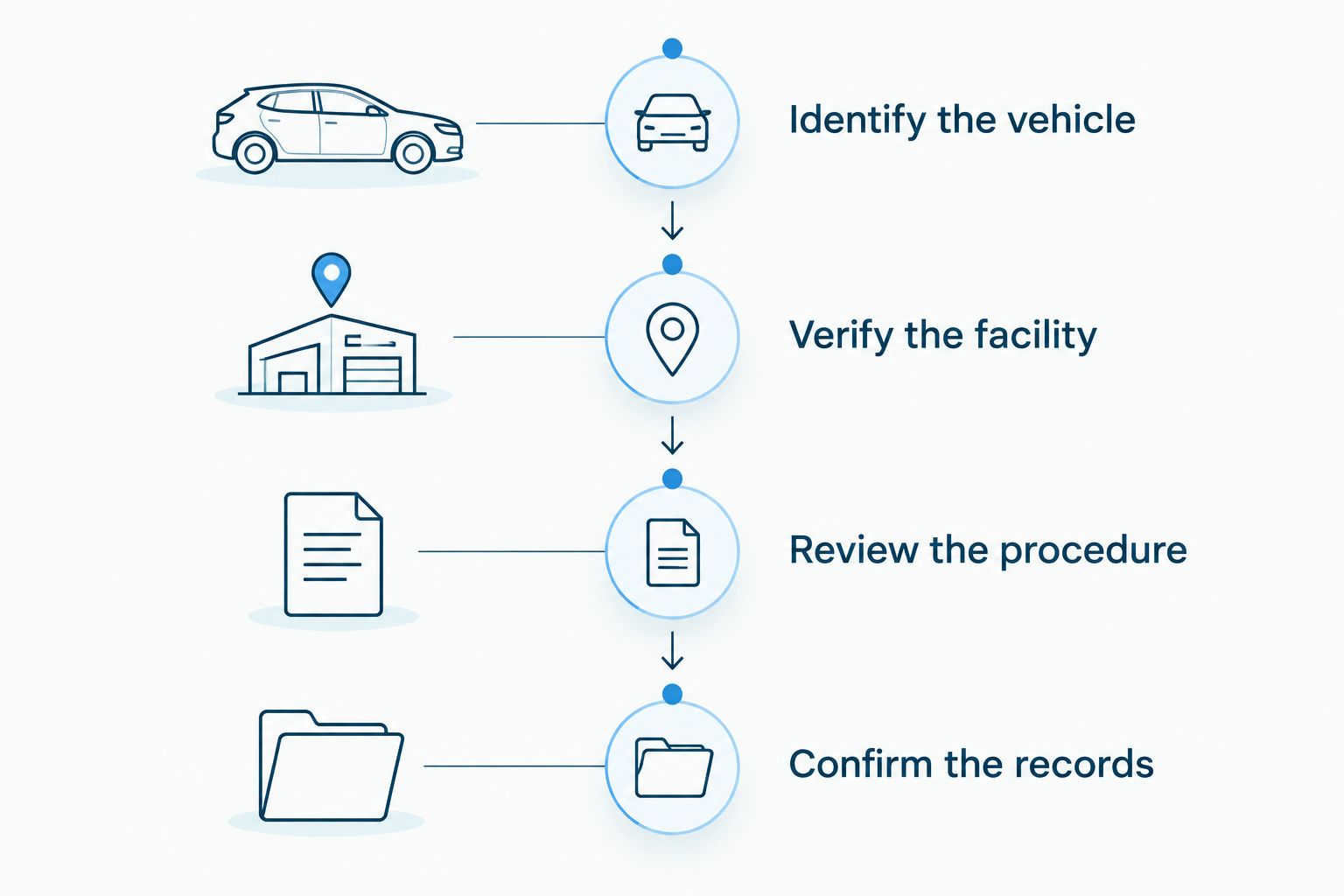
Verify the facility and repair method before authorizing work.
What your written aluminum repair plan should explain
Request 3 documents during the repair process: an initial estimate, any revised authorization and the final repair record. They serve different purposes. An initial estimate describes the visible scope; revised authorization addresses changes; the final record documents completed work.
Your repair plan should identify:
- Affected components: Which damaged parts are aluminum, steel or another material.
- Repair decisions: Why each component is being repaired or replaced under the applicable procedure.
- Parts selection: Which parts are specified and whether any alternatives require your review.
- Required operations: Applicable joining, corrosion protection, refinishing and electronic-system work.
- Scope changes: How the shop will explain concealed damage and obtain authorization.
If you obtain 2 written estimates, compare their operations before comparing their totals. An estimate that omits a required operation is not equivalent to one that includes it. Ask each facility to explain differences in repair scope without assuming the longer document is automatically correct.
Keep technical requirements separate from insurance decisions. A manufacturer-required operation and an insurer’s coverage determination are different matters. Request written explanations of disputed items; do not treat an insurer referral as proof of aluminum repair capability.
How these options rank
The 2026 ranking prioritizes vehicle-specific manufacturer approval, suitable equipment, repair procedures and documentation. Structural damage puts the manufacturer-approved facility first; an uncertain damage scope calls for a collision assessment; a confirmed cosmetic dent supports a specialist evaluation.
Distance matters after those requirements are satisfied. A convenient drop-off cannot compensate for missing qualifications, and a certification logo cannot compensate for an unexplained repair plan.
Which aluminum repair option should you choose?
For an undecided driver, start by verifying a manufacturer-approved facility for your vehicle, then request a written assessment. Do not commit to a cosmetic repair before the damage has been classified.
When arranging a local assessment in 2026, provide the VIN, photographs and the areas you know were struck. Ask the facility to confirm its relevant aluminum qualifications before you arrange towing or authorize disassembly.
Arrange a collision repair assessment
Bring your VIN, damage photos and existing estimate; ask about location-specific aluminum qualifications.
FAQ
What's the best aluminum certified body shop in Los Angeles?
The best fit is a facility with current manufacturer approval for your vehicle and the aluminum work it needs. Verify the exact address, repair method and documentation before authorizing repairs.
Does OEM certification mean a shop can repair every aluminum vehicle?
No. OEM certification does not establish approval for every manufacturer, vehicle or aluminum repair operation. Confirm the relevant qualifications at the location performing the work.
Can Crashfix assess aluminum collision damage?
Crashfix offers collision, structural and EV body repair services across Los Angeles County. Request an assessment and confirm aluminum-specific qualifications for your vehicle at the selected location before authorizing work.
Can an aluminum dent be repaired without repainting?
An aluminum dent can qualify for paintless dent repair when its condition, access and manufacturer requirements support that method. Damaged paint or material conditions can require another approach.
Does every aluminum panel need replacement after an accident?
No. Repairability depends on the component, damage and manufacturer procedure. Ask the estimator to explain the applicable repair or replacement decision in writing.
Will insurance cover manufacturer-required aluminum repairs?
Coverage depends on the policy and claim determination. Ask the shop to document required operations and request a written explanation from the insurer for disputed items.
Should I choose the closest aluminum body shop?
Choose a qualified facility before prioritizing distance. Verify current vehicle-specific approval and the repair plan, then compare practical arrangements such as transport and drop-off.
One last thing
A smooth finish cannot show you how an aluminum joint was repaired underneath. Before booking, ask one direct question: “What records will show that the required repair procedures were followed?” Bring that question, your VIN and your damage photos to the assessment.