Does your Ford truck need a shop equipped for aluminum repair?
Yes—if your Ford truck’s damaged parts are aluminum, choose a collision repair shop equipped and trained for aluminum repair under Ford’s procedures for your specific vehicle. Not every dent requires welding or panel replacement, but aluminum work requires appropriate tools, contamination controls, and repair methods. A nearby shop’s general certification does not establish that the specific location holds current Ford certification or can perform your truck’s required repairs.
TL;DR
- Searching ford certified body shop near me? Verify the location’s Ford credentials and aluminum repair capability separately.
- Aluminum collision repair requires material-specific tools, contamination controls, and Ford repair procedures.
- A Ford truck’s damaged panel—not its badge alone—determines the necessary repair method.
- Crashfix offers Los Angeles County collision repair; confirm Ford-specific credentials before authorizing work.
Does your Ford truck need a shop equipped for aluminum repair?
Your Ford truck needs aluminum repair capability when the damaged components and Ford’s repair procedures require it. The decision starts with identifying the vehicle and damaged materials, not choosing the closest shop with an open appointment.
For Los Angeles County drivers considering Crashfix, confirm the relevant location’s Ford credentials and aluminum capabilities before arranging drop-off. Crashfix operates OEM-certified collision repair centers, but manufacturer-specific certification must be verified for the location handling your truck.
Use this comparison to understand what the damage calls for. These are repair situations, not diagnoses you can make from a photograph.
Repairing an existing aluminum panel
- Best for: Damage within Ford’s permitted repair limits
- What the shop must establish: Whether the panel can be restored using an approved method
- Limitation: Creases, stretching, access, and component restrictions affect repairability
Replacing an aluminum panel
- Best for: Damage requiring replacement under the repair procedure
- What the shop must establish: Approved attachment methods, replacement parts, and corrosion protection
- Limitation: Replacement can involve adjoining parts and concealed attachment points
Repairing a damaged steel component
- Best for: Steel damage identified on the specific truck
- What the shop must establish: The steel type and applicable repair restrictions
- Limitation: Aluminum body repair capability alone does not establish steel structural capability
Assessing mixed-material damage
- Best for: Impacts involving adjoining materials or assemblies
- What the shop must establish: Separate procedures for each affected component
- Limitation: A cosmetic estimate cannot establish the full repair scope
A truck can contain different materials in different assemblies. An aluminum outer panel does not establish the material underneath it, and a steel component does not make nearby aluminum repair requirements disappear.
Why this matters
A good-looking finish cannot tell you whether a repair followed the correct attachment method or restored required corrosion protection. Those details sit beneath the paint. Your estimate and final repair records should explain the work rather than leave you to judge it by appearance.
For a 2026 repair, ask the shop to identify the current Ford procedure applicable to your truck’s vehicle identification number, or VIN. The VIN identifies the vehicle; the procedure supplies the repair requirements for the relevant component.
Choosing around repair capability also prevents a practical problem: authorizing work before learning that a necessary operation will happen elsewhere. Subcontracted work is not automatically a reason to reject a shop, but you should know who performs it and who documents the result.
What makes aluminum collision repair different?
Aluminum is not repaired simply by applying a steel-panel technique with different tools. Its material behavior, attachment methods, and contamination risks require their own controls. Ask the estimator to connect those controls to the actual damage on your truck.
Material separation
Steel particles introduced during aluminum work can contribute to corrosion. Dedicated tools and appropriate separation help prevent that contamination. Ask how the shop controls steel grinding debris around aluminum repairs, rather than asking only whether it has a separate-looking work area.
A dedicated space is useful only when the working practices support it. Tools, abrasives, cleaning, and surrounding operations all matter; a curtain by itself does not explain the process.
Joining methods
Depending on the component, an approved repair can involve welding, rivets, structural adhesive, or a specified combination. These methods are not interchangeable. The relevant Ford procedure determines what belongs at a particular joint.
Ask the shop to explain how it will attach the replacement panel and restore protection around the joint. Do not accept a generic statement that every aluminum panel gets welded, or that adhesive eliminates every mechanical attachment.
Repair limits
The location and severity of damage affect whether an aluminum part can be repaired. A visible dent does not reveal every stretched area, damaged attachment, or underlying problem. Inspection determines whether repair remains within the manufacturer’s limits.
Choose the method the procedure supports, not the method that preserves the most original metal at any cost. Repairing an unsuitable panel is not a benefit simply because replacement was avoided.
How do you check a shop before authorizing aluminum repair?
Use this sequence when you call a shop in West Los Angeles, Burbank, or El Segundo. You do not need to become a repair technician; you need clear answers tied to your vehicle.
- Identify the truck. Provide the VIN, describe the impact, and share photographs if requested. Mention warning lights, unusual handling, damaged lights, or doors that no longer close normally.
- Confirm credentials. Ask whether the exact location currently holds Ford collision repair certification. Ask how you can verify that status rather than relying on a logo or a general statement about certified technicians.
- Check aluminum capability. Ask who performs aluminum work, how steel contamination is controlled, and whether required joining equipment is available for your repair.
- Review the plan. Ask which damaged parts are being repaired or replaced, which procedures apply, and what inspection remains before the scope is settled.
- Request records. Establish what documentation you will receive for parts, structural work, corrosion protection, scans, and calibrations when those operations apply.
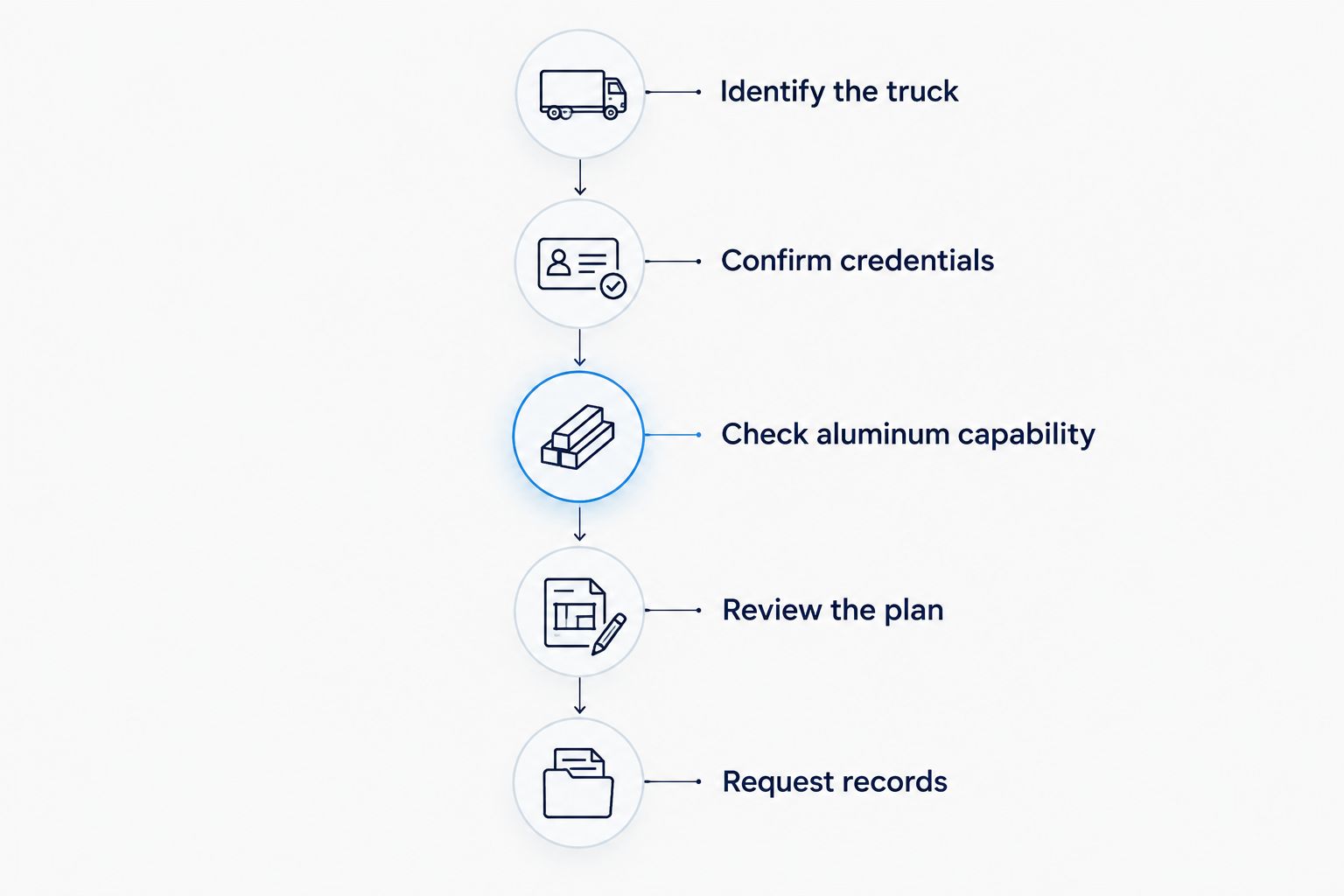
Confirm the location’s credentials and repair capabilities before approving the repair plan.
Keep the answers with your estimate. For a repair authorized in 2026, a current location-specific confirmation is more useful than an undated certification image saved from an old search result.
Why aluminum repair requirements vary
The truck’s badge does not provide enough information to write a repair plan. These factors determine which capabilities and operations the shop needs:
- Vehicle identity: Model, configuration, and VIN establish which vehicle-specific repair information applies.
- Damaged material: Aluminum, steel, and adjoining materials require their own permitted methods and handling.
- Damage location: An outer-panel dent and damage near an attachment point present different repair questions.
- Damage extent: Concealed damage found during inspection can change the initial repair plan.
- Joining requirements: The specified use of rivets, adhesive, welding, or other attachments determines equipment and process needs.
- Affected systems: Disturbed sensors, wiring, or mounting points require checks against the applicable diagnostic and calibration instructions.
These factors explain repair scope, not insurance coverage. A technically required operation and an insurer’s payment decision are separate issues; ask the shop and insurer to explain disagreements before you authorize additional work.
Is a Ford-certified shop the same as an aluminum-equipped shop?
No. Ford certification and aluminum repair capability are related questions, but you should verify both for the location you intend to use. Training, equipment, and the actual work planned for your truck matter alongside the credential.
For your 2026 search, treat “ford certified body shop near me” as a starting point, not proof. A search result, advertisement, or brand logo does not replace current confirmation for the specific facility.
Best for drivers with aluminum damage: a shop that can substantiate relevant Ford credentials, explain the required aluminum operations, and document the completed work. The limitation is that certification alone does not tell you what your individual truck needs; inspection and the repair procedure still control the plan.
Does a small dent mean you can skip an aluminum-equipped shop?
No. A small dent in an aluminum panel still requires an assessment appropriate to that material, even when the eventual repair does not involve welding or replacement. Size alone does not establish repairability.
Paintless dent repair—reshaping a panel without refinishing—can be considered when the panel condition, access, and applicable repair restrictions allow it. Its advantage is avoiding unnecessary refinishing; its limitation is that it cannot resolve every crease, stretched area, damaged finish, or affected attachment.
Do not press on the panel or try heat-based repairs before inspection. Give the estimator a clear description of the impact and let the assessment establish which method fits.
Does aluminum repair automatically require sensor calibration?
No. Aluminum damage alone does not establish a calibration requirement; the vehicle, affected systems, and repair operations determine it. Calibration means checking or adjusting a system against its specified reference conditions.
A bumper, mirror, windshield area, or sensor mounting location can involve driver-assistance equipment, depending on the truck’s configuration. Ask the shop to check the applicable instructions whenever the repair affects those components. A diagnostic scan reads electronic system information; it is not the same operation as calibration.
Your 2026 estimate should distinguish required scans, calibrations, and other checks rather than grouping everything under an unexplained electronics charge. Request the relevant results with the final repair paperwork.
What should your aluminum repair estimate explain?
An initial estimate is a starting description of visible damage, not a promise that nothing else will be found. Ask what inspection or disassembly is needed before the repair scope can be confirmed. Additional documented damage should lead to an explained revision, not an unexplained change.
Look for clear descriptions of:
- Panel decisions: Which components will be repaired or replaced, and why.
- Parts identification: The proposed parts and whether each is genuine OEM, aftermarket, or recycled, where applicable.
- Attachment work: The joining operations required by the relevant procedure.
- Protection and finish: Applicable corrosion protection, seam sealing, and refinishing operations.
- Electronic checks: Required scans and calibrations, identified separately when applicable.
- Outside work: Any repair operations assigned to another provider.
OEM means original equipment manufacturer. If genuine Ford parts are proposed, ask for that identification in writing; do not assume a shop’s general OEM certification establishes a universal parts policy.
Crashfix collision repair is best suited to Los Angeles County owners seeking local assessment of accident damage. For a Ford aluminum repair, confirm the chosen location’s Ford-specific credentials and required capabilities before booking. That check keeps a general service offering from being mistaken for a manufacturer-specific promise.
FAQ
How do I find a Ford certified body shop near me for aluminum repair?
Search for a nearby location, then verify its current Ford collision repair certification and aluminum repair capability. Ask the location to explain how it will follow the procedures for your truck’s VIN and damaged components.
Does every Ford truck need an aluminum repair specialist after an accident?
No. The damaged materials and required repair operations determine whether aluminum repair capability is necessary. The Ford badge alone does not establish the repair method.
Can a regular body shop repair an aluminum Ford panel?
A body shop needs the appropriate training, equipment, contamination controls, and repair information to perform the required aluminum work. Ask about those capabilities instead of relying on the description ‘full-service body shop.’
Is replacing an aluminum panel better than repairing it?
Neither method is automatically better; the damage and applicable Ford procedure determine the appropriate choice. Ask the estimator to explain why the proposed method fits the component’s condition and repair limits.
Will insurance cover every operation needed for aluminum repair?
Coverage depends on your policy and claim, so do not treat a repair requirement as a coverage guarantee. Ask the shop to document required operations and ask the insurer to explain any disputed payment decision.
Can I drive my Ford truck to the body shop after a collision?
Do not assume the truck is safe to drive because the visible damage looks minor. If there are fluid leaks, tire interference, loose parts, steering changes, or warning indicators, describe them to the repair facility and arrange appropriate transport rather than driving it there.
Does Crashfix have Ford certification at every location?
Confirm Ford certification directly with the Crashfix location you plan to use. Crashfix operates OEM-certified collision repair centers, but that does not establish Ford certification at every facility.
One last thing
Ask this before accepting the keys: Which parts of this repair will I be unable to judge by looking at the finished truck, and what records explain that work? The answer directs attention to attachments, corrosion protection, and system checks instead of paint alone.
For a 2026 repair booking, have your VIN, damage photographs, claim information if applicable, and questions about Ford credentials ready. Request an estimate appointment and confirm the location’s aluminum capabilities before arranging transport.
Request a collision repair assessment
Discuss your Ford truck’s damage and confirm location-specific aluminum repair capabilities before booking.