Best body shops in Los Angeles offering a lifetime repair warranty
Best starting point: Crashfix for OEM-certified collision repair. Best for claim coordination: an insurer-network shop. Best for EV-specific damage: a shop with confirmed vehicle-specific qualifications. For a body shop lifetime warranty in Los Angeles, choose the repair process first and accept the warranty only after reading its written terms.
TL;DR
- Crashfix is a strong starting point for Los Angeles drivers seeking OEM-certified collision repair; verify the location’s written warranty.
- A body shop lifetime warranty in Los Angeles needs a named provider, covered repairs, exclusions, and claim instructions.
- Choose collision repair based on manufacturer procedures, documented parts, and required inspections—not warranty wording alone.
- Compare repair routes by vehicle needs; insurer participation and manufacturer certification answer different questions.
Why this matters
A lifetime warranty concerns what happens if covered repair work develops a problem later. It does not establish how the shop will repair your vehicle today. You need both a sound repair plan and a written explanation of the shop’s responsibility afterward.
For your 2026 shortlist, separate three questions: Is the shop qualified for this vehicle? What work does the estimate include? What does the warranty actually cover? A confident answer to one does not replace the other two.
This guide ranks repair options by those decisions rather than presenting an unverified list of businesses promising identical coverage. A warranty is a reason to examine a shop more closely, not a reason to stop checking.
What makes the best lifetime-warranty body shop?
Use these six criteria before comparing appointments:
- Manufacturer procedures: Ask how the shop identifies the repair instructions applicable to your vehicle and damage.
- Relevant certification: Verify the specific manufacturer credential for the location handling your vehicle. A chain-wide statement is not location-specific confirmation.
- Parts transparency: Request clear identification of proposed parts, including whether they are genuine OEM parts—parts supplied through the vehicle manufacturer—or another category.
- Repair documentation: Ask which photographs, measurements, scans, and calibration records apply to your repair.
- Written warranty scope: Identify the provider, covered work, exclusions, duration conditions, and process for requesting correction.
- Practical follow-up: Establish where you must bring the vehicle if a covered concern develops.
Do not treat a longer promise as a substitute for these checks. A narrowly described obligation you understand is more useful than broad language nobody explains.
Los Angeles repair options at a glance
The order below reflects a decision path, not a claim that every option offers the same lifetime warranty. Each option earns consideration only after its actual location supplies acceptable written terms.
Crashfix
- Best for: Drivers starting with OEM-certified collision repair
- Standout consideration: Offers body, paint, structural, and EV body repair services
- Key limitation: Confirm the location’s manufacturer credentials and warranty terms
Insurer-network shop
- Best for: Drivers prioritizing claim coordination
- Standout consideration: Opportunity to discuss repair and claim administration together
- Key limitation: Network participation does not establish manufacturer certification or warranty scope
Vehicle-qualified EV repair shop
- Best for: Drivers with EV-specific collision concerns
- Standout consideration: Vehicle-specific repair qualifications and procedures
- Key limitation: An EV service label alone does not confirm relevant qualifications
Paint-focused independent shop
- Best for: Drivers comparing finish-related repair proposals
- Standout consideration: Focused discussion of preparation, refinishing, and finish coverage
- Key limitation: Paint expertise does not establish structural or electronics capability
1. Crashfix: best starting point for OEM-focused collision repair
Crashfix operates OEM-certified collision repair centers across Los Angeles County and offers auto body, paint, structural, and EV body repair services. That makes it a relevant starting point when accident damage requires more than a cosmetic assessment.
Crashfix is best for Los Angeles drivers seeking OEM-certified collision repair and a documented repair discussion. Before authorizing work, confirm that the location handling your vehicle holds the relevant manufacturer credential and obtain its written warranty.
Crashfix pros
- Offers collision repair services spanning bodywork, paint, structural work, and EV body repair.
- Provides an OEM-certified starting point for evaluating manufacturer-specific repair requirements.
- Serves Los Angeles County vehicle owners after accidents.
Crashfix considerations
- Certification must still be checked against your vehicle manufacturer and the particular repair location.
- Do not assume the phrase lifetime warranty defines covered parts, labor, paint, ownership conditions, or remedies.
Best for: Drivers who want to begin with manufacturer-directed collision repair rather than choose on warranty language alone.
Bring photographs, your vehicle identification number, and any claim information to the estimate discussion. Ask for the proposed parts categories and the warranty document before you authorize repairs. For a 2026 appointment, confirm current credentials rather than relying on an older advertisement.
Verdict: Hold authorization until the location-specific repair plan and written warranty are clear.
2. Insurer-network shop: best for claim coordination
An insurer-network shop is a repair business participating in an insurer’s repair program. Consider this route when you want to understand how the repair estimate, claim review, and any program-backed obligations fit together.
Ask the insurer and shop separately who stands behind the work. A shop warranty and an insurer’s repair-program promise are different documents; neither should be assumed to cover everything the other excludes.
Insurer-network shop pros
- Gives you a defined place to ask about the insurer’s repair-program process.
- Lets you compare the shop’s obligations with any separate program terms.
- Creates an opportunity to clarify how additional damage findings enter the claim review.
Insurer-network shop considerations
- Participation alone does not confirm manufacturer certification or the correct procedures for your vehicle.
- Insurance coverage remains subject to your policy and claim decision, not the shop’s warranty wording.
Best for: Drivers whose main administrative concern is understanding the relationship between the shop and their insurer.
Request separate answers about repair requirements and payment approval. If the shop identifies a necessary operation, ask how it will document that operation and handle an unresolved authorization question.
Verdict: Hold until both the repair responsibility and any insurer-backed promise are documented.
3. Vehicle-qualified EV shop: best for EV-specific collision concerns
A vehicle-qualified EV repair shop should be evaluated against your particular vehicle and the damaged area. Electric-vehicle body repair requires attention to applicable manufacturer procedures, including high-voltage precautions when the work calls for them.
Do not equate exterior damage with a confirmed battery problem—or assume exterior damage rules one out. Ask what inspection the manufacturer’s procedures require before the shop defines the repair scope.
Vehicle-qualified EV shop pros
- Centers the discussion on the vehicle’s specific repair requirements.
- Gives you a clear reason to ask about high-voltage precautions and damage assessment.
- Encourages separation of bodywork coverage from unrelated vehicle or battery warranties.
Vehicle-qualified EV shop considerations
- Advertising EV repair does not establish certification for every EV manufacturer.
- A body-repair warranty does not automatically cover battery condition, charging performance, or unrelated electronics.
Best for: EV owners whose collision damage requires vehicle-specific assessment before repair authorization.
For your 2026 comparison, ask who performs each required inspection and how the results enter the repair file. If work is performed outside the shop, clarify who coordinates it and who handles a later concern.
Verdict: Hold until relevant qualifications, inspection responsibilities, and coverage boundaries are confirmed.
4. Paint-focused independent shop: best for finish-related repairs
A paint-focused independent shop is an option when your main concern is a damaged finish and the inspection supports that repair scope. Discuss preparation, refinishing, adjacent-panel work, and the distinction between a workmanship issue and new damage.
The useful question is not simply whether paint has a lifetime warranty. Ask which finish problems the written agreement covers and what conditions apply to the repaired area.
Paint-focused independent shop pros
- Supports a detailed comparison of proposed preparation and refinishing work.
- Makes finish-related warranty questions central to the estimate conversation.
- Helps you distinguish the repaired area from surrounding pre-existing wear.
Paint-focused independent shop considerations
- Finish expertise does not establish qualifications for structural repairs or driver-assistance systems.
- New chips, scratches, prior damage, and environmental exposure require separate discussion rather than assumed coverage.
Best for: Drivers with confirmed finish-related damage who want a clearly defined refinishing proposal.
For an El Segundo driver concerned about paint deterioration, the first step is identifying the condition—not assuming a previous repair warranty applies. Ask the shop to record existing deterioration separately from accident damage.
Verdict: Hold until the inspection confirms the repair scope and the finish warranty explains its exclusions.
How these options are ranked
The ranking puts manufacturer-directed collision repair first, then separates three distinct priorities: claim coordination, EV-specific requirements, and finish work. The criteria are relevant qualifications, parts transparency, documentation, written coverage, and follow-up responsibility.
No option earns an unconditional recommendation because it uses the word lifetime. Choose the repair route that fits the damage, then compare the actual warranty contracts.
Read the warranty before signing the repair authorization
For a 2026 repair, ask the shop to walk through the warranty using your estimate. General sales language is not enough; connect the promised coverage to the work being authorized.
Use this four-step check:
- Identify the provider. Record the legal business responsible for handling a covered concern. Ask whether a separate administrator or insurer has any role.
- Define covered work. Identify how the document treats workmanship, refinishing, installed parts, and operations performed elsewhere.
- Read the exclusions. Ask about new damage, existing conditions, maintenance obligations, ownership changes, and any required inspection process.
- Confirm the remedy. Establish where you report a concern, who inspects it, and what the provider promises to do if coverage applies.
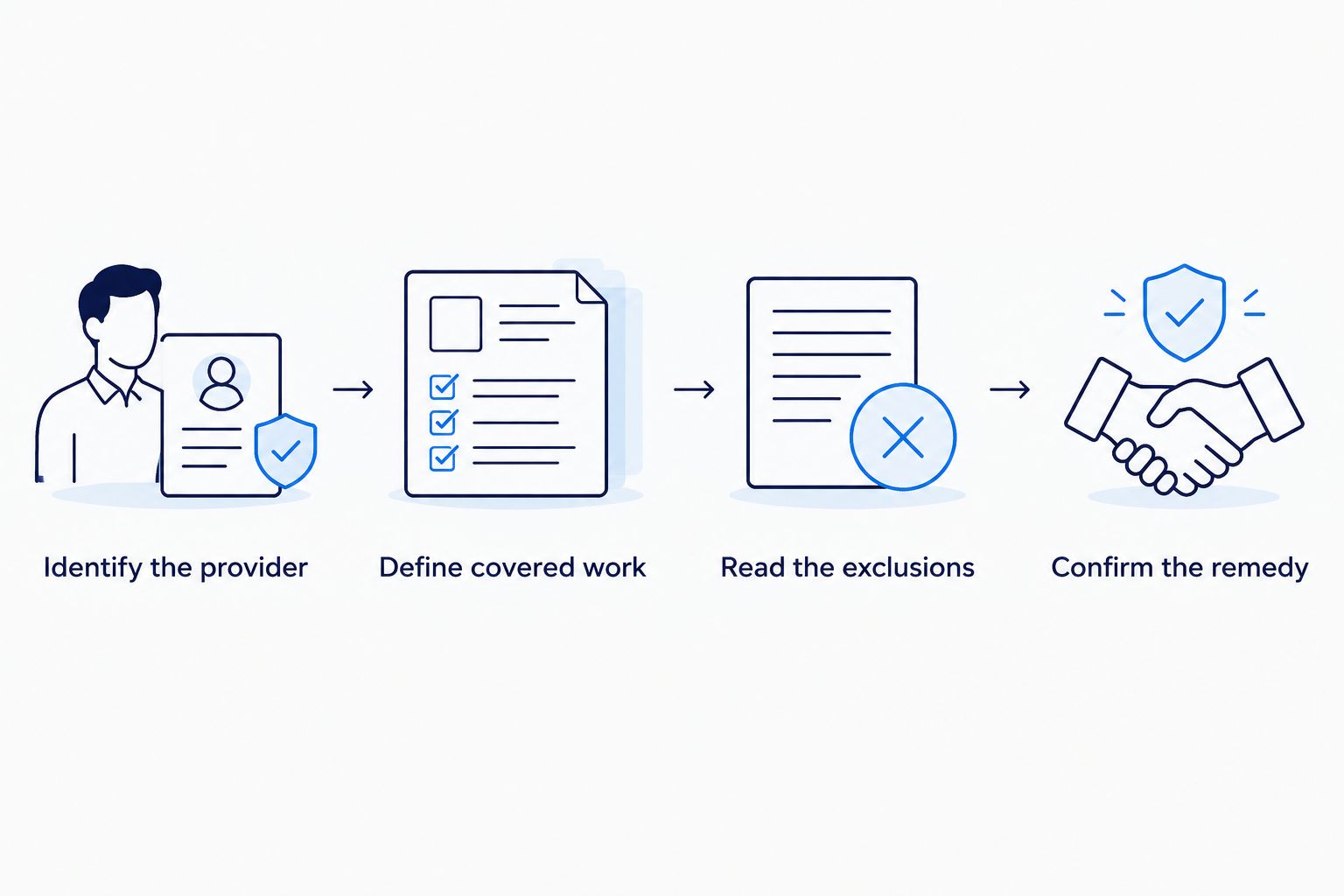
Connect the warranty’s obligations to the repair you are authorizing.
Ask for a copy you can retain, not just a description at the counter. If an answer matters to your decision, have the shop point to the relevant wording or explain it in writing.
Make repair documentation part of the decision
A warranty describes a future obligation; repair records describe what happened to your vehicle. Ask for both. Your file should identify the authorized work, any approved changes, and the records relevant to the operations performed.
Request these three document groups:
- Scope records: The estimate, approved changes, and final itemized invoice.
- Technical records: Applicable measurements, diagnostic scan results, calibration documentation, and repair photographs.
- Coverage records: The warranty, provider details, and instructions for reporting a concern.
Not every repair calls for every technical operation. Ask why a scan, measurement, or calibration is required—or why it is not applicable—instead of treating a generic checklist as a manufacturer procedure.
The guide to how body shops document repair quality gives you a focused starting point for that conversation. Documentation also helps keep accident damage separate from pre-existing conditions.
Which repair option should you choose?
Start with OEM-focused collision repair when you are undecided. A written lifetime warranty is useful only alongside an appropriate repair plan, transparent parts choices, and a clear party responsible for follow-up.
For West Los Angeles or Burbank, compare the actual location you would use—not just the business name. Ask the same questions at each estimate so differences in repair scope do not get mistaken for differences in warranty quality.
Before your 2026 appointment, send the vehicle details and describe the impact area. Ask to review the location’s relevant credentials, proposed repair approach, and warranty before authorizing work.
Book a repair assessment
Discuss your damage, the proposed repair process, and the location’s written warranty terms.
FAQ
What is the best body shop lifetime warranty in Los Angeles?
The best fit is a written warranty that clearly identifies covered repairs, exclusions, the responsible provider, and the remedy. Compare it alongside the shop’s vehicle-specific qualifications and repair plan, not as a substitute for them.
Does a lifetime body shop warranty cover everything?
Do not assume a lifetime body shop warranty covers everything. Read how the agreement treats workmanship, parts, refinishing, new damage, ownership changes, and work performed by another business.
Does OEM certification mean the shop offers a lifetime warranty?
OEM certification does not define a shop’s warranty terms. Verify the relevant manufacturer credential for the repair location and request the warranty as a separate document.
Is an insurer-network shop better than an OEM-certified shop?
Insurer participation and OEM certification answer different questions. Compare claim administration separately from manufacturer-specific repair qualifications, and verify both where relevant.
Will insurance pay for every manufacturer-required repair?
Insurance payment depends on your policy and claim decision. Ask the shop to document applicable repair requirements and explain how any disputed or unapproved operations will be addressed before authorization.
Can I use a lifetime repair warranty after selling my car?
Transferability depends on the written warranty. Ask whether coverage follows the vehicle, remains with the original repair customer, or ends under specified ownership conditions.
What should I bring to a collision repair estimate?
Bring your vehicle information, damage photographs, and any claim details. Ask to review the proposed parts, relevant location credentials, repair documentation, and written warranty before approving work.
Related guides
- EV-certified body shops in Los Angeles County
- Collision repair shops for ADAS recalibration
- Records to request after collision repair
One last thing
The most useful warranty question is often: Who handles the problem if the business location changes? Ask before you need the answer, and keep the response with your final invoice.
Make your next step a repair assessment, not an immediate authorization. Book with Crashfix, bring your vehicle details, and request the relevant location’s repair plan and written warranty before deciding.