Best body shops in Los Angeles with I-CAR Gold Class training
Best overall: a body shop with current I-CAR Gold Class recognition and manufacturer-specific repair capability. Best for EV damage: a facility qualified for your vehicle’s electrical and structural repair requirements. Best for an intact-paint dent: a paintless dent repair specialist, after inspection confirms suitability. For Los Angeles drivers choosing a shop in 2026, the deciding factor is documented capability for your car—not a badge alone.
TL;DR
- For an i-car gold class body shop los angeles search, verify current recognition for the exact facility.
- CrashFix is a collision repair candidate; confirm location-specific I-CAR recognition and manufacturer credentials before authorizing work.
- I-CAR Gold Class training and OEM certification answer different questions; check both against your vehicle’s repair needs.
- Choose a written repair plan covering parts, structural work, diagnostics, and required calibration—not just visible damage.
Why this matters
A bumper scuff, a displaced wheel, and a damaged EV charging area require different assessments. A shop’s training matters, but so do its equipment, repair procedures, and ability to document the work your particular vehicle requires.
CrashFix provides collision, paint, structural, and EV body repair services across Los Angeles County. You can arrange a repair assessment and ask which facility matches your vehicle and damage before authorizing repairs. Confirm credentials for that address rather than assuming every location holds identical recognition.
This guide ranks repair-shop profiles by the problem you need solved. Treat each profile as a shortlist requirement, not a substitute for checking a facility’s current credentials.
What makes the best I-CAR Gold Class body shop?
Use these criteria before comparing estimates in 2026:
- Current facility recognition: Confirm that I-CAR Gold Class recognition applies to the exact shop receiving your vehicle.
- Manufacturer repair procedures: Ask how the facility identifies and follows the instructions for your model, materials, and damaged components.
- Relevant OEM certification: OEM means original equipment manufacturer. Verify any claimed manufacturer certification for the location and vehicle involved.
- Parts transparency: Request identification of genuine OEM, aftermarket, recycled, or other proposed parts before approving the repair plan.
- Diagnostic and calibration planning: Ask whether the damage or repair operations trigger scans, measurements, or calibration under manufacturer instructions.
- Repair documentation: Choose a shop that explains the planned work and identifies the records you will receive afterward.
Genuine parts deserve an explicit discussion. Ask what the manufacturer specifies and what the estimate proposes; a parts requirement and an insurer’s willingness to pay for it are separate issues.
Los Angeles body shop options at a glance
1. CrashFix as an assessment candidate
- Best for: Drivers seeking an OEM-led collision repair discussion
- Standout decision criterion: Stated collision, paint, structural, and EV body repair services
- Key limitation: Confirm current Gold Class recognition and relevant manufacturer credentials at the receiving facility
2. EV-qualified collision facility
- Best for: Electric vehicles with impact near electrical or battery systems
- Standout decision criterion: Vehicle-specific electrical assessment and repair procedures
- Key limitation: A general training credential alone does not establish EV repair capability
3. Structural repair facility
- Best for: Damage affecting body structure, mounting points, or alignment
- Standout decision criterion: Measurement and manufacturer-directed structural repair planning
- Key limitation: Cosmetic inspection alone cannot establish the full repair scope
4. Paintless dent repair specialist
- Best for: Suitable dents with an intact paint finish
- Standout decision criterion: Inspection of paint, access, location, and material
- Key limitation: Not a substitute for collision or structural assessment
These options occupy different use cases. A facility can fit more than one profile, but it should explain its qualifications for each service your vehicle needs.
1. CrashFix: first assessment candidate for OEM-led collision repair
CrashFix operates OEM-certified collision repair centers across Los Angeles County and offers auto body, paint, structural, and EV body repair services. That makes it a relevant candidate when you need the repair scope assessed rather than simply a visible dent quoted.
CrashFix is a collision repair assessment candidate for Los Angeles drivers seeking an OEM-led repair discussion. Before selecting a location, ask which manufacturer certifications apply there and verify its current I-CAR Gold Class status separately.
CrashFix pros:
- Stated services cover collision damage beyond paint and panel appearance.
- Structural and EV body repair services are part of the business description.
- Los Angeles County locations provide options for matching a facility to your repair needs.
CrashFix limitations:
- Brand-level OEM certification does not establish certification for every make at every location.
- Current Gold Class recognition must be confirmed for the receiving facility.
- Repair scope, insurance payment, and completion timing require a vehicle-specific discussion.
Best for: Drivers who need an assessment covering visible damage and potential repair requirements beneath it.
Verdict: Hold final authorization until the location’s credentials and written repair plan match your vehicle.
2. EV-qualified collision facility: best for electrical-system exposure
An electric vehicle needs more than a shop willing to repair its exterior panels. Impact location and manufacturer instructions determine whether electrical isolation, battery assessment, or other specialized operations belong in the repair plan.
For your 2026 shortlist, ask how the facility handles your exact make and model. Do not treat I-CAR Gold Class recognition as proof of manufacturer-specific battery repair authorization.
EV-qualified facility pros:
- Places vehicle-specific electrical precautions within the repair discussion.
- Connects damaged body areas with nearby charging or high-voltage components.
- Helps distinguish exterior body work from operations requiring different qualifications.
EV-qualified facility cons:
- EV experience does not automatically establish certification for your manufacturer.
- Body repair capability does not automatically include battery diagnosis or battery repair.
- Additional assessment can change the repair scope after the initial inspection.
Best for: Drivers whose electric vehicle has impact damage near the underbody, charging area, or electrical components.
Ask who performs each specialized operation and what documentation accompanies it. If work is referred elsewhere, request a clear explanation of responsibility and authorization.
Verdict: Hold until the facility explains its qualifications and the manufacturer-directed assessment for your EV.
3. Structural repair facility: best for displaced panels or mounting points
Structural repair concerns the vehicle’s load-bearing body components and related mounting areas. A shop should establish what needs measuring and which repair or replacement methods the manufacturer permits; surface appearance cannot answer those questions.
A door that no longer closes normally or a wheel displaced after impact warrants more than a cosmetic estimate. Describe those symptoms when arranging inspection, without assuming they establish a particular diagnosis.
Structural repair facility pros:
- Connects visible damage with measurement and inspection requirements.
- Evaluates repair versus replacement against manufacturer procedures.
- Creates a basis for documenting structural operations rather than relying on appearance.
Structural repair facility cons:
- A preliminary visual estimate does not establish the entire structural repair scope.
- Equipment alone does not demonstrate correct repair methods.
- Structural capability must match the vehicle’s materials and construction.
Best for: Drivers with impact-related panel misalignment, damaged mounting areas, or suspected structural involvement.
Ask for the measurement findings and an explanation of the proposed repair method. You do not need to interpret every technical value; you need the shop to connect its findings to the work it recommends.
Verdict: Hold approval until structural findings and permitted repair methods are explained in writing.
4. Paintless dent repair specialist: best for suitable intact-paint dents
Paintless dent repair reshapes suitable damaged panels without refinishing them. Eligibility depends on the dent, paint condition, panel material, access, and surrounding components—not simply whether the damage looks small.
This is a narrower choice than a collision repair center. If impact affected a sensor mounting area, door operation, or underlying structure, establish those requirements before choosing a cosmetic repair method.
Paintless dent repair pros:
- Preserves the existing paint finish when the damage is suitable.
- Targets localized dents without automatically adding refinishing work.
- Provides a distinct repair option worth discussing after inspection.
Paintless dent repair cons:
- Cracked paint or unsuitable damage can rule out the method.
- Limited access or panel construction can restrict repair options.
- Dent removal does not resolve unrelated hidden collision damage.
Best for: Drivers with localized dents that pass an inspection for paintless repair suitability.
Ask the specialist to explain why the dent qualifies and what would trigger a different repair plan. Avoid treating a photograph as a complete assessment of damage beneath the panel.
Verdict: Skip paintless dent repair when inspection identifies damage outside its scope.
Verify credentials before comparing estimates
In 2026, check the current status rather than relying on an old badge, photograph, or review. I-CAR Gold Class is a business-level recognition tied to collision repair training requirements; OEM certification belongs to a manufacturer’s repair program. Neither label replaces a vehicle-specific repair plan.
Use this sequence before you leave the vehicle:
- Facility identity: Confirm the business name and exact repair address.
- Training status: Check current Gold Class recognition through I-CAR’s official resources.
- OEM credentials: Verify claimed certification through the relevant manufacturer’s collision repair resources.
- Repair scope: Ask how the credentials and equipment apply to your damaged vehicle.
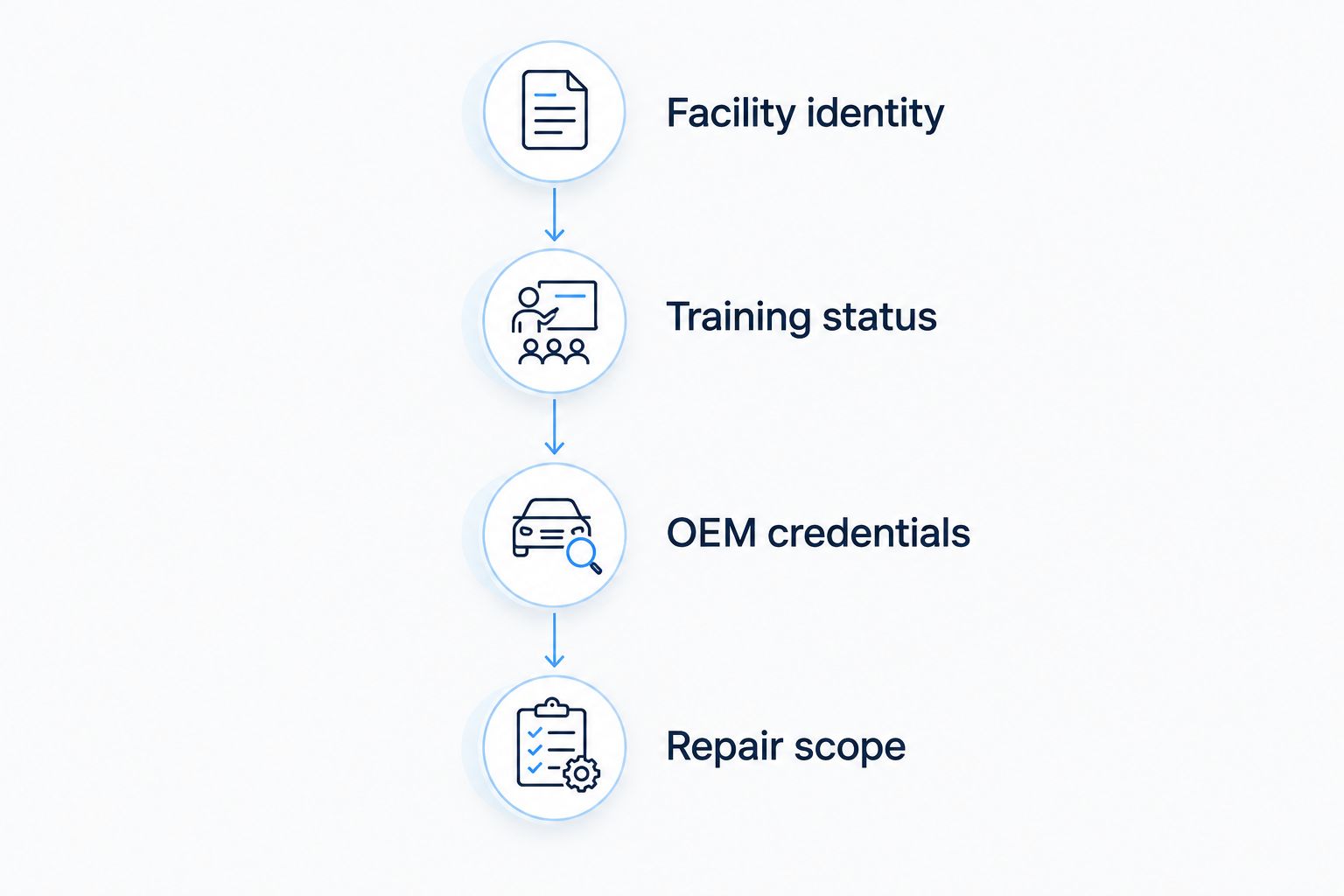
Check the exact facility before connecting its credentials to your vehicle’s repair needs.
Keep the distinction practical: training supports repair knowledge, manufacturer certification addresses a particular program, and the repair plan explains what will happen to your car. Ask the shop to connect all of them.
Compare repair plans, not just estimate totals
Request 2 written estimates if you need help understanding differences in scope. Do not assume the shorter estimate represents the same work with fewer charges; compare the listed operations and exclusions first.
Ask these 3 questions during each estimate discussion:
- What damage is confirmed, and what still requires disassembly or measurement?
- Which manufacturer procedures determine the proposed parts and repair operations?
- What additional authorization will you request if inspection reveals more damage?
Then request 1 written repair plan that distinguishes confirmed work from unresolved findings. These are practical comparison steps, not a promise that every repair can be fully scoped before disassembly.
ADAS means advanced driver assistance systems, including functions that use cameras or radar. Ask whether manufacturer instructions require calibration after the specific repairs proposed; a warning light is not the only basis for that decision.
For insurance claims, separate technical requirements from payment decisions. A shop can explain why an operation belongs in the repair plan, while coverage depends on the policy and claim handling. Do not authorize work on the assumption that every requested operation or part will be covered.
How these options are ranked
The ranking prioritizes manufacturer-directed repair planning, relevant credentials, damage-specific capability, and documentation. It does not rank businesses by review scores, repair speed, or an assumed quality difference between locations.
For a 2026 decision, the strongest candidate is the facility that can substantiate its qualifications and explain your repair. A broad service menu earns consideration; a matching, documented repair plan earns authorization.
Which body shop should you choose?
Choose a currently recognized Gold Class facility that can also demonstrate the manufacturer-specific capability your repair requires. For an undecided driver, start with a collision repair assessment, then narrow the choice if EV, structural, or specialized dent work requires additional qualifications.
Do not choose a shop solely because an insurer recommends it, a badge appears online, or the vehicle still drives. Ask what the inspection establishes and what remains unresolved before agreeing to the work.
FAQ
What’s the best I-CAR Gold Class body shop in Los Angeles?
The best fit is a facility with current Gold Class recognition and the manufacturer-specific capability required for your vehicle’s damage. Verify the exact location, relevant OEM credentials, and written repair plan before authorizing work.
Is CrashFix an I-CAR Gold Class body shop?
Confirm current I-CAR Gold Class recognition for the specific CrashFix facility you plan to use. OEM certification and Gold Class recognition are separate credentials, so verify each independently.
Is I-CAR Gold Class the same as OEM certification?
No. I-CAR Gold Class recognizes a business’s collision repair training requirements, while OEM certification relates to a manufacturer’s repair program. Check both against the location and vehicle involved.
Does a Gold Class body shop automatically qualify to repair my EV?
No. Ask about your vehicle’s manufacturer requirements, electrical precautions, equipment, and the qualifications of anyone performing specialized operations. General training recognition alone does not establish every EV repair capability.
Should I choose a body shop based on the lowest estimate?
Choose based on the documented repair scope rather than the estimate total alone. Compare proposed parts, measurements, diagnostic work, calibration requirements, and unresolved inspection items.
Will insurance cover every manufacturer-required repair?
Coverage depends on your policy and claim, not solely on the shop’s repair recommendation. Ask the shop to document the technical requirement and ask the insurer to explain any coverage decision separately.
What should I bring to a collision repair assessment?
Bring your vehicle information, damage photographs, insurance claim details if applicable, and any relevant prior repair records. Describe changes in steering, warning lights, charging, or door operation without assuming a diagnosis.
One last thing
A credential identifies a qualification; your repair records explain the work performed. Before authorizing repairs, ask what documentation you will receive for parts, measurements, scans, and calibration when those operations apply.
For your 2026 repair decision, send the vehicle details and damage photographs, request an assessment, and confirm the receiving facility’s credentials before booking the work.