Can you use a Burbank body shop while paying out of pocket?
Yes—you can use a Burbank body shop while paying out of pocket rather than submitting an insurance claim, provided the shop accepts direct payment and you authorize the work. You remain responsible for the approved repair bill, including any additional damage discovered during disassembly; paying directly does not change the vehicle manufacturer’s repair requirements.
TL;DR
- An auto body shop Burbank drivers choose for self-pay repairs should provide a written estimate and clear authorization terms.
- CrashFix provides collision repair; confirm direct-payment arrangements with the location before authorizing work.
- Paying out of pocket changes who pays, not the manufacturer-approved repair procedures your vehicle needs.
- Approve additional work in writing, and keep the final invoice and repair documentation.
Can you use a Burbank body shop while paying out of pocket?
Yes. You do not need an insurance claim to request collision repairs. The practical question is whether you understand the repair scope, payment terms and process for approving changes before work begins.
CrashFix operates collision repair centers across Los Angeles County. When contacting CrashFix, explain that you are considering direct payment and ask what the relevant location needs to prepare an estimate.
For a self-pay repair in 2026, use these 5 steps:
- Request an inspection. Describe the accident, identify the damaged areas and disclose any warning lights or changes in how the vehicle drives.
- Review the estimate. Ask which repairs, parts, paint operations and diagnostic procedures are included—and which items still require investigation.
- Confirm authorization terms. Separate permission to inspect or disassemble the vehicle from permission to complete repairs.
- Approve changes. Require an explanation and updated written scope before additional work proceeds.
- Collect your records. Keep the final itemized invoice, parts information and applicable inspection or calibration documentation.
These steps create decision points. They do not establish a completion date, a fixed final bill or a guarantee about what an initial inspection will uncover.
Why this matters
Paying directly gives you responsibility for reviewing and approving the repair bill. It does not make collision damage cosmetic, remove the need for diagnostics or make a damaged component repairable when the manufacturer requires replacement.
A bumper scrape from a Burbank parking lot and a rear-end impact can look similar in a photograph while needing different investigations. Describe how the damage happened rather than asking the estimator to judge the repair solely from its appearance.
Choose the repair plan first, then decide how to fund it. Reversing that order encourages decisions based on an incomplete picture of the damage.
Paying directly versus using an insurance claim
Direct payment and an insurance claim are payment routes, not different repair standards. The appropriate route depends on the damage, your policy, any other involved parties and your ability to cover the authorized work.
Paying out of pocket
- Best for: Drivers prepared to fund the approved repair themselves
- Main advantage: You can authorize work without seeking payment through your insurer
- Main limitation: You carry responsibility for approved additions as hidden damage emerges
Insurance claim
- Best for: Drivers seeking a coverage determination for accident damage
- Main advantage: A covered claim can provide payment under the policy’s terms
- Main limitation: Coverage, deductibles, exclusions and payment decisions depend on the policy and claim
Neither route makes every requested operation automatically payable by an insurer. Likewise, an insurer’s payment decision does not establish the manufacturer’s technical repair requirements.
Before deciding in 2026, review your policy’s reporting requirements and any lease or financing obligations. Paying for your own vehicle’s damage does not resolve another person’s injury or property-damage claim.
Can you get an estimate before deciding whether to file a claim?
Yes—you can request a repair estimate before choosing a payment route. Tell the shop that you are still deciding, and clarify whether the proposed inspection involves disassembly or other work requiring separate authorization.
The guide to getting a repair estimate before deciding to file a claim addresses that decision point. An estimate helps you understand the proposed scope; it is not an insurer’s coverage determination.
Does paying out of pocket mean the repair is simpler?
No—paying out of pocket does not change the damage or the repair procedure. A small visible mark can coexist with damaged attachments, wiring or components behind the exterior panel.
Ask the estimator to distinguish confirmed damage from areas that need further inspection. That distinction is more useful than treating every preliminary estimate as final.
What should your written estimate explain?
A self-pay estimate should let you identify what you are authorizing. Ask for plain-language explanations wherever the document uses abbreviations or combines several operations into one line.
Damage and repair method
The estimate should identify the affected area and whether the proposed work involves repair, replacement, refinishing or further inspection. Ask why that method fits the material, damage location and manufacturer’s instructions.
Do not assume that repair is always preferable to replacement. The correct method depends on what the component does and which procedures apply.
Parts and materials
Ask which parts are included and how their source is identified. OEM means original equipment manufacturer; the term identifies parts associated with the vehicle manufacturer rather than describing every replacement part on the market.
For a 2026 estimate, request clear parts descriptions rather than accepting an unexplained reference to equivalent parts. Confirm any proposed substitution before authorizing it, especially where fit, sensors or manufacturer instructions affect the repair.
Paint and adjacent panels
Refinishing replaces the paint finish on the repaired area. Blending extends color into an adjacent area to help manage the visual transition.
Ask the estimator to explain why each panel appears on the paint plan. A panel listed for blending is not necessarily a panel with collision damage.
Diagnostics and calibration
A diagnostic scan checks vehicle systems for relevant electronic information. Calibration adjusts or verifies the operation of specified systems using the applicable procedure; it is not the same task as scanning.
Ask whether the planned work triggers requirements for advanced driver assistance systems, often called ADAS. Do not remove a required operation simply because no dashboard warning is visible.
Why the scope of a self-pay repair varies
The payment route does not determine the repair scope. These factors explain why apparently similar damage can produce different repair plans:
- Hidden damage: Covers and trim can conceal damaged brackets, absorbers, wiring or mounting points.
- Material and construction: Steel, aluminum and other materials require different repair methods and equipment.
- Damage location: A dent near a seam, reinforcement or mounting area raises different questions from a dent in an accessible outer panel.
- Paint condition: Existing fading, previous refinishing and adjacent panels affect the refinishing assessment.
- Electronic equipment: Sensors, cameras and related components can introduce inspection, diagnostic or calibration requirements.
- Previous repairs: Earlier damage or poor workmanship can complicate access and affect the proposed work.
Ask what changed in the repair plan, not just what changed in the bill. An updated estimate should connect additional work to a documented finding or required operation.
How should you approve hidden damage?
Set an approval process before the shop starts disassembly. A supplement is an addition or revision to the original estimate after further findings; it is not, by itself, your authorization to proceed.
Use these 3 approval checkpoints:
- Initial scope: Confirm the work you are authorizing and any inspection or disassembly limits.
- Updated findings: Request photographs or an explanation of newly identified damage and the proposed response.
- Written approval: Confirm the revised scope and payment responsibility before additional work begins.
The sequence matters because inspection can reveal information that was unavailable at intake. Ask how the shop will contact you and what happens if you are unavailable to review a proposed change.
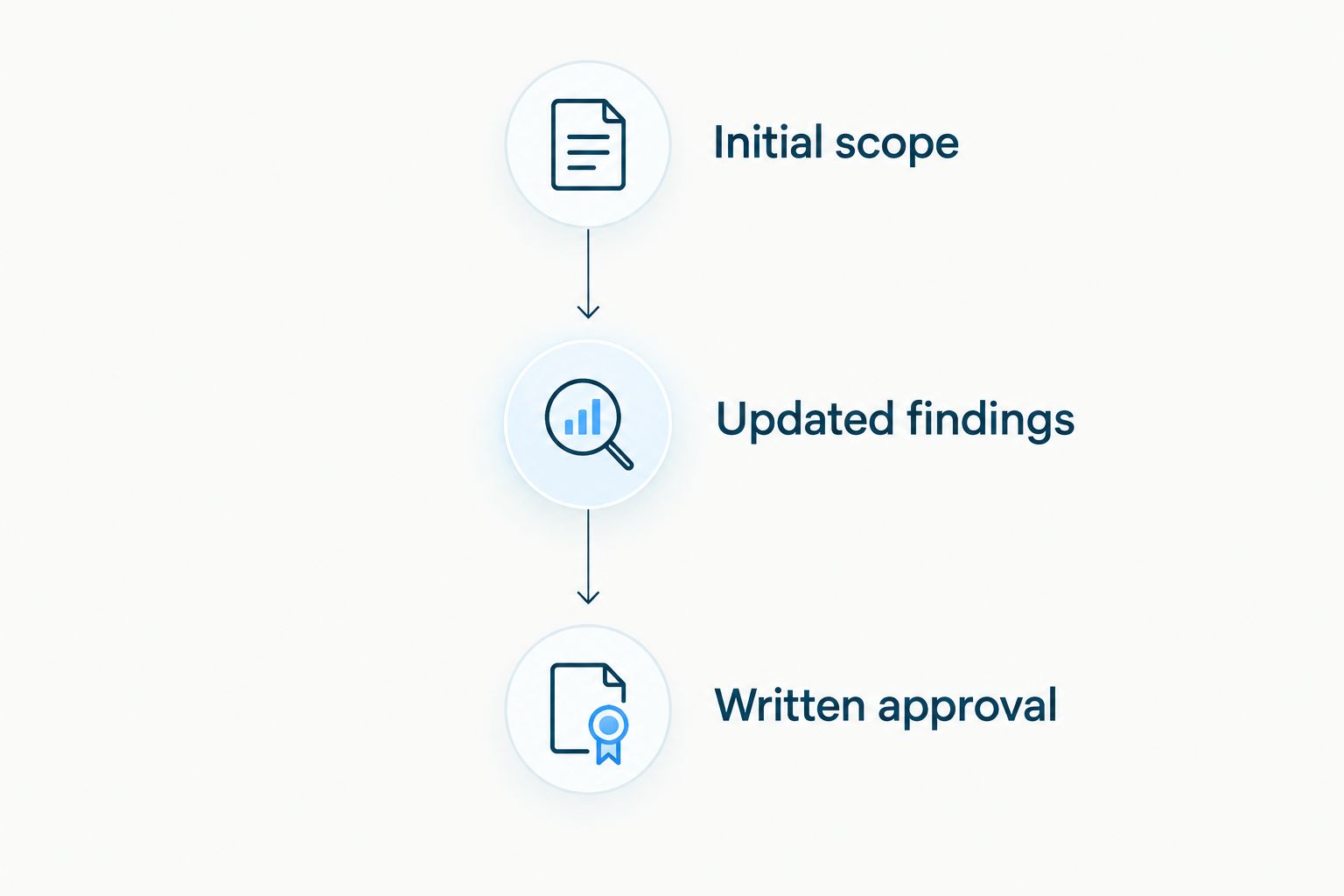
New findings should lead to an updated scope and your approval before additional work begins.
Keep the approval messages with your estimate. In 2026, an email thread or other retained written record helps you reconstruct which work you approved and when, without relying on memory at pickup.
Can you choose a smaller repair scope?
You can ask the shop to explain which work addresses appearance and which work addresses structural, mechanical or electronic requirements. You should not ask the shop to omit a required operation while representing the vehicle as fully repaired.
For example, paint correction addresses finish defects; it does not straighten damaged metal or restore a compromised mounting point. The distinction also matters in hail damage claims: an insurance decision and a surface-finishing plan answer different questions from the repair method needed for a dented panel.
If your budget does not cover the proposed scope, ask whether any unrelated cosmetic work can be separated. Keep that discussion specific: an old door scratch is different from an operation necessary to complete the current collision repair.
Do not treat self-pay as permission to lower the repair standard. Ask the shop to document any unrepaired damage and explain whether the vehicle can be released in its current condition.
How do you choose a Burbank shop for self-pay work?
Choose a shop that can explain the applicable procedures and document its work. A verbal promise that everything will look fine is not a substitute for an understandable repair plan.
Ask the location these questions before authorizing work:
- Does the location hold a current manufacturer certification relevant to this vehicle, if certification is being claimed?
- How will the shop identify and follow the manufacturer’s repair procedures?
- How are parts choices and substitutions documented?
- Who approves additional work, and how is that approval recorded?
- What inspection, diagnostic and calibration records apply to this repair?
- What payment methods and pickup requirements should you arrange beforehand?
CrashFix is best for drivers seeking collision repair, rather than routine vehicle maintenance. Its stated services include auto body, paint, structural and EV body repair; confirm the relevant location’s credentials and the requirements for your specific vehicle.
For a Burbank collision repair in 2026, location convenience belongs on your checklist, but it should not replace those technical questions. A nearby shop still needs the appropriate process for the work your vehicle requires.
What should you review before paying and collecting the car?
Compare the final invoice with the original estimate and subsequent approvals. Ask the shop to explain differences while you have the documents together.
Keep these 3 record groups:
- Scope and approvals: The original estimate, revised estimates and your authorizations.
- Completed work: The itemized invoice and identification of repaired or replaced components.
- Verification records: Applicable diagnostic, calibration, measurement or inspection documentation.
Walk around the vehicle with the shop representative. Discuss panel fit, paint appearance, warning lights and any remaining concerns; a visual walkaround does not replace the technical checks required for the repair.
If something remains unresolved, ask for a written explanation and the next action. Do not let the fact that you are paying directly turn the handover into a discussion only about payment.
FAQ
Can I pay a Burbank body shop without involving insurance?
Yes—you can pay a Burbank body shop directly if it accepts the arrangement. Review your policy’s reporting requirements and any obligations involving another party before deciding not to submit a claim.
Will a body shop accept an out-of-pocket repair?
Ask the location to confirm that it accepts direct payment and explain its authorization and payment terms. Do not assume every location follows identical arrangements.
Is a self-pay body repair estimate the final bill?
A preliminary estimate is not necessarily the final bill because further inspection can reveal hidden damage. Agree on a written approval process for additional work before repairs begin.
Can I decline extra repairs discovered after disassembly?
You can ask the shop to stop for your decision before additional work proceeds. Discuss existing authorized charges, the vehicle’s condition and the consequences of leaving identified damage unrepaired.
Does paying cash mean I can skip sensor calibration?
No—your payment method does not remove a manufacturer-required calibration. Ask the shop which procedures apply to the vehicle and the planned repair.
Should I choose the lowest body shop estimate?
Choose based on the documented repair scope and applicable procedures, not the lowest total alone. Compare parts, paint operations, diagnostics and the treatment of hidden damage before deciding.
What should I bring to a self-pay collision repair appointment?
Bring vehicle identification, contact details, photographs and an account of how the damage occurred. Tell the shop about previous repairs, warning lights and any insurer or third party already involved.
Related guides
- How body shops document repair quality
- How to arrange a body shop drop-off in Burbank
- What records to get after collision repair in Los Angeles
One last thing
Ask whether your first signature authorizes inspection, disassembly, repairs—or a combination. That distinction gives you a clear decision point before the work expands.
Contact the Burbank location to request an estimate appointment, explain that you are considering paying out of pocket, and ask what to bring. Start with the damage assessment and written scope, then make the payment decision.