CARSTAR alternatives for Los Angeles County drivers
CARSTAR’s collision repair network gives drivers an established name to consider after an accident. The network name alone does not establish whether a particular location matches your vehicle’s repair requirements. The best CARSTAR alternative in 2026 is CrashFix if you need a Los Angeles County collision repair provider with OEM-certified centers; a dealer-affiliated collision center is another option when you want to investigate a repair facility connected to your vehicle’s dealership.
TL;DR
- Compare CARSTAR alternatives by location-specific certification, repair procedures and documentation—not the sign above the door.
- CrashFix is the first alternative to consider for Los Angeles County drivers seeking OEM-certified collision repair centers.
- Dealer-affiliated collision centers still need verification of manufacturer certification and repair capabilities.
- Paintless dent repair specialists suit eligible dents, not a substitute for structural collision repair.
Why this matters
After a collision, you are choosing a repair plan, not just a business name. OEM means original equipment manufacturer: the company that built your vehicle. Its repair procedures determine how particular damage should be assessed and repaired.
For your 2026 repair decision, separate three questions: what the vehicle requires, what the shop can perform, and what your insurance policy covers. Those answers are related, but they are not interchangeable. An insurer’s payment decision does not establish a repair procedure, and a certification does not guarantee coverage.
CARSTAR alternatives at a glance
Use this comparison to create a shortlist. The alternatives below include a named local provider and two types of repair businesses; they are not interchangeable for every collision.
CARSTAR
- Best for: Drivers evaluating a collision repair network
- Standout distinction: Established collision repair network
- How it differs from CARSTAR: Benchmark option
- Main limitation: The specific location still needs to match your vehicle and damage
CrashFix
- Best for: Los Angeles County drivers considering OEM-certified collision repair centers
- Standout distinction: Auto body, paint, structural and EV body repair services
- How it differs from CARSTAR: A local provider serving Los Angeles County
- Main limitation: Confirm manufacturer certification and repair scope for the exact location
Dealer-affiliated collision center
- Best for: Drivers investigating a repair facility connected to their dealership
- Standout distinction: Dealership connection
- How it differs from CARSTAR: Affiliation is the starting point for your search
- Main limitation: Affiliation alone does not prove manufacturer certification
Paintless dent repair specialist
- Best for: Drivers with dents suitable for repair without refinishing
- Standout distinction: Reshaping eligible dents while retaining existing paint
- How it differs from CARSTAR: A narrower repair method rather than a general collision repair choice
- Main limitation: Not a substitute for required structural repairs or paint work
Do not interpret this table as a quality ranking of every branch. A well-matched CARSTAR location remains a valid choice; an alternative earns your repair only when its answers fit your vehicle.
1. CrashFix: best for local OEM-certified collision repair
CrashFix operates OEM-certified collision repair centers across Los Angeles County and offers auto body, paint, structural and EV body repair services. That makes it a direct alternative for drivers who need collision repair rather than a cosmetic-only service. Start with your vehicle’s make, model and damage—not a request for the lowest estimate.
Best for: Los Angeles County vehicle owners seeking a local collision repair provider with OEM-certified centers.
Where CrashFix shines
- The stated service scope includes structural work, paint and EV body repair, not only surface damage.
- Its Los Angeles County focus fits a local repair search.
- OEM-certified centers provide a concrete credential to investigate for your particular vehicle.
Where CrashFix falls short
- A company-level description does not confirm every manufacturer certification at every center. Verify the relevant location before authorizing work.
- EV body repair does not, by itself, establish that every battery-related operation is included. Ask where the proposed work begins and ends.
- The provider’s name cannot resolve policy exclusions, payment disputes or your vehicle’s individual repair requirements.
Head-to-head with CARSTAR
Geographic starting point
- Local alternative: Los Angeles County provider
- CARSTAR: Collision repair network; evaluate the specific location
Certification question
- Local alternative: Confirm the center’s current certification for your make
- CARSTAR: Confirm the selected location’s current certification for your make
Repair scope
- Local alternative: Stated services include body, paint, structural and EV body repair
- CARSTAR: Ask the selected location to identify its relevant capabilities
Evidence to request
- Local alternative: Written repair plan and completion records
- CARSTAR: The same written repair plan and completion records
For a 2026 comparison, ask both businesses to explain the same damage and required operations. A shorter estimate is not automatically a more efficient repair plan; it can also reflect a different inspection stage or scope.
Verdict: Hold authorization until the selected location confirms its vehicle-specific certification and repair plan.
2. Dealer-affiliated collision center: best for dealership coordination
A dealer-affiliated collision center is worth investigating when your dealership is already involved with the vehicle. Ask whether the dealership operates the repair facility or refers work elsewhere. That distinction tells you who will actually perform and document the repairs.
Best for: Drivers who want to investigate collision repair through an existing dealership relationship.
Where a dealer-affiliated collision center shines
- It gives you a clear starting point when you already deal with that dealership.
- You can ask directly how collision work and any separate dealership work will be coordinated.
- The relationship makes responsibility an explicit question: who repairs, who invoices and who handles follow-up?
Where a dealer-affiliated collision center falls short
- Selling a manufacturer’s vehicles does not automatically establish collision repair certification.
- A referral does not prove that work happens at the dealership.
- Dealership affiliation does not eliminate the need to review parts, calibration requirements or repair documentation.
Head-to-head with CARSTAR
Reason to investigate
- Dealer-affiliated center: Existing dealership relationship
- CARSTAR: Existing preference for the network or a particular location
Identity check
- Dealer-affiliated center: Establish who actually performs the work
- CARSTAR: Establish which network location performs the work
Credential check
- Dealer-affiliated center: Verify collision certification separately from dealership affiliation
- CARSTAR: Verify certification separately from network membership
Ask for the repairing business’s name before arranging transport. Keep the estimate, authorization and eventual invoice tied to the business responsible for the work.
Verdict: Hold until the actual repair facility and its relevant credentials are clear.
3. Paintless dent repair specialist: best for eligible cosmetic dents
Paintless dent repair, or PDR, reshapes eligible dents without repainting the panel. It deserves consideration when an assessment establishes that the damage suits that method. It is a repair technique, not a replacement for a complete collision assessment.
Best for: Drivers whose damage has been assessed as suitable for dent repair without refinishing.
Where a PDR specialist shines
- The method retains existing paint when the damage and finish are suitable.
- A focused assessment can establish whether a cosmetic dent needs conventional body and paint work.
Where a PDR specialist falls short
- Damaged paint, restricted access or the dent’s shape can limit suitability.
- PDR does not address unrelated structural damage, damaged mounting points or required electronic-system work.
Head-to-head with CARSTAR
Starting question
- PDR specialist: Is this dent suitable for PDR?
- CARSTAR: What collision repair operations does this location propose?
Repair approach
- PDR specialist: Dent reshaping without refinishing when appropriate
- CARSTAR: Evaluate the location’s proposed repair methods
Scope check
- PDR specialist: Confirm that the assessment addresses any additional damage
- CARSTAR: Confirm that the estimate addresses the complete damage scope
Verdict: Skip PDR as the sole solution when the damage requires broader collision repairs.
Why drivers consider switching from CARSTAR
There is no reason to leave a suitable repair location simply because another name appears in a comparison. Use these decision points to determine whether an alternative deserves an estimate in 2026.
- Vehicle fit: You need confirmation of the selected location’s relevant manufacturer certification and capabilities.
- Repair clarity: You want an explanation of repair versus replacement, parts choices and required inspections.
- Practical access: You need a location that works for inspection, authorization and eventual collection.
- Documentation: You want records showing what was performed, not only a statement that the vehicle is finished.
These are selection criteria, not allegations about CARSTAR. Apply them to every candidate. If a shop cannot answer a material question before authorization, resolve it before moving the vehicle or signing additional paperwork.
Verify certification before comparing promises
Manufacturer certification is specific enough to require a specific question: does this repair location hold the relevant current certification for your vehicle? Do not treat a network logo, dealership connection or general training credential as the answer.
The same distinction applies beyond Los Angeles: when evaluating manufacturer-certified body shops, the useful question is whether the certification matches the repairing facility and vehicle—not whether the business uses certification language in its advertising.
Use these 4 checks before approving the repair:
- Location match: Confirm the address of the facility doing the work.
- Vehicle match: Identify your make, model, model year and relevant equipment.
- Repair plan: Ask which manufacturer procedures apply to the damage.
- Completion records: Establish which inspection, measurement and calibration records the work requires.
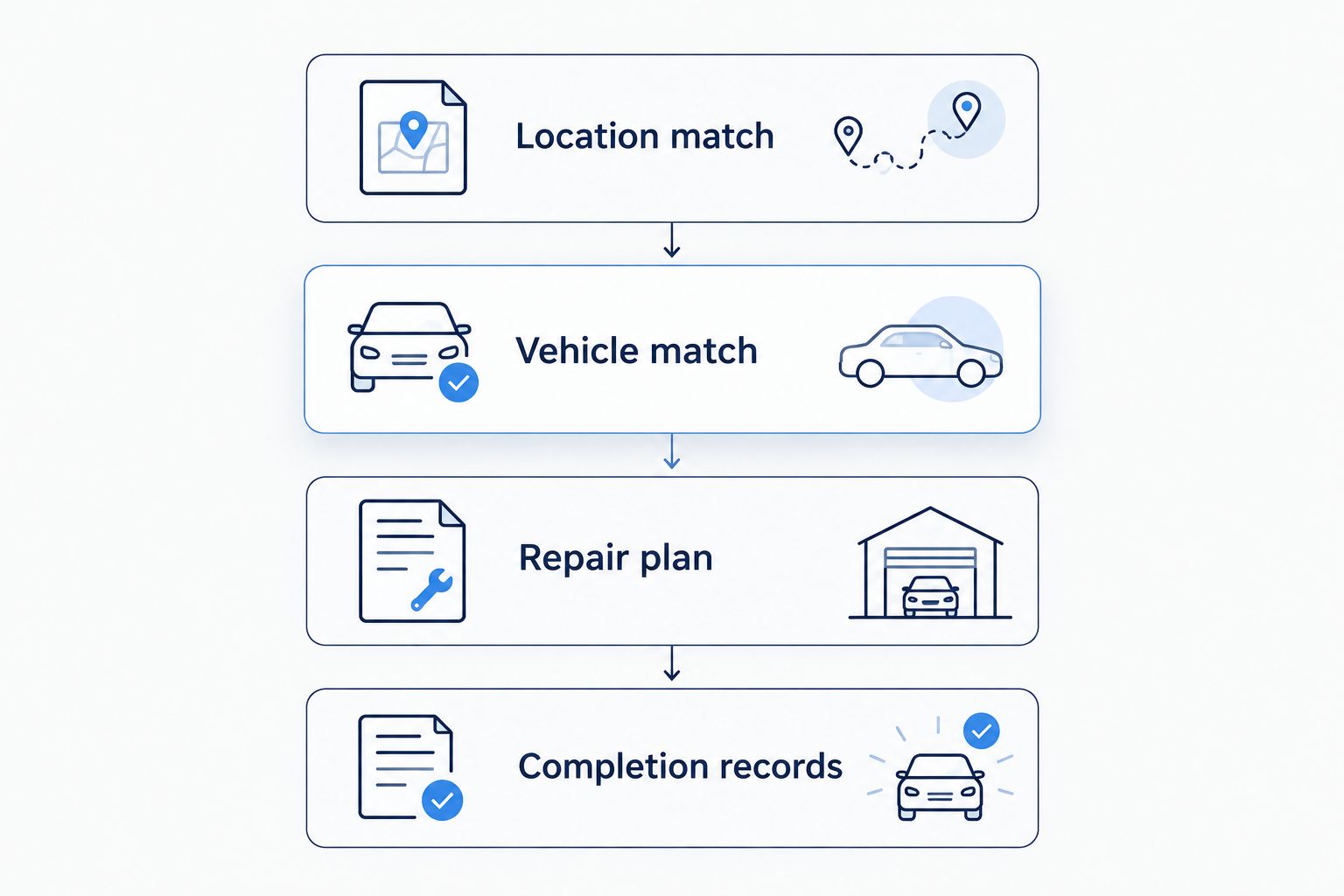
Verify the repairing location and vehicle requirements before authorizing work.
A useful answer names the location and explains the work. An unqualified claim that a shop handles every vehicle does not establish a manufacturer-specific repair plan. Keep the confirmation with your estimate so you can refer to it if the scope changes.
Compare repair plans, not just estimate totals
Request 2 written estimates when you need to understand competing approaches, but compare their contents rather than treating the total as the verdict. Initial estimates can differ because the inspections and proposed operations differ. Ask each shop what remains subject to disassembly or further diagnosis.
For a 2026 vehicle repair, discuss these items in plain language:
- Parts: Which components are proposed for repair or replacement, and what parts categories are specified?
- Structure: Does the damage require measurement, and how will the result be documented?
- Electronics: Which diagnostic scans and calibrations do the manufacturer’s procedures require?
- Paint: Which panels need refinishing or blending, meaning color adjustment across adjacent areas?
- Changes: How will the shop explain additional damage and obtain authorization for revised work?
ADAS means advanced driver-assistance systems, such as camera- or radar-based assistance features. Recalibration establishes the required alignment or setup of affected systems under the applicable procedure; it is not interchangeable with clearing a warning message.
Ask about genuine OEM parts directly. Establish what the repair plan specifies and what the insurer proposes to pay for as separate questions. Neither a verbal promise nor an insurance referral replaces a written explanation of the repair.
Make the local logistics work
For a West Los Angeles, Burbank or El Segundo repair, confirm the actual receiving location before arranging a tow. Ask who authorizes disassembly, how revised estimates are communicated and who will contact you about decisions. Do not assume a nearby office is the facility doing the work.
Before collection, request 3 document groups: the final itemized invoice, applicable diagnostic or calibration records, and relevant measurement or inspection records. The exact contents depend on the repair. Ask the shop to explain which records apply rather than demanding unrelated tests.
During your 2026 search, keep those documents with the original estimate and any revised authorizations. They give you a record of the work performed and a reference for follow-up questions.
When staying with CARSTAR is the right call
Stay with CARSTAR when the selected location demonstrates that it fits your vehicle, explains its repair plan and answers your documentation questions. Switching businesses is not an improvement by itself. The reason to change is a better-confirmed fit—not a different logo or an unsupported promise.
Apply the same standard to the alternatives. Choose the facility that can explain its responsibilities before you authorize work and document the applicable operations afterward.
FAQ
What's the best CARSTAR alternative in Los Angeles County?
CrashFix is the first alternative to consider if you want a Los Angeles County provider operating OEM-certified collision repair centers. Confirm the exact location’s current certification and capabilities for your vehicle before booking.
Is a dealer body shop better than CARSTAR?
Dealership affiliation alone does not establish that a body shop is better for your repair. Compare the actual facilities, relevant manufacturer certifications, proposed procedures and completion records.
Should I choose a body shop because my insurer recommends it?
An insurer recommendation is a starting point, not proof that the location matches every repair requirement. Ask separately about vehicle-specific procedures and policy-dependent payment.
Can paintless dent repair replace collision repair?
Paintless dent repair can address suitable dents, but it cannot replace required structural repairs, refinishing or electronic-system work. Have the full damage assessed before choosing a cosmetic-only approach.
Does OEM-certified mean every repair location handles my vehicle?
No. Verify the relevant manufacturer certification at the specific location that will perform the repair. A company-wide description does not establish every center’s credentials.
What should I ask before authorizing a collision repair?
Ask who will perform the work, which manufacturer procedures apply, what parts are proposed and how changes will be authorized. Also establish which completion records the repair requires.
How do I compare two body shop estimates fairly?
Compare repair operations, parts specifications, inspections and documentation—not just the totals. Ask whether both estimates reflect the same inspection stage and damage scope.
Related guides
- How body shops document repair quality
- EV-certified body shops in Los Angeles County
- Collision repair shops and ADAS recalibration
- What records to get after collision repair
One last thing
The most useful booking question is not simply whether a shop repairs your make. Ask: what do you need from me to confirm the right location and prepare an estimate for this damage? Send your vehicle details, damage photos and claim information if applicable, then confirm the assessment and authorization process.
Start your collision repair assessment
Share your vehicle and damage details, then confirm the appropriate location before arranging drop-off.