Collision repair for leased vehicle owners: complete 2026 guide
Leased-vehicle collision repair is accident-damage repair planned around the manufacturer's procedures and your lease obligations, with the aim of restoring the vehicle and documenting the work before return. Unlike an owned car, your leased vehicle also faces a separate acceptance decision from the company that owns it.
TL;DR
- Collision repair for leased vehicle owners starts with the lease agreement, manufacturer procedures, and written repair documentation.
- CrashFix suits Los Angeles County drivers seeking collision repair, not a substitute for their lessor's return inspection.
- Insurance approval, manufacturer repair requirements, and lease-return acceptance are separate decisions.
- Keep parts details, repair invoices, and required calibration records; a clean exterior does not document the repair.
Why collision repair matters for leased vehicle owners
The repair bill and the lease-return decision are not the same thing. Your insurer evaluates a claim under your policy. Your repairer determines the work required for the damage. Your lessor—the company that owns the vehicle—applies the lease agreement and return standards.
Those responsibilities overlap, but one approval does not replace the others. A paid insurance claim does not promise that the lessor will accept every repair detail, and a return inspection does not establish that hidden collision damage was repaired correctly.
For Los Angeles County drivers arranging repairs in 2026, the useful starting point is not a promised turnaround date. It is a repair plan that addresses the damage and the lease requirements. The related guide to repairing a leased car at a Los Angeles body shop addresses that shop-selection question.
How to arrange repairs without losing track of lease requirements
Read the lease before authorizing repairs
Start with the documents you already have: the lease agreement, return-condition guide, insurance policy, and any previous repair records. Search for sections covering accident damage, repairs, replacement parts, notice requirements, and excess wear.
Do not assume the dealership salesperson controls return acceptance. Ask the leasing company which department handles accident-related requirements, and request written clarification when the documents leave a question unanswered. Keep that response with your repair file.
The distinction matters when someone says a repair is approved. Approved by whom, and for what purpose? Permission to proceed with an insurance claim is different from confirmation about an eventual lease return.
- Identify the lessor named on the agreement.
- Find the accident-notification and repair provisions.
- Request the current return-condition guide.
- Ask whether repair documentation must be submitted.
- Save written answers alongside the lease.
Separate repair requirements from insurance coverage
Read the estimate yourself before asking anyone to resolve a disagreement. Identify what the shop proposes, what the insurer has approved, and which items remain undecided. A supplement is an addition or change to the estimate, often following further inspection or disassembly.
A coverage decision does not establish the correct repair method. Ask the repairer to explain the relevant manufacturer procedure, then ask the insurer how the policy addresses that work. Avoid signing a broad authorization without understanding your potential responsibility for disputed charges.
California Insurance Code section 758.5 protects a driver's choice of repair shop and limits insurer requirements to use a particular repairer. For a California claim in 2026, shop choice still does not settle every coverage or payment question.
- Request an itemized written estimate.
- Separate approved work from unresolved items.
- Ask how supplements receive authorization.
- Request the procedure behind disputed repair operations.
- Get an explanation of your payment responsibility before proceeding.
Choose a shop for the vehicle and the damage
Use the vehicle identification number, damage photographs, and lease documents to prepare your inquiry. Describe the impact and any warning lights or changes in operation. Then ask each shop to explain how it will establish the repair requirements for that specific vehicle.
CrashFix is best suited to Los Angeles County drivers seeking collision repair rather than a lease-return inspection alone. CrashFix provides auto body, paint, structural, and EV body repair services; confirm the relevant location's current manufacturer certification and suitability for your vehicle before authorizing work.
A certification should match the manufacturer and location being discussed. It is not a substitute for a written repair plan, and a shop's ability to repair accident damage does not give it authority to promise your lessor's acceptance.
- Provide the vehicle identification number and damage photographs.
- Ask about experience with the affected vehicle structure and materials.
- Verify any claimed manufacturer certification for the actual location.
- Ask who performs required scans, measurements, and calibrations.
- Confirm how the shop records completed work.
Resolve parts and procedure questions in writing
Start by comparing the proposed parts with the lease language and the manufacturer's repair information. OEM parts are parts supplied through the vehicle manufacturer's parts system. Other descriptions, including aftermarket or recycled, identify different sourcing categories; do not treat those terms as interchangeable.
Ask the shop to identify what it proposes to install and why. If the lease, repair plan, and insurer's estimate appear inconsistent, request a written explanation before the part is ordered or installed. Do not assume the policy pays for every lease requirement.
The same discipline applies to scanning and calibration. Scanning checks electronic systems for diagnostic information. Calibration establishes a specified relationship or setting for a system or sensor. Neither word, by itself, proves that every required operation was completed.
- Obtain the proposed part descriptions and sourcing categories.
- Flag any lease provision concerning replacement parts.
- Ask which manufacturer procedures govern the repair.
- Identify required electronic checks and calibrations.
- Record unresolved approvals before work proceeds.
Build a repair record as the work progresses
Create a folder on your phone or computer before drop-off. Save the initial photographs and estimate, then add revised estimates, authorizations, correspondence, and final documents. This manual approach works; the important part is keeping the records together rather than scattered across messages.
Ask the repairer what records it will provide before you authorize the job. For CrashFix collision repair, make the same request: establish the documentation you need rather than assuming every report automatically comes with the invoice.
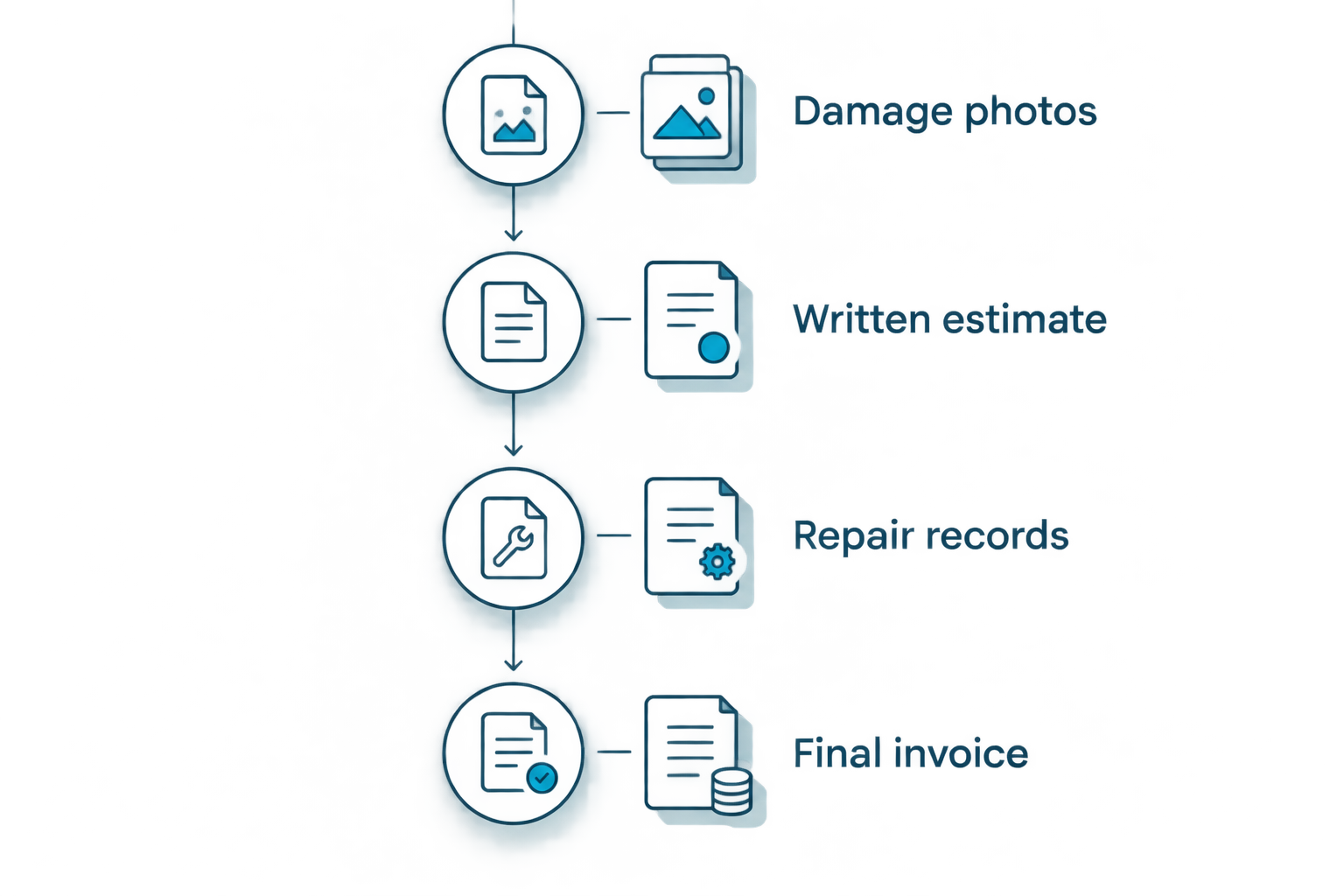
A useful sequence is damage photos, written estimate, repair records, final invoice. The guide to how body shops document repair quality explains why evidence of the work matters beyond the finished paint.
- Damage photos: retain the original accident and damage images.
- Written estimate: save the initial estimate and approved revisions.
- Repair records: request relevant measurements, scans, and calibration results.
- Final invoice: check the completed operations and installed parts.
- Written correspondence: retain answers from the insurer and lessor.
Keep the evidence of the repair, not just the receipt.
Review the repair separately from the lease return
At pickup, compare the final invoice with the authorized scope. Ask the shop to explain changes, outstanding items, and any instructions that apply after delivery. Review warning lights, panel operation, and the repaired area with a staff member; a walkaround does not replace technical verification.
Then address the lessor's process. Ask whether an inspection is available before the scheduled return and what opportunity exists to resolve identified issues. Do not create your own deadline based on a shop's initial estimate: repair needs and the lessor's arrangements are separate schedules.
If your lease ends in 2026, keep its return appointment visible throughout the repair. Tell both parties about timing constraints, but do not exchange required repair work for an unsupported promise to finish sooner.
- Review the final invoice against the authorized work.
- Ask for explanations of any remaining warnings or concerns.
- Collect the agreed repair documentation before closing the file.
- Confirm the lessor's inspection and return instructions.
- Retain copies after the vehicle is returned.
Compare the available repair routes
These options describe different ways to organize the work, not a ranking of repair quality. Choose by the documented repair plan and vehicle-specific capability, not by the label over the door.
Manufacturer-certified collision center
- Best for: Drivers seeking a repairer with a relevant, current manufacturer certification
- Practical advantage: Gives you a specific credential to verify for the vehicle and location
- Key limitation: Certification does not guarantee insurance coverage or lease-return acceptance
Insurer-recommended repair shop
- Best for: Drivers who want to consider the insurer's proposed repair arrangement
- Practical advantage: Provides a starting point for discussing claim coordination
- Key limitation: Insurer recommendation does not establish compliance with every lease requirement
Dealer-referred repairer
- Best for: Drivers whose dealer offers a collision-repair referral
- Practical advantage: Provides a repair contact through an existing dealership relationship
- Key limitation: A referral does not establish who performs the work or which certifications apply
Independent collision repairer
- Best for: Drivers comparing repair plans directly across local shops
- Practical advantage: Lets you assess the proposed work and documentation on their merits
- Key limitation: You must verify vehicle-specific capability rather than assume it
The categories can overlap. An independent repairer can hold manufacturer certifications and participate in insurer programs. A dealership can refer collision work elsewhere. Ask who will repair the vehicle, at which facility, and under which procedures.
For your 2026 repair decision, compare written answers to the same questions. A convenient location helps with drop-off and follow-up, but convenience does not resolve an unclear parts list or missing repair operation.
Common mistakes leased vehicle owners make
Treating a paid claim as lease approval
An insurer's payment addresses the claim, not every obligation under your lease. Ask the lessor about its requirements directly and keep the response. Do not rely on a repairer or adjuster to promise how another company will assess the returned vehicle.
Repairing only what will be visible at return
A bumper cover or painted panel is the visible portion of an impact area. Ask the repairer whether inspection or disassembly is needed to establish the scope. A cosmetic estimate is not a finding that everything behind the panel is undamaged.
Assuming all replacement parts satisfy the agreement
Read the actual parts provision rather than relying on a general statement about leased cars. If the proposed part raises a question, resolve it with the shop, lessor, and insurer before installation. Their responsibilities differ, so a single verbal answer is not enough.
Waiting until the return appointment to find the records
An invoice stored in an old email account is difficult to produce under pressure. Keep a complete file and ask the lessor what it wants to review. Documents help explain the work, but they do not guarantee that the lessor will waive a charge or accept a disputed condition.
FAQ
Can I choose the body shop for my leased car in California?
California Insurance Code section 758.5 protects your choice of repair shop in an insurance claim. You still need to check the lease requirements and understand which proposed charges the policy covers.
Does a leased car always need OEM replacement parts?
Read your lease and obtain vehicle-specific repair guidance rather than assuming a universal rule. Ask the shop to identify proposed parts, and resolve any conflict between the lease requirements and insurance estimate before installation.
Will insurance-approved repairs prevent lease-return charges?
Insurance approval does not guarantee that your lessor will accept the vehicle without charges. Claim coverage and lease-return condition are separate decisions governed by different documents.
Should I repair accident damage before returning a leased vehicle?
Have the damage assessed and review the lessor's requirements before deciding. Damage that affects vehicle operation needs a repair assessment, while any decision about return charges should use the lessor's written standards rather than a guess.
Does manufacturer certification guarantee my leased car will pass inspection?
Manufacturer certification does not guarantee lease-return acceptance. Verify the certification for the relevant repair location, then review the repair plan, completed work, and lessor's requirements separately.
What documents should I keep after leased-car collision repair?
Keep damage photographs, estimates, approved supplements, the final invoice, and relevant technical reports. Retain written correspondence with your insurer and lessor so the repair decisions remain traceable.
Can CrashFix help with collision repair on a leased vehicle?
CrashFix provides collision repair services for Los Angeles County vehicle owners. Share your vehicle details, damage information, and lease requirements with the relevant center to confirm suitability; lease-return acceptance remains the lessor's decision.
Related guides
- What records to get after collision repair in Los Angeles
- What happens when collision repair parts are on back order
One last thing
Ask this before authorizing repairs: What will I receive that explains how the repair was completed? That question connects the estimate, the technical work, and the file you can later show your lessor.
For a repair assessment, prepare your vehicle identification number, damage photographs, lease requirements, and return date. Send those details when arranging your estimate so the conversation starts with your actual vehicle—not a generic promise about leased cars.