How do you keep old damage separate on a new repair estimate?
Keep old damage separate on a new auto body repair estimate by identifying it before repairs, photographing it, and labeling each repair operation as related to the current collision, pre-existing, or unresolved. Ask for unrelated repairs on a separate estimate or clearly separated customer-authorized section; when old and new damage overlap, request a written explanation rather than an unsupported allocation.
TL;DR
- An auto body repair estimate should distinguish current collision damage, pre-existing damage, and unresolved findings.
- Photograph the affected panel before repairs and retain earlier photos, estimates, and invoices.
- Shared repair work needs a written explanation, not an unsupported split between claims.
- Crashfix serves Los Angeles County drivers seeking collision repair after an accident.
How do you keep old damage separate on a new repair estimate?
Separate the evidence, repair scope, and authorization—not just the totals. A note saying that a vehicle has prior damage does not explain which repairs belong to the current accident.
For your 2026 repair file, keep the inspection photos, estimate versions, and written approvals together. The same documentation principles used to document repair quality help you distinguish existing conditions from newly discovered damage.
- Identify existing damage. Tell the estimator about known dents, scratches, previous repairs, and unrepaired collision damage. Point to the exact location rather than describing an entire side as damaged.
- Photograph the condition. Capture the whole affected area and close-up details before work begins. Preserve original files and any earlier photos showing the same panel.
- Label the repair scope. Ask which operations address the current collision, which address unrelated damage, and which remain uncertain pending inspection.
- Explain overlapping work. If both conditions affect the same panel, request an explanation of shared labor, refinishing, or replacement work. Do not assume each condition requires an independent full repair operation.
- Separate permission to proceed. Put optional old-damage repairs in a distinct written scope. Confirm what you authorize and what remains subject to inspection or insurance review.
Keep 3 photo views for each disputed area: the whole panel, a close-up, and a wider view showing its position on the vehicle. This is a practical documentation checklist, not a method for proving when damage occurred.
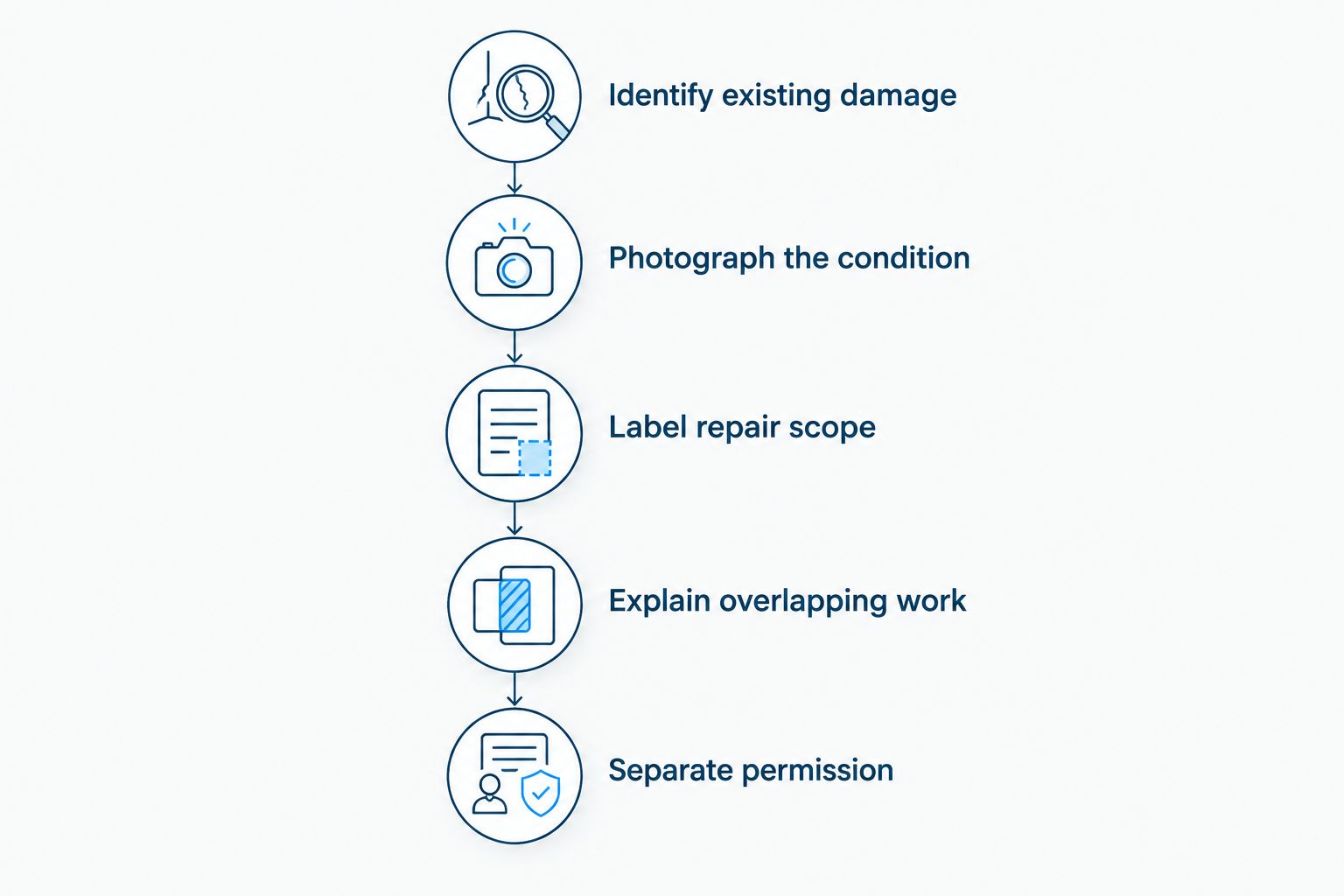
Separate the evidence and repair scope before authorizing unrelated work.
Why this matters
Your auto body repair estimate describes proposed work. Your insurance policy and claim review determine coverage; a repair line does not establish payment responsibility by itself.
Without clear separation, you can misunderstand which repairs you approved or expect an insurer to address an unrelated condition. You can also overlook a repair operation that the current collision genuinely requires because an adjacent panel already had a scratch.
Old damage should neither disappear into the new claim nor automatically exclude necessary collision work. Ask the estimator to explain the relationship between the observed condition and the proposed repair.
For Los Angeles County drivers, that conversation belongs before drop-off whenever the condition is visible. Whether you arrange repairs in West Los Angeles, Burbank, or El Segundo, keep the same written record with the vehicle.
What should each damage category show?
Use clear categories rather than one vague notation covering the entire vehicle. The table below is a checklist for discussing the estimate, not a coverage determination.
Current collision damage
- Best for: Work attributed to the new accident
- What the estimate should explain: Affected area, proposed operation, and supporting observations
- Limitation: Initial inspection does not reveal every hidden condition
Pre-existing damage
- Best for: Known unrelated dents, scratches, or previous damage
- What the estimate should explain: Exact location and whether repair is excluded or separately requested
- Limitation: An older mark does not establish the scope of damage beneath it
Unresolved findings
- Best for: Conditions needing further inspection
- What the estimate should explain: What is uncertain and what inspection is needed
- Limitation: Neither repair scope nor payment responsibility is settled
Shared repair operations
- Best for: Old and new damage affecting the same repair area
- What the estimate should explain: Why work overlaps and how the estimate treats that overlap
- Limitation: A simple percentage split does not explain the repair method
A labeled estimate makes questions easier to resolve, but labels need supporting observations. Ask for photos or notes tied to the affected panel instead of accepting a broad description such as prior damage throughout.
What belongs in the old-damage notes?
Identify the panel, location, visible condition, and source of any history. Distinguish what you know from what you suspect.
For example, you can identify a previously photographed bumper scuff without claiming to know the condition of the reinforcement behind it. If you do not know when a dent happened, say so. An honest unknown is more useful than an invented accident history.
What if old and new damage affect the same panel?
The same panel can contain unrelated cosmetic damage and damage from the current accident. Separating those conditions does not always mean separating every repair operation.
Suppose an old scratch and a new dent affect a door. Ask whether the proposed work addresses the dent, the scratch, or both, and whether refinishing operations overlap. The repair method must follow the applicable manufacturer procedures and the actual condition—not a convenient accounting split.
A separate estimate is best for unrelated work you can independently accept or decline. Its advantage is clear authorization; its limitation is that shared operations still need explanation so the scopes do not duplicate work.
Separately labeled sections in one document are best for reviewing connected work together. Their advantage is context; their limitation is that exclusions and customer responsibility become harder to spot if the headings or totals are unclear.
Neither format replaces a repair explanation. Ask the estimator to identify the operation in question and describe why it belongs in that scope.
Why separating old and new damage varies
The difficulty depends on the evidence and the repair relationship, not simply the size of the visible mark. These factors affect how clearly the estimator can separate the work:
- Location: Damage on unrelated panels is easier to describe separately than overlapping conditions on one repair area.
- Earlier documentation: Photos, repair invoices, and previous estimates provide a record of an earlier condition. An earlier estimate alone does not prove that work was completed.
- Previous repairs: Existing filler, coatings, or repaired attachments can affect the proposed method. Inspection must establish the relevant condition.
- Hidden damage: Disassembly can expose conditions that were not visible during the initial estimate. Those findings need their own documentation.
- Shared operations: Panel repair, refinishing, or replacement can address overlapping conditions. The estimate should explain the relationship without duplicating the operation.
- Uncertain history: Missing records limit what can be established about timing. Record the uncertainty rather than treating an assumption as a fact.
Do not use appearance alone to date damage. A photograph records what was visible when it was taken; it does not, by itself, establish the cause of every condition shown.
What records should you bring to the inspection?
Bring records that connect a condition to a vehicle, location, and time. For a 2026 accident, retain the original accident photos alongside any earlier images rather than combining them into an unlabeled album.
Useful records include:
- Earlier photos showing the affected panel before the current accident.
- Photos from the current accident and before repair drop-off.
- Previous estimates identifying work that was proposed.
- Final invoices identifying work recorded as completed.
- Relevant messages about earlier damage or repairs.
- The current claim information and accident description.
Use 2 document groups: earlier condition and current accident. Within each group, label files by panel or location so the estimator can compare the same area without guessing.
Keep original files as well as any annotated copies. Circling a dent can help explain your concern, but do not replace the original image with an edited version.
Can an insurer exclude an entire panel because of an old scratch?
An old scratch does not, by itself, explain whether every proposed operation on that panel is unrelated to the new accident. Ask for the decision to identify the disputed work and its supporting reason.
The useful question is not whether the panel had any prior damage. It is which repair operations the current collision requires and how pre-existing conditions affect that scope. Coverage remains dependent on the policy and claim review.
If you disagree, request a written explanation and provide the relevant photos or prior records. Keep the repair discussion separate from payment approval: manufacturer-required work and insurance reimbursement are different questions.
What happens if old damage appears during disassembly?
Newly discovered damage should be photographed and evaluated before it is assigned to the current collision or treated as unrelated. Ask for the revised repair scope and an explanation of what changed.
A supplement is an update to an existing estimate. It can document additional findings, but the supplement itself does not prove when damage happened or guarantee insurer approval.
For a 2026 supplement, retain the initial estimate and each revision rather than replacing the earlier copy. Ask which added operations address the current collision, which concern existing conditions, and what authorization is needed before additional work proceeds.
How should you review the estimate before signing?
Review the scope line by line with the estimator. Do not sign based only on the final total. A clear total cannot correct an unclear description of the work.
Ask these questions:
- Which damage is attributed to this accident?
- Where is unrelated damage documented?
- What remains uncertain until inspection or disassembly?
- Does any repair operation appear in both scopes?
- Which optional repairs am I authorizing?
- What happens if the repair plan changes?
Also ask how manufacturer procedures affect the repair plan, including parts, inspections, and calibration when applicable. Genuine-part requirements, repair methods, and payment decisions need specific discussion rather than assumptions based on a shop's general credentials.
Crashfix is best suited to Los Angeles County vehicle owners seeking collision repair after an accident. For an auto body repair estimate at Crashfix, explain your known damage history and ask how the relevant location will document separate scopes; confirm any vehicle-specific certification directly.
FAQ
Should I tell the body shop about damage that was already there?
Yes. Identify known pre-existing damage before the inspection and provide earlier photos or repair records. Tell the estimator when the history is uncertain rather than guessing.
Can I get an auto body repair estimate without repairing the old damage?
Ask for the auto body repair estimate to exclude unrelated work or place it in a separately authorized scope. If an existing condition affects the proposed repair method, request an explanation before deciding.
Does a photo prove a dent happened in the latest accident?
A photo alone does not prove when a dent happened. Earlier and current photos help document changes, while the repair assessment must address the condition and its relationship to the collision.
Can old and new damage appear on the same estimate?
Yes, but old and new damage should be clearly distinguished. Separate sections must identify the proposed work and authorization without presenting unrelated repairs as part of the current collision.
What should I do if the estimate includes damage I do not recognize?
Ask the estimator to show you the condition and explain the proposed operation. Request photos and a written clarification before authorizing disputed work.
Will insurance pay to fix an old scratch on a newly damaged bumper?
Payment for an old scratch depends on the policy and claim review; do not assume it is included. Ask how the proposed bumper repair addresses the current damage and whether any operations overlap.
Should I keep every revised repair estimate?
Yes. Keep the initial estimate, supplements, photos, and written approvals together so you can follow changes in the repair scope. Retain the final invoice separately from estimates of proposed work.
Related guides
- Getting an estimate before deciding to file a claim
- Records to request after collision repair in Los Angeles
- Arranging a body shop drop-off in Burbank
One last thing
Separating damage does not always mean separating physical work. Two distinct conditions can affect the same repair operation; what matters is an explanation that makes the scope and authorization clear without counting the work twice.
Before arranging your 2026 inspection with Crashfix, gather your earlier photos, current accident photos, and previous repair records. Ask the relevant location to document known old damage at intake and explain overlapping work before you authorize repairs.