What happens to a Tesla's charging port after a rear-side impact?
A rear-side impact near a Tesla’s charging port can damage the port door, mounting area, electrical connections, or surrounding body structure; a dent alone does not establish which parts need repair. Do not plug in a visibly damaged charging port or use successful charging as proof that the collision caused no hidden damage.
TL;DR
- A Tesla charging port needs inspection after a nearby impact, even when the door still opens.
- For a tesla body shop los angeles search, prioritize model-specific repair procedures over a cosmetic estimate.
- Crashfix offers EV body repair; confirm Tesla-specific qualifications and electrical assessment arrangements before booking.
- Do not force a damaged port door, straighten connector contacts, or test a visibly damaged inlet yourself.
What happens to a Tesla’s charging port after a rear-side impact?
The outcome depends on where the impact landed and how force traveled through the surrounding panels. Damage can remain outside the charging inlet, or it can extend behind the visible opening into mounts, wiring, and adjacent structure. Neither the size of the dent nor the absence of a dashboard warning settles that question.
Your repair estimate should separate visible damage from findings that require inspection behind the panel. Ask for photographs and written explanations, not just a replacement-parts list. This guide to how body shops document repair quality explains the records to request.
Scraped or dented port door
- What the shop needs to establish: Whether the door, hinge, surrounding opening, and inlet remain undamaged and correctly aligned
- What you should not assume: A cosmetic-looking mark means the inlet is unaffected
Door will not open or close normally
- What the shop needs to establish: Whether body movement, mechanical damage, or an electrical fault explains the problem
- What you should not assume: Forcing the door will solve it
Cracked, shifted, or exposed inlet
- What the shop needs to establish: The condition of the inlet, its mounts, nearby wiring, and protective components
- What you should not assume: A charging attempt is an appropriate owner test
Distorted surrounding panel
- What the shop needs to establish: Whether damage extends behind the panel or changes the port’s mounting position
- What you should not assume: Repainting the panel completes the repair
Charging fault after impact
- What the shop needs to establish: Whether collision damage, charging equipment, or another condition explains the fault
- What you should not assume: The charging port is automatically the only failed component
Why this matters
A charging port is an electrical connection mounted within a body opening. Collision repair therefore needs to address both the surrounding metal or panel assembly and the charging components—not treat them as unrelated jobs.
For a 2026 repair, ask the shop to identify the applicable manufacturer procedure for your exact vehicle before authorizing work. Model, configuration, and build details matter more than a general statement that the shop repairs electric vehicles.
A charging session proves that charging occurred; it does not verify the condition of every collision-damaged component. Your release paperwork should explain what was inspected, repaired, and checked afterward.
If only the charging-port door looks damaged
The outer door can be scratched, bent, or displaced without proving that the inlet itself needs replacement. That distinction matters: replacing every nearby component without findings is not a substitute for diagnosis.
Ask the estimator to explain whether the door moves normally, whether the opening has shifted, and whether inspection reveals damage beneath it. A door that rubs against the surrounding panel needs an explanation, not simply adjustment until it appears to close.
The benefit of a localized repair is that it addresses the damaged area without assuming unrelated parts have failed. Its limitation is visibility: an exterior inspection alone cannot establish the condition of components hidden behind the opening.
Best next step: Have the shop document the door, surrounding panel, and inlet condition before deciding the repair scope. Do not pry the door open or push a displaced assembly back into place yourself.
If the inlet or mounting area is damaged
The inlet is the socket where the charging connector attaches. Cracks, displacement, exposed components, or damage to the connection area require qualified assessment before another charging attempt.
The mounting area matters because the surrounding bodywork supports the assembly. An inlet that appears intact can still sit incorrectly if its supports or the adjacent panel have moved. Correcting the exterior appearance does not, by itself, establish that the mounting area meets repair requirements.
Ask which components require replacement, which can remain, and what manufacturer information supports that decision. Request genuine replacement parts where specified, with the part description recorded on the estimate; do not accept a vague line item that conceals what will actually be installed.
Best next step: Arrange inspection rather than attempting an electrical test yourself. Replacing a damaged inlet addresses that component, but the repair plan must still account for surrounding collision damage.
If charging stops working after the collision
A charging failure after an impact needs diagnosis, not an automatic charging-port replacement. The inlet, related wiring, vehicle controls, and charging equipment are different parts of the charging process.
Save any warning messages and describe when they appeared. Tell the shop whether the problem began immediately after impact, whether a connector was attached during the collision, and whether anyone attempted charging afterward.
Do not repeatedly reconnect a charger to reproduce the fault. Give the technician the history and let the assessment determine appropriate testing.
For your 2026 repair file, keep the initial fault description separate from the eventual diagnosis. That distinction preserves what you observed without presenting an unconfirmed explanation as a fact.
Best next step: Request a documented diagnosis before approving component replacement. A fault message is useful evidence, but it is not a complete repair plan.
Why charging-port damage varies
Several factors change what the shop needs to inspect:
- Impact location: A strike directly against the charging opening presents a different inspection problem from damage farther along the quarter panel.
- Panel movement: Distortion around the opening can affect alignment and support even when the inlet’s face looks intact.
- Vehicle configuration: The applicable repair instructions depend on the specific Tesla, not just the badge.
- Connector involvement: A collision while a charging connector is attached can involve the connector, inlet, and their attachment points.
- Visible exposure: Cracks, exposed wiring, or displaced components change the precautions needed before assessment.
- Observed faults: Warning messages and changes in door operation or charging behavior help guide diagnosis, without proving the cause.
The repair requirement and the insurance decision remain separate. An insurer’s initial estimate does not establish that every hidden component has been inspected, and a repair recommendation does not guarantee policy coverage.
What should you do before moving or charging the car?
Do not charge a visibly damaged inlet, and do not handle exposed electrical components. If the vehicle is smoking, producing unusual heat, or showing signs of fire, move away and contact emergency services. Do not remain beside it to photograph the damage.
For a vehicle without those immediate warning signs, use this sequence:
- Record symptoms. From a safe position, photograph the impact area and save dashboard warnings. Do not remove trim to improve the view.
- Avoid charging. Leave a visibly damaged port alone. Do not insert tools, straighten contacts, or force its door.
- Arrange assessment. Tell the repair facility where the impact occurred and describe any charging-related symptoms before drop-off.
- Confirm transport. If roadworthiness is uncertain, arrange appropriate transport and tell the operator the vehicle is an EV with collision damage.
- Request records. Ask for the inspection findings, repair scope, and checks required before release.
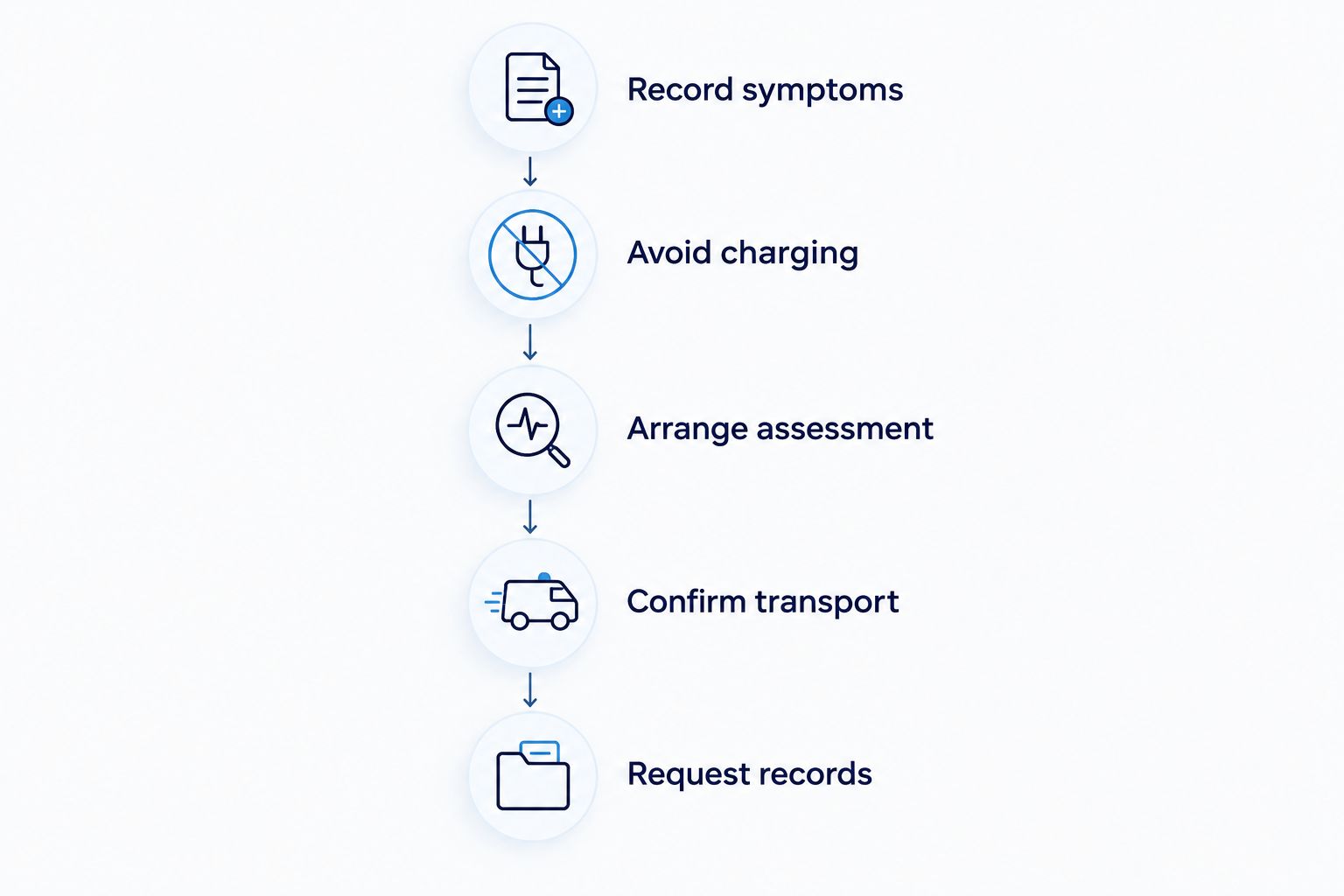
Document the damage without turning an owner charging attempt into a diagnostic test.
Being able to drive does not establish that charging is appropriate, and a charging fault alone does not establish whether the car can be driven. Ask for separate guidance on vehicle movement and charging based on the actual damage.
How do you choose a Tesla body shop in Los Angeles?
If your search is “tesla body shop los angeles,” look beyond the search listing. Ask who will assess the charging system, who will perform the body repair, and how the work will follow the applicable manufacturer procedures.
Crashfix is a fit for Los Angeles County vehicle owners seeking collision and EV body repair. Its stated services include body, paint, structural, and EV body repair; that does not establish Tesla-specific certification for every location or every repair operation.
Before selecting a West Los Angeles, Burbank, or El Segundo facility, ask:
- Can this location confirm its current qualifications for the specific Tesla repair?
- Who performs any required high-voltage assessment, and where does that work happen?
- How will the estimate distinguish the outer door, inlet, mounting area, and surrounding panel?
- Which manufacturer repair instructions determine replacement and verification requirements?
- How will the shop document parts, additional damage, and completed checks?
The advantage of a collision facility offering EV body repair is relevant service scope. The limitation is that a service description alone does not confirm the personnel, equipment, or manufacturer recognition needed for your particular job.
For a 2026 booking, verify those details with the location handling your vehicle. Start with Crashfix and describe the impact before agreeing to drop-off arrangements.
What should the estimate and handover records include?
The estimate should identify the damaged area in plain language. Ask the shop to distinguish confirmed damage from components that still require inspection; an initial estimate is not the same as a completed diagnosis.
Look for a clear explanation of the proposed body repairs, charging-related work, parts, and any outside specialist involvement. If inspection reveals additional damage, request an updated explanation before authorizing added work.
At handover, ask what checks were required by the repair procedure and how the shop recorded their results. A diagnostic scan reads information from vehicle systems; it does not replace physical inspection, and a charging check does not replace the rest of the repair verification.
Keep the 2026 estimate, approvals, photographs, parts records, and final invoice together. These records explain the scope of the work without forcing you to reconstruct the conversation later.
Can I charge my Tesla if the port door still opens?
An opening port door does not establish that the inlet or its mounting area is undamaged. If the impact affected the charging opening, arrange assessment before treating normal door operation as permission to charge.
Does charging-port damage mean the battery needs replacement?
Charging-port damage does not automatically mean the traction battery needs replacement. The shop must assess the actual collision damage and any relevant faults rather than infer battery condition from the port alone.
Will insurance cover the charging-port repair?
Insurance coverage depends on your policy, claim circumstances, and the insurer’s decision. Ask the shop to document the repair requirements separately from coverage discussions, including any additional findings after inspection.
FAQ
Can I plug in my Tesla after a rear-side collision?
Do not plug in a visibly damaged charging inlet or handle exposed components. If the impact affected the charging opening, arrange a qualified assessment before using charging as a test.
What if my Tesla charges normally after the accident?
Normal charging does not establish that the surrounding panel, mounts, or electrical components escaped damage. Have the collision damage inspected rather than relying on a successful charging session.
Can a body shop repair just the charging-port door?
A door-only repair depends on the findings and applicable manufacturer procedures. The shop should establish whether the inlet, mounting area, and surrounding panel also need attention.
Does a charging warning mean I need a new port?
A charging warning does not automatically establish that the port needs replacement. Save the message and request diagnosis before approving a component replacement.
Is Crashfix certified to repair my particular Tesla?
Confirm Tesla-specific certification and repair capability with the location handling your vehicle. Crashfix offers EV body repair, but that service description does not establish Tesla approval for a particular location.
What should I send the shop before an estimate?
Send safely obtained damage photographs, vehicle details, and any warning messages. Describe whether a charging connector was attached during the impact and whether charging behavior changed afterward.
Will a charging-port repair fix all the accident damage?
A charging-port repair addresses only the work identified in its repair scope. The surrounding body structure and any other affected systems need their own inspection and documented repair decisions.
One last thing
Before booking, ask the estimator to distinguish three things: damage already confirmed, areas still awaiting inspection, and checks required before release. That request is more useful than asking whether the car will “charge fine afterward.”
For a 2026 Crashfix estimate, provide your vehicle details, impact photographs, and warning messages, then ask the receiving location to confirm its Tesla-specific assessment arrangements. Book an assessment built around the damage—not a promise based on the photograph alone.