What should a Hyundai repair plan include after a side impact?
A Hyundai repair plan after a side impact should identify hidden damage, specify repairs using the applicable manufacturer procedures, and document required structural, restraint-system, diagnostic, and driver-assistance checks. It should also list parts, explain repair-versus-replacement decisions, and define the records you receive at delivery. Insurance approval and the vehicle’s repair requirements are separate questions; ask the shop to explain both before authorizing work.
TL;DR
- A hyundai certified body shop should build the repair plan around your vehicle’s manufacturer procedures, not visible damage alone.
- Side-impact assessment should address affected doors, pillars, rocker panels, restraints, wiring, and equipment-specific safety checks.
- Crashfix serves Los Angeles County collision repair customers; verify Hyundai certification for the specific repair location.
- Request an itemized plan, documented changes, and final inspection records before collecting your Hyundai.
What should a Hyundai repair plan include after a side impact?
Your repair plan should connect each damaged area to a repair method and a final verification step. A line for replacing a door is not enough if the impact also affected its opening, nearby wiring, or restraint components. This guide to how body shops document repair quality explains the evidence to request.
Use this 7-step checklist when reviewing a repair plan in 2026:
- Vehicle identification. Record the VIN, equipment, impact location, and reported symptoms so the shop uses procedures for your actual Hyundai.
- Damage assessment. Inspect the struck area and adjacent components, with disassembly where needed to expose concealed damage.
- Structural evaluation. Assess affected pillars, rocker panels, floor areas, and attachment points; document measurements where the repair requires them.
- Repair methods. Identify which components need repair or replacement and the applicable manufacturer instructions.
- Parts selection. Identify replacement parts and distinguish genuine manufacturer parts from other proposed categories.
- System checks. Address restraints, diagnostics, wiring, and any driver-assistance or high-voltage procedures applicable to the damage and equipment.
- Final verification. Specify inspections, required scans or calibrations, functional checks, and the records supplied at handover.
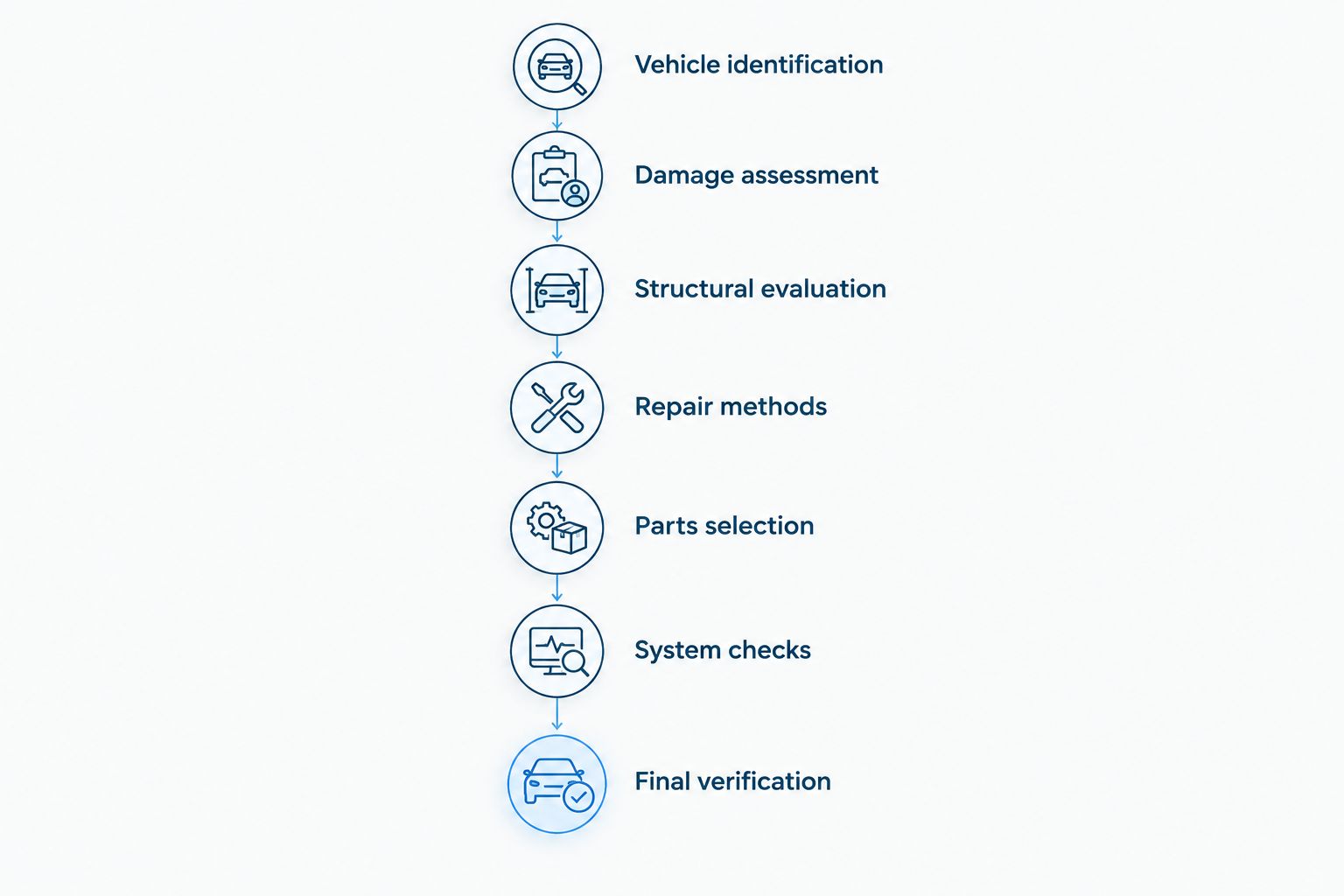
Each repair decision should lead to a defined verification step.
Why this matters after a side impact
The visible dent does not establish the full repair scope. A side impact can affect components behind trim or within a door opening, so the plan must address what inspection reveals rather than assume the damage is cosmetic.
For a Los Angeles County driver comparing shops in 2026, the useful distinction is not a short estimate versus a long estimate. It is whether the shop can explain what it inspected, which procedures apply, and how it will verify the completed work. Ask for that explanation before treating an estimate as a complete repair plan.
Damage assessment: Look beyond the outer door panel
Tell the estimator where the vehicle was struck and what changed afterward. A door that catches, a window that no longer operates, a warning light, or new wind noise gives the shop a specific condition to investigate. Do not force a jammed door or repeatedly operate damaged equipment to demonstrate the problem.
The assessment should distinguish visible observations from findings that require disassembly. Ask whether the shop has inspected the door’s internal components, hinges, latch, wiring, and surrounding opening, as relevant to the impact. Photographs should make the findings understandable without requiring you to interpret repair terminology.
A supplement is an update to the estimate when additional work is identified. If the initial inspection leaves concealed areas unexamined, ask how the shop will document discoveries, notify you, and obtain any necessary authorization. An estimate prepared in 2026 still needs a clear process for changes; a polished document does not eliminate hidden damage.
Structural repairs: Require a method, not a vague description
Pillars are the upright body structures around door openings; the rocker panel runs beneath the doors. Damage in these areas deserves a specific explanation of whether it affects the vehicle’s structure and what inspection or measurement supports the proposed repair.
Ask the estimator to explain terms such as sectioning, which means replacing part of a component at a permitted location rather than replacing the entire component. Whether sectioning, straightening, or replacement is appropriate depends on the applicable manufacturer procedure and the damaged material. Do not accept a general assurance that every pillar can be repaired the same way.
When structural work is required, the plan should identify the relevant attachment methods and restoration of disturbed corrosion protection. You do not need to audit welding instructions yourself. You do need a shop that can connect its proposed method to the instructions for your vehicle.
How different damage findings change the plan
These are assessment outcomes, not repair packages you select by preference. The inspection determines which scope applies.
Localized panel repair
- Best for: Damage confirmed as suitable for repair
- What the plan should address: Panel condition, repair method, finish work, adjacent functions
- Limitation: Exterior appearance alone cannot establish suitability
Door replacement
- Best for: A door requiring replacement under the applicable procedure
- What the plan should address: Replacement part, transferred components, fit, wiring, glass and latch operation
- Limitation: Replacing the door does not resolve damage to its opening
Structural repair
- Best for: Damage involving structural components
- What the plan should address: Measurements where required, permitted repair locations, attachment methods, corrosion protection
- Limitation: Requires more than a cosmetic inspection
Choose the repair scope supported by the inspection, not the shortest list of operations. Ask the estimator to identify the finding that makes each proposed repair appropriate.
Parts and refinishing: Make the choices explicit
A repair plan should name the parts being replaced and identify their category. OEM means original equipment manufacturer; genuine Hyundai replacement parts should be identified as such rather than described only as replacement parts. Do not assume a certification label establishes every parts choice on your estimate.
If different part categories appear in the proposal, ask how they fit the manufacturer’s requirements for the repair. Discuss any difference between your preferred parts and the insurer’s payment position before work proceeds. Coverage is governed by the claim and policy, not by a general promise from a repair shop.
Refinishing also deserves a clear scope. Ask which panels will receive paint work, whether adjacent-panel blending is proposed, and how disturbed sealers or protective coatings will be restored. Blending extends color into an adjoining area to manage the transition; it is not the same operation as repairing damage to that panel.
Restraints, diagnostics, and driver-assistance checks
Side-impact planning should address affected restraint components, including airbags and seat-belt systems, according to the vehicle’s procedures. Tell the shop about any deployment or warning message. An undeployed airbag does not, by itself, establish that every restraint component is unaffected.
Ask which diagnostic scans the repair requires and how the shop will handle relevant fault findings. A scan reads electronic diagnostic information; it does not replace physical inspection. Likewise, clearing a fault code is not an explanation of what caused it or what repair resolved it.
ADAS means advanced driver-assistance systems. If affected equipment or repair operations trigger a manufacturer calibration requirement, the plan should identify that requirement and the resulting documentation. Calibration checks or adjusts a system against specified references; it is not simply switching a warning light off.
For an electric Hyundai, ask whether the impact requires high-voltage precautions or inspection of battery-related areas. Do not assume every side impact damages the battery, and do not assume an undamaged exterior rules out the need for assessment. Let the vehicle-specific procedure and findings determine the work.
Why a Hyundai side-impact repair plan varies
Two vehicles with similar-looking dents can need different operations. The following 6 factors explain why the written scope must be vehicle-specific:
- Vehicle identity and equipment: The VIN and installed systems determine which information applies.
- Impact location: Damage centered on a door differs from damage extending into a pillar, rocker, or wheel area.
- Concealed findings: Disassembly can reveal damage that exterior photographs do not show.
- Material and repair restrictions: The affected component’s construction and manufacturer instructions determine permitted methods.
- Restraint and electronic involvement: Damaged components, warning messages, and affected sensors require investigation.
- Condition of adjacent components: Glass, hinges, latches, wiring, trim, and seals can change the repair scope.
Ask the shop to separate these repair drivers from claim administration. An insurer’s request for additional documentation is not a technical reason to omit a required repair operation.
How do you verify a Hyundai certified body shop?
When choosing a hyundai certified body shop in 2026, ask for confirmation that the specific facility holds current Hyundai certification. A business operating several locations should identify the location performing your repair; credentials should not be assumed to transfer between addresses.
Crashfix is suited to Los Angeles County drivers seeking collision repair after an accident. For a Hyundai repair, confirm the selected location’s Hyundai certification, the proposed parts, and the manufacturer procedures before booking. The company’s general OEM-certified positioning is not a substitute for that location-specific confirmation.
If you are arranging a Burbank drop-off, ask where assessment and repair will occur and who will explain changes to the plan. Drivers in West Los Angeles or El Segundo should ask the same practical questions rather than treating proximity as proof of the required credentials.
What should you receive before collecting your Hyundai?
Request 3 record groups: the final itemized repair order, applicable diagnostic or calibration results, and relevant inspection or measurement documentation. Each group serves a different purpose. Together, they explain what was done and how the completed work was checked.
Your handover should also cover the original symptoms you reported. Ask the shop to demonstrate affected door, window, mirror, and lock functions where applicable, and explain any unresolved issue before you accept the vehicle. A clean finish is not a substitute for functional verification.
Keep the records with your vehicle history after a repair completed in 2026. This guide to records to get after collision repair helps you organize the handover documents.
FAQ
What should a Hyundai repair plan include after a side impact?
A Hyundai side-impact repair plan should include damage assessment, applicable manufacturer repair methods, parts identification, required system checks, and final verification records. It should distinguish confirmed findings from areas still awaiting inspection.
Does every Hyundai side impact require structural repair?
No, structural repair depends on the damage findings and applicable manufacturer procedures. A damaged outer panel does not by itself establish whether the underlying structure needs repair.
Should I choose a hyundai certified body shop for a damaged door?
Verify current Hyundai certification at the specific shop and ask how it will follow the procedures for your vehicle. A damaged door still requires assessment of its opening, attachments, and affected systems.
Does an undeployed side airbag mean the restraint system is fine?
No, an undeployed side airbag does not establish that the entire restraint system is unaffected. The shop should assess relevant components and follow the vehicle’s inspection requirements.
Will insurance pay for genuine Hyundai replacement parts?
Payment for genuine Hyundai replacement parts depends on the policy and claim decision. Ask the shop to identify proposed parts and explain any payment disagreement before authorizing the work.
Does a side-impact repair always need ADAS calibration?
No, ADAS calibration depends on the vehicle’s equipment, affected components, repair operations, and manufacturer instructions. Ask the shop to identify the requirement rather than promise or dismiss calibration automatically.
Can Crashfix assess my Hyundai after a side impact?
Crashfix offers collision and auto body repair in Los Angeles County. Before booking, confirm the selected location’s Hyundai certification and discuss the assessment needed for your vehicle.
What should I ask if the estimate changes after disassembly?
Ask which newly discovered damage changed the estimate, what additional operations are proposed, and what authorization is required. Request photographs and an updated written scope so you can understand the change.
Related guides
- Arranging a body shop drop-off in Burbank
- Repairing a leased car at a Los Angeles body shop
- Arranging pickup with an auto body shop
One last thing
Bring a symptom list, not just photographs. Note which door stopped closing normally, which warning appeared, and whether a window or lock changed after the impact. That gives the estimator specific conditions to investigate alongside the visible damage.
Before booking your 2026 assessment with Crashfix, have your VIN, accident photos, and claim details ready. Ask the selected location to confirm Hyundai certification and explain how you will receive the written repair plan.
Arrange your collision repair assessment
Discuss your Hyundai’s side-impact damage and confirm the repair location’s credentials before booking.