What should a repair estimate include for child seat replacement?
An auto body repair estimate should document each child restraint involved in the crash, the manufacturer’s replacement instructions, the supporting records, and whether replacement is being handled on the estimate or through a separate claim request. It should distinguish the removable child seat from damage to the vehicle’s seat belts, anchors, seats, or mounting structure; a replacement recommendation does not guarantee insurance reimbursement.
TL;DR
- An auto body repair estimate should separate child seat replacement from vehicle restraint-system repairs.
- NHTSA’s minor-crash exception requires all five conditions; always follow the child seat manufacturer’s instructions.
- CrashFix serves Los Angeles County drivers seeking OEM-certified collision repair; confirm child seat documentation when arranging an estimate.
- Keep seat labels, crash photos, manufacturer instructions, and reimbursement correspondence together.
What should a repair estimate include for child seat replacement?
Ask for a written record that identifies the restraint, explains the replacement decision, and shows who handles the next step. A vague note saying child seat involved leaves too much unresolved: it does not identify the seat, establish the applicable instructions, or confirm whether the insurer has received the request.
When arranging an estimate with CrashFix, tell the estimator about every child restraint that was in the vehicle. Include unoccupied restraints and any detachable base that was installed during the collision.
For your 2026 repair file, use this checklist:
Restraint identification
- What the record should show: Manufacturer, model, manufacture date, and readable label photographs
- Why it matters: Connects the replacement decision to the correct instructions
Crash involvement
- What the record should show: Seat position, occupancy, installed base, and relevant crash details
- Why it matters: Establishes what was present during the collision
Replacement basis
- What the record should show: Applicable manufacturer instructions and documented crash facts
- Why it matters: Explains why replacement is required or why further review is needed
Claim handling
- What the record should show: Whether the restraint appears on the estimate or a separate reimbursement request
- Why it matters: Prevents the request from disappearing between the shop and insurer
Vehicle inspection
- What the record should show: Findings involving belts, anchors, seat assemblies, and mounting areas
- Why it matters: Keeps vehicle repairs separate from replacing the removable restraint
Supporting documents
- What the record should show: Photos, receipts if available, correspondence, and replacement documentation
- Why it matters: Gives the claim reviewer an organized record
Do not treat a missing child-seat line as proof that replacement is unnecessary. Ask whether it is being documented elsewhere and request that record.
Why this matters
A body repair estimate and a child-seat replacement request answer different questions. The estimate describes vehicle damage and proposed repair work; the restraint decision depends on the seat manufacturer’s instructions and the circumstances of the collision.
That distinction matters whether you are dropping off a vehicle in West Los Angeles, Burbank, or El Segundo. A repaired bumper does not establish that a child restraint can be reused, and a new restraint does not resolve damage to the vehicle’s anchorage points.
For a 2026 claim, keep both decisions visible in writing. You need a documented basis for the restraint decision and a separate record of any vehicle repair requirements.
Document the child seat before it leaves your possession
Start with identification, not a replacement purchase. The manufacturer’s label connects your seat to its instructions, and those instructions should guide the decision after a collision.
Use these steps to build the record:
- Identify the restraint. Photograph the manufacturer, model, manufacture-date label, and serial number where present. Record each restraint separately rather than grouping multiple seats under one description.
- Record crash involvement. Note where the restraint was installed, whether a child occupied it, and whether a detachable base was in the vehicle. Preserve relevant photographs and the collision report if available.
- Find the instructions. Check the manual for that exact model and contact the manufacturer if the crash-replacement language is unclear. Keep the response or the applicable manual section.
- Confirm claim handling. Ask the estimator and adjuster whether the seat belongs on the repair estimate or in a separate request. Get the answer in writing.
- Keep the records. Retain receipts, label photos, and correspondence. Before disposal, ask what documentation the insurer needs and follow the manufacturer’s disposal instructions.
The 5-step record above is an administrative checklist, not a test of whether a seat remains usable. You still need the manufacturer’s crash instructions.
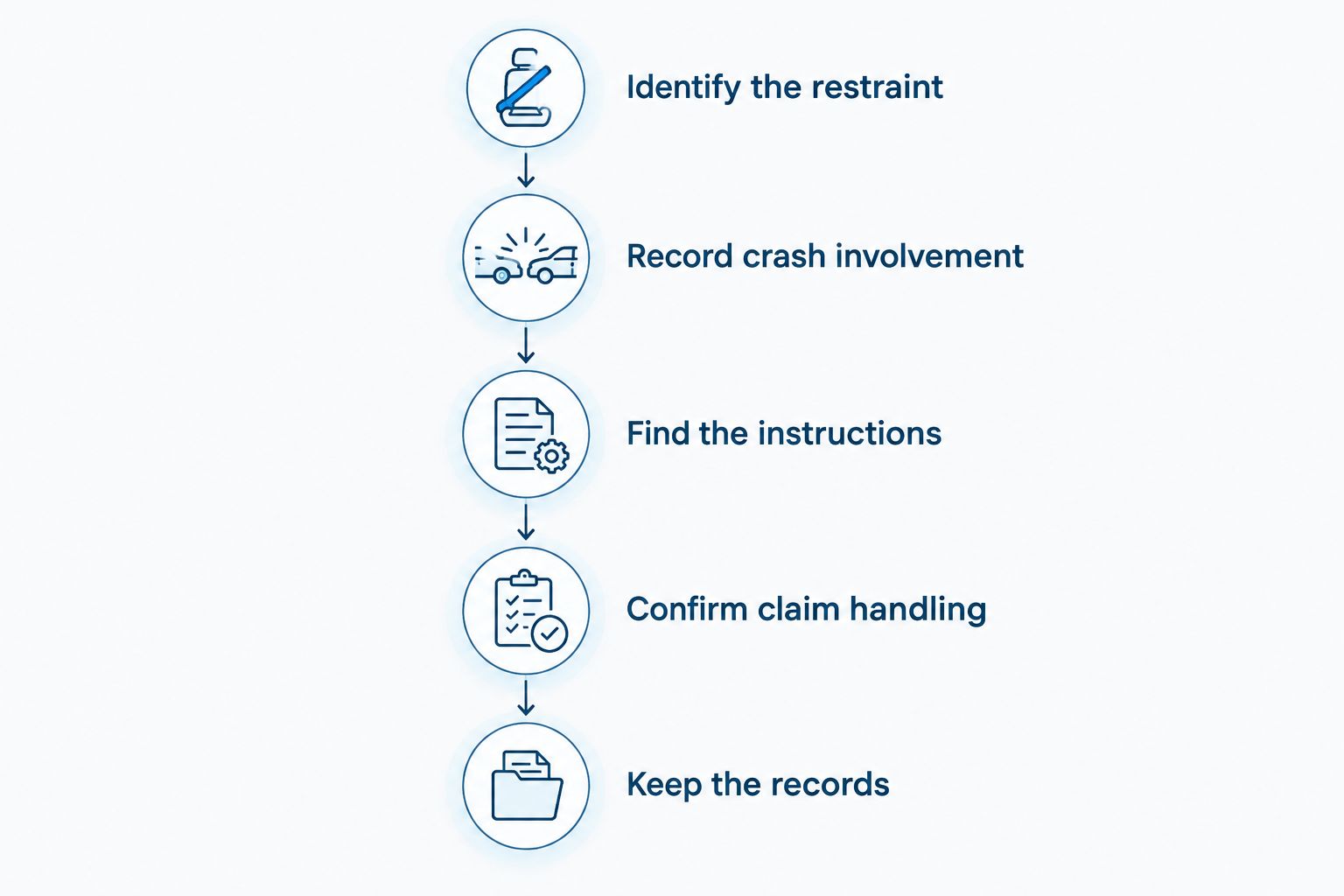
Document the restraint and its instructions before closing out the replacement request.
When does a child seat need replacement after a crash?
The National Highway Traffic Safety Administration recommends replacing child restraints following a moderate or severe crash. NHTSA allows an exception after a minor crash only when every condition in its minor-crash checklist is satisfied, and it directs families to follow the restraint manufacturer’s instructions.
For your 2026 review, use NHTSA’s guidance as a checklist—not as permission to disregard a manufacturer that requires replacement after any crash. Some manufacturers use stricter replacement instructions.
What are NHTSA’s five minor-crash conditions?
NHTSA’s child-seat reuse guidance defines a minor crash as one in which all 5 conditions apply:
- The vehicle could be driven away from the crash site.
- The vehicle door nearest the child restraint was not damaged.
- No vehicle occupants were injured.
- The airbags did not deploy.
- There is no visible damage to the child restraint.
If even 1 condition is not met, the collision does not satisfy NHTSA’s minor-crash definition. Passing the checklist still does not override the seat manufacturer’s instructions.
Do not replace this review with a judgment about how hard the crash felt. A small-looking dent, a functioning buckle, or an intact cover cannot establish compliance with the manufacturer’s requirements.
Does an unoccupied child seat still need review?
An unoccupied child seat still needs review under its manufacturer’s crash instructions. Do not assume an empty restraint or installed base is exempt simply because no child was riding in it.
Document the restraint’s location and occupancy accurately. Let the applicable instructions determine the replacement decision rather than leaving an empty seat out of the claim record.
Can a visual inspection prove a crashed seat is safe?
A visual inspection cannot, by itself, establish that a crashed restraint meets its manufacturer’s reuse instructions. Visible damage is only one element of NHTSA’s minor-crash checklist.
Photograph cracks, deformation, or other visible damage without treating their absence as clearance. A collision repair inspection of the vehicle is not certification of the removable child seat.
Separate child seat replacement from vehicle restraint repairs
Child restraints attach to vehicle systems that also need attention after a collision. LATCH means Lower Anchors and Tethers for Children; it refers to vehicle attachment points and corresponding restraint attachments, not the entire child seat.
Ask the estimator to distinguish 3 work categories: the removable child restraint, the vehicle’s belts and anchors, and any surrounding seat or structural damage. Each category needs its own findings and applicable instructions.
Child restraint replacement
- Best for addressing: A restraint that requires replacement under its crash instructions
- What it does not establish: Whether the vehicle’s belts, anchors, or mounting structure are undamaged
Belt and anchor inspection or repair
- Best for addressing: Collision-related concerns involving the vehicle’s restraint attachment systems
- What it does not establish: Whether the removable child seat can be reused
Seat or structural repair
- Best for addressing: Damage involving the seat assembly, mounting points, or surrounding body structure
- What it does not establish: Whether an insurer will reimburse a replacement child restraint
The benefit of separate documentation is clarity: a replacement request cannot accidentally stand in for necessary vehicle repairs. The limitation is equally important—an estimate records proposed work, not a blanket safety guarantee.
If the impact affected the area around a child seat, read about repairing a car seat mounting area. Ask which vehicle manufacturer procedures apply to the findings on your particular vehicle.
CrashFix is best for Los Angeles County drivers seeking OEM-certified collision repair after an accident. Confirm the relevant location’s certification for your vehicle, and keep the child-seat manufacturer’s replacement decision separate from the body repair scope.
Why child seat documentation varies
The right paperwork depends on the restraint, the vehicle, and how the claim is administered. Use the same questions for a 2026 estimate regardless of whether you are paying directly or opening an insurance claim.
- Manufacturer instructions. Different restraint manufacturers have different post-crash replacement rules. Use the instructions for the identified model.
- Crash circumstances. Door damage, injuries, airbag deployment, drivability, and visible restraint damage affect the NHTSA minor-crash review.
- Restraint configuration. A detachable base, multiple installed seats, or different seating positions require clear identification rather than one generic entry.
- Vehicle findings. Damage involving belts, anchors, seats, or surrounding structure belongs in the vehicle repair assessment.
- Claim requirements. The insurer’s documentation and reimbursement process determines what you submit and where the request is handled; it does not replace manufacturer instructions.
You do not need to resolve every issue at the initial appointment. You do need a written next step for anything still undecided, including who will obtain the instructions or submit the replacement request.
What should I ask the estimator and insurance adjuster?
Ask the estimator to explain what the vehicle inspection covers and where the child-seat information will appear. Ask the adjuster what documents are required and whether replacement is being considered under your claim.
Keep these questions practical:
- Is each restraint and installed base identified separately?
- Which manufacturer instructions support the replacement decision?
- Are vehicle belts, anchors, and mounting areas included in the inspection scope where applicable?
- Is the child-seat request on the estimate or handled separately?
- What records must I preserve before disposing of the restraint?
- What remains unresolved, and who is responsible for the next response?
Repair requirements and insurance coverage are separate decisions. A manufacturer’s replacement instruction does not establish policy coverage, and a claim decision does not override that instruction.
If your initial estimate omits an item, request written clarification rather than assuming the item was rejected. Estimates can change as damage is documented, while a child-seat request can remain in a separate claim file.
FAQ
Should my auto body repair estimate list the child seat?
Your auto body repair estimate or associated claim record should identify the child restraint and explain how its replacement request is handled. If the insurer uses a separate reimbursement process, ask for written confirmation rather than assuming the estimate includes it.
Do I replace a car seat after a crash if nobody was sitting in it?
An unoccupied child seat still needs review under its manufacturer’s crash-replacement instructions. Record that it was installed during the collision and check the instructions for the seat and any installed base.
Does no airbag deployment mean I can keep the child seat?
No airbag deployment alone does not establish that a child seat can be reused. It is only one of NHTSA’s five minor-crash conditions, and the restraint manufacturer’s instructions still apply.
Will insurance cover a replacement child seat?
Insurance reimbursement depends on the applicable policy and claim decision. Submit the restraint identification, crash documentation, and manufacturer’s replacement instructions, then request the insurer’s written response.
Should I throw away the crashed car seat before the claim is settled?
Preserve the seat identification and supporting records before disposal, and ask the insurer what evidence it requires. Follow the manufacturer’s disposal instructions and do not pass a restraint requiring replacement to another family.
Does replacing the child seat fix damaged LATCH anchors?
Replacing the child seat does not repair damaged vehicle anchors. The vehicle’s attachment points, belts, seats, and surrounding structure need their own assessment under applicable vehicle manufacturer procedures.
What if I cannot find the original child seat receipt?
Ask the adjuster what alternative documentation is acceptable. Manufacturer labels, model information, photographs, and available purchase records can help identify the restraint, but acceptance depends on the claim requirements.
One last thing
A finished vehicle repair does not automatically close the child-seat question. Before pickup, check that your 2026 repair records show the restraint decision, any vehicle restraint-system work, and any outstanding reimbursement request.
When you arrange an estimate with CrashFix, bring the seat label photos and tell the estimator where every restraint was installed. Ask for a clear separation between vehicle repair work and child-seat replacement documentation.
Related guides
- How body shops document repair quality
- Records to get after collision repair in Los Angeles
- Getting a repair estimate before deciding to file a claim
Bring your restraint records to the estimate appointment and ask the estimator to identify the next step for every unresolved item before you authorize repairs.