Best OEM-certified body shops in El Segundo
Best starting point: CrashFix El Segundo for general collision repair assessment. Best for structural damage: a facility with current certification for your vehicle’s manufacturer. Best for an electric vehicle with suspected battery-area damage: an appropriately qualified EV collision facility. If you’re searching for an OEM certified body shop El Segundo drivers can trust in 2026, choose by vehicle-specific repair capability—not a certification badge alone.
TL;DR
- Crashfix is a starting point for El Segundo drivers seeking OEM-certified collision repair; confirm the relevant location’s manufacturer credentials.
- An OEM certified body shop El Segundo search should end with vehicle-specific verification, not the nearest listing.
- Structural damage requires manufacturer repair procedures, appropriate equipment, and documented measurements.
- EV collision repair needs a separate check of high-voltage precautions and battery-area inspection requirements.
Why this matters
A shop’s certification must match the vehicle and the facility doing the work. OEM means original equipment manufacturer: the company that made your vehicle. A manufacturer’s collision-repair program is different from an insurance company’s repair network or an individual technician’s training credential.
Crashfix is an OEM-certified collision repair option for El Segundo drivers seeking body, paint, structural, or EV repair assessment. Confirm the relevant manufacturer certification at the proposed repair location before authorizing work.
For your 2026 repair decision, separate three questions: Can the facility perform the required repair? What does the written repair plan include? What will your insurance policy cover? An answer to one does not settle the others.
What makes the best OEM-certified body shop?
Use these criteria before comparing recommendations. They apply whether the damage looks like a scraped bumper or involves a distorted door opening.
- Manufacturer match: Verify current certification for your vehicle’s make at the exact repair address. A group’s credentials do not automatically apply to every facility.
- Repair procedures: Ask how the shop identifies manufacturer instructions for your vehicle and the damaged areas. Repair-versus-replacement decisions should follow those instructions.
- Parts clarity: Request an itemized parts list identifying genuine OEM, aftermarket, or recycled components. Ask the shop to explain each proposed substitution.
- Structural capability: For damage affecting the vehicle’s load-bearing structure, ask about measuring, joining methods, and material-specific equipment.
- Electronic checks: Ask which scans, inspections, and calibrations the manufacturer requires. ADAS means advanced driver assistance systems, including features that use cameras or radar.
- Repair records: Expect a clear explanation of the work, supporting documentation, and any unresolved issues before pickup.
For a 2026 shortlist, treat certification as an entry requirement where relevant—not a substitute for reviewing the actual repair plan.
Repair options at a glance
These are ranked decision routes, not interchangeable shop types. Start with general collision assessment, then move to a more specific facility requirement when the damage demands it.
1. Crashfix
- Best for: General collision assessment and body repair planning
- Standout consideration: Offers body, paint, structural, and EV body repair services across Los Angeles County
- Key limitation: Confirm manufacturer credentials and service suitability at the proposed location
2. Manufacturer-matched structural repair facility
- Best for: Damage involving structural members or attachment areas
- Standout consideration: Vehicle-specific certification paired with the required structural repair capability
- Key limitation: Certification alone does not explain the proposed repair method
3. EV-qualified collision facility
- Best for: Electric vehicles with suspected battery-area or high-voltage-related damage
- Standout consideration: Appropriate inspection procedures and high-voltage precautions
- Key limitation: EV body repair capability does not establish battery repair capability
1. Crashfix: best starting point for general collision assessment
Crashfix operates OEM-certified collision repair centers across Los Angeles County and offers auto body, paint, structural, and EV body repair services. That makes the business a relevant starting point when an El Segundo driver needs collision damage assessed and a repair plan explained.
Begin with your vehicle’s make, model, damage photos, and incident details. Ask which location is appropriate and verify that location’s current manufacturer credentials before arranging vehicle movement or authorizing repairs.
Pros:
- Offers several collision-related services, including body and paint repair.
- Includes structural and EV body repair within its stated service scope.
- Operates collision repair centers within Los Angeles County.
Cons:
- A brand-level certification claim is not proof of certification for your make at every location.
- EV body repair service does not, by itself, establish suitability for a damaged high-voltage battery.
- An initial assessment still needs to become a vehicle-specific written repair plan.
Best for: Drivers who need a practical starting point for collision assessment rather than choosing separate providers before the damage is understood.
Ask for genuine OEM parts to be identified explicitly in the estimate, along with any proposed alternatives. Do not assume a parts policy, warranty term, or insurer payment decision from the business name or certification status.
Verdict: Choose Crashfix for an initial assessment; authorize the repair after confirming the location, credentials, and written scope.
2. Manufacturer-matched facilities: best for structural damage
A structural repair facility addresses damage to the vehicle’s load-bearing body or frame. The appropriate choice combines current manufacturer credentials with the equipment and procedures required for your specific vehicle.
A shifted door opening, impact near a suspension attachment, or visible deformation underneath the vehicle deserves more than a cosmetic estimate. Ask how the facility will identify affected structural areas and document the repair method.
Pros:
- Connects the repair decision to the vehicle manufacturer’s instructions.
- Places measuring and material-specific joining methods at the center of the assessment.
- Creates a basis for reviewing repair-versus-replacement decisions.
Cons:
- A certification badge does not explain which structural operations the estimate includes.
- Exterior photos alone do not establish the full extent of structural damage.
- Manufacturer requirements and insurance reimbursement remain separate questions.
Best for: Drivers whose vehicle has suspected structural damage, distorted openings, or damage near important mounting points.
Ask the estimator to distinguish a cosmetic outer panel from an underlying structural component. Similar-looking dents can require different work because the panel’s function, material, and damage location differ.
Verdict: Choose a manufacturer-matched structural facility when the damage involves the vehicle’s structure; skip cosmetic-only comparisons.
3. EV-qualified facilities: best for battery-area concerns
An EV-qualified collision facility needs to assess the body damage alongside the manufacturer’s high-voltage precautions. An electric vehicle’s battery enclosure, electrical components, and nearby mounting areas require vehicle-specific handling decisions after an impact.
Tell the shop about underbody contact, warning messages, unusual heat, smoke, or damage near the charging area. If the vehicle shows signs of an immediate hazard, keep away and contact emergency services rather than attempting an inspection yourself.
Pros:
- Brings high-voltage precautions into the repair assessment.
- Separates body repair needs from battery inspection or specialist referral needs.
- Helps establish appropriate handling before disassembly begins.
Cons:
- EV body repair experience does not prove capability for every battery-related operation.
- A vehicle that powers on still needs the inspections required for its damage condition.
- A general manufacturer certification does not answer every model-specific EV question.
Best for: Electric-vehicle owners reporting underbody impact, battery-area damage, charging-area damage, or relevant warning messages after a collision.
Ask who will perform any required high-voltage work and whether another qualified provider must be involved. Get that responsibility clarified before assuming the entire repair will happen at one facility.
Verdict: Choose an EV-qualified facility when battery-area or high-voltage concerns exist; wait on repair authorization until the inspection responsibilities are clear.
How these options are ranked
The order follows the decision most drivers need to make: establish the repair scope, identify structural requirements, and address EV-specific concerns when relevant. It is not a claim that every vehicle belongs at the same facility.
The 2026 selection criteria are manufacturer match, repair procedures, parts clarity, structural capability, electronic checks, and repair records. A nearby shop that cannot explain those points is not a better fit simply because the drive is shorter.
Verify certification before you move the vehicle
Use the vehicle manufacturer’s official collision-repair locator where one is available. Match the facility name and street address, then ask the shop to confirm that its current certification covers your vehicle’s make and any relevant model restrictions.
Have the 17-character vehicle identification number, or VIN, ready for a modern U.S.-market vehicle. The VIN helps identify the vehicle accurately; your registration and the vehicle itself provide places to check it.
Use this sequence:
- Identify vehicle: Share the VIN, make, model, and collision details.
- Verify facility: Check the exact address and relevant manufacturer certification.
- Review scope: Ask about parts, structural work, scans, and calibration requirements.
- Authorize work: Read the authorization and understand what work it permits.
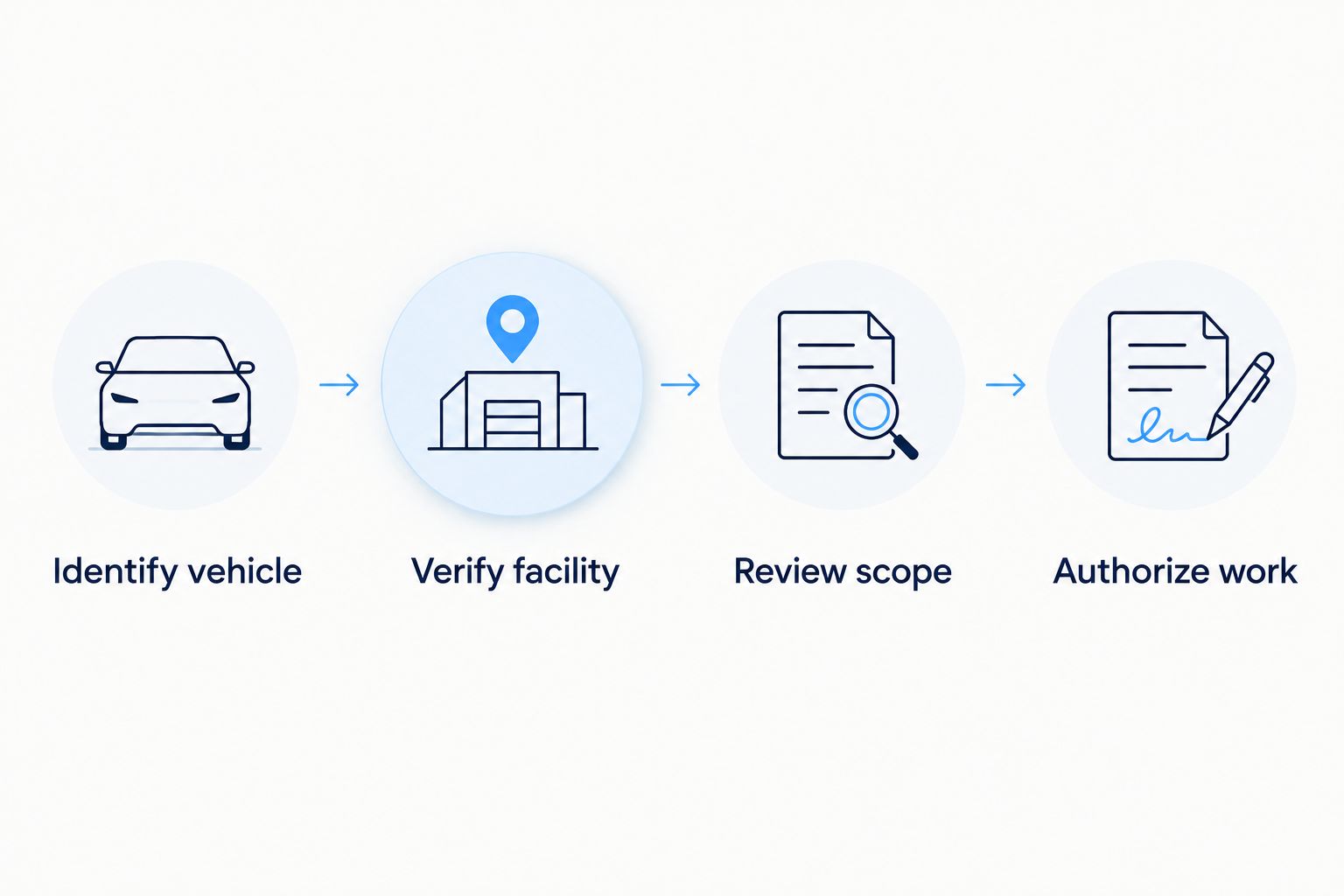
Verify the facility and repair scope before authorizing the repair.
Do not confuse an insurer’s preferred-provider status with manufacturer certification. Both can be relevant to your decision, but they describe different relationships.
Compare repair plans, not just estimate totals
If you obtain 2 written estimates, compare the operations and parts line by line. A shorter estimate can describe a smaller repair scope rather than a more efficient version of the same work.
Ask these 3 questions before signing:
- What is included? Identify disassembly, parts, refinishing, structural operations, and required electronic work.
- What changes after inspection? Ask how newly discovered damage will be documented and how additional authorization will work.
- What records will I receive? Clarify which invoices, photographs, measurements, scan reports, or calibration records apply to the repair.
A supplement is an addition or revision to an estimate when the repair scope changes, such as after hidden damage is exposed. Ask how the shop communicates supplements and distinguishes repair requirements from insurer-approved payment.
The guide to how body shops document repair quality explains the records to discuss. Documentation supports accountability; a clean-looking finish does not explain what happened beneath the paint.
Which repair option should you choose?
Choose the facility that can verify its fit for your vehicle and explain the required work in writing. General body damage starts with assessment. Structural or EV-specific concerns add requirements that should shape the facility choice.
For an El Segundo driver comparing locations in 2026, convenience matters after capability. Confirm where the vehicle will be repaired, who will communicate updates, and how any outside specialist work will be coordinated.
If you also consider West Los Angeles or Burbank, apply the same location-specific checks. A familiar business name does not replace confirmation at the address receiving your vehicle.
FAQ
What’s the best OEM-certified body shop for an El Segundo driver?
The best fit is a facility with current certification for your vehicle’s manufacturer and capability for the required repair. Crashfix offers OEM-certified collision repair services across Los Angeles County; confirm the relevant credentials at the proposed location.
How do I verify that a body shop is actually OEM certified?
Check the vehicle manufacturer’s official collision-repair locator where available and match the exact facility address. Ask the shop to confirm current certification and any relevant vehicle restrictions.
Is an insurer-approved body shop the same as an OEM-certified shop?
No. Insurer approval concerns a relationship with an insurance company, while OEM certification concerns a vehicle manufacturer’s repair program. A facility can have either relationship, both, or neither.
Does OEM certification mean every replacement part will be genuine?
Do not assume every proposed part is genuine OEM from certification alone. Review the itemized estimate and ask the shop to identify genuine OEM, aftermarket, and recycled components before authorization.
Does my car need calibration after a bumper repair?
Calibration requirements depend on the vehicle, affected systems, and repair operations. Ask the shop to identify the manufacturer procedures that apply to sensors, cameras, and related components involved in the repair.
Can an EV body shop also repair a damaged battery?
EV body repair capability does not automatically establish battery repair capability. Ask who will inspect the battery area, perform any required high-voltage work, and handle specialist referrals.
Will insurance cover all manufacturer-required repair work?
Coverage depends on your policy, claim circumstances, and the insurer’s decisions. Ask for the required repair scope and the insurer’s payment position to be explained separately before approving work.
One last thing
Ask what happens behind the damaged panel. A bumper cover can conceal brackets, wiring, sensors, and other components. The visible mark is a starting point for assessment, not a complete repair diagnosis.
Before booking, gather your VIN, damage photos, incident date, and insurance information if you plan to use a claim. Describe warning messages and changes in door operation or vehicle behavior without trying to diagnose them yourself.
Related guides
- EV-certified body shops in Los Angeles County
- Collision repair shops for ADAS recalibration
- Auto body repair in El Segundo for drivers with airport travel
Your next step is an assessment request. Confirm the appropriate location and manufacturer credentials before arranging drop-off.
Request a collision repair assessment
Share your vehicle and damage details, then confirm the appropriate location and repair requirements.