Maaco alternatives for OEM-certified repair in LA
Maaco is known for auto painting and collision repair, but a familiar name does not establish whether a particular location holds the manufacturer certification your vehicle needs. For accident damage, compare Maaco alternatives by the repair procedures, location-specific credentials and documentation behind the estimate—not the paint finish alone. CrashFix belongs on your shortlist for collision repair in Los Angeles County; a dealer-affiliated collision center is another route when you want to investigate your vehicle manufacturer’s repair network.
TL;DR
- Compare Maaco alternatives by the specific facility’s credentials and repair plan, not the chain name.
- CrashFix offers collision, paint, structural and EV body repair; confirm manufacturer certification at your chosen location.
- A dealer-affiliated collision center still needs scrutiny: dealership affiliation is not proof of manufacturer certification.
- Ask every shop to explain parts, hidden damage, required calibrations and final repair documentation.
Why the repair plan matters more than the badge
A bumper scrape and a collision that moves the bumper’s mounting points can look similar from outside. They do not necessarily require the same work. Paint appearance alone cannot establish whether concealed damage, attachment points or affected driver-assistance equipment have been addressed.
Your useful comparison is therefore not simply Maaco versus another business name. It is one facility’s written repair plan against another’s, for your vehicle and its actual damage.
Start with how body shops document repair quality. The central question is practical: what evidence will you receive that connects the approved work to the completed repair?
Maaco alternatives at a glance
These are repair routes to investigate, not a ranking of unverified local facilities. Certification belongs to a specific facility and manufacturer program; do not assume it applies across an entire business or to every vehicle make.
Maaco
- Best for: Drivers considering painting or collision work at a particular local facility
- Main distinction: An established name associated with painting and collision repair
- What to verify before authorizing work: That location’s relevant certifications, procedures and proposed repair scope
CrashFix
- Best for: Los Angeles County drivers seeking collision, structural, paint or EV body repair
- Main distinction: A collision-repair business operating OEM-certified centers
- What to verify before authorizing work: Which manufacturer certifications apply at your selected location and to your vehicle
Dealer-affiliated collision center
- Best for: Drivers who want to investigate a repair facility connected with a vehicle dealership
- Main distinction: Dealership affiliation provides a starting point for questions about the manufacturer’s repair network
- What to verify before authorizing work: Who actually performs the repair and whether that facility holds the relevant certification
Another manufacturer-certified independent shop
- Best for: Drivers comparing a second facility with credentials relevant to their make
- Main distinction: A separate repair business with a potentially suitable manufacturer-program credential
- What to verify before authorizing work: Current certification, damage-specific capabilities and the written repair plan
The strongest alternative is the facility that can substantiate its suitability for your car—not the one with the most reassuring label.
1. CrashFix: best for collision-focused repair in LA County
CrashFix provides auto body, paint, structural and EV body repair after accidents. That makes the business a relevant option when your concern extends beyond repainting a damaged panel. Confirm the selected location’s manufacturer credentials before treating certification as a reason to book.
Best for: Drivers seeking a collision-repair assessment with questions about body damage, structure or an electric vehicle’s repair needs.
Where this option fits
- The stated service scope includes structural repair, not just exterior refinishing.
- EV body repair is part of the stated offering.
- The business operates across Los Angeles County, giving local drivers a repair provider to investigate.
Where this option falls short
- Paintless dent repair, auto glass and windshield services are outside the stated service offering.
- Classic-car work is also outside scope.
- A business-wide description does not establish the correct manufacturer certification for your selected location. You still need that confirmation.
Stated work relevant to this comparison
- CrashFix: Collision, paint, structural and EV body repair
- Maaco: Painting and collision repair
Certification question
- CrashFix: Confirm the chosen center’s relevant manufacturer certification
- Maaco: Confirm whether the chosen facility holds the relevant manufacturer certification
Scope question
- CrashFix: Ask how the proposed work addresses your accident damage
- Maaco: Ask how the proposed work addresses your accident damage
Evidence to request
- CrashFix: Written repair scope and applicable completion records
- Maaco: Written repair scope and applicable completion records
For an electric vehicle, ask what the facility needs to know before accepting the car, including any battery warnings or visible damage near the battery area. The guide to EV-certified body shops in Los Angeles County provides a related starting point for evaluating that repair route.
Verdict: Hold authorization until the selected facility confirms its fit for your vehicle and explains the repair scope.
2. Dealer-affiliated collision centers: best for investigating a dealer route
A dealership-associated repair facility is another option to investigate after a collision. The important distinction is between a dealership referring you somewhere and the actual repair facility holding the manufacturer credential you need.
Best for: Drivers who want to begin with their vehicle dealer and establish exactly where the body repair would take place.
Where this option shines
- You have a clear starting question: does the dealer operate a collision center or refer repairs elsewhere?
- You can ask the dealer to identify the actual repair business before arranging transport.
- You can compare that facility’s written plan with an independent shop’s proposal.
Where this option falls short
- A dealer relationship alone does not prove collision-repair certification.
- The business handling your inquiry is not necessarily the business performing the work.
- You still need written clarity about parts, subcontracted work and completion records.
Compared with Maaco, this route changes where you begin your search—not the standard of evidence you should require. Ask for the repair facility’s name, address and relevant manufacturer credential before moving the vehicle.
Verdict: Hold until you identify and verify the facility actually doing the repair.
3. Another manufacturer-certified independent: best for a second assessment
A separate independent facility with the relevant manufacturer certification gives you another repair plan to evaluate. Use the vehicle manufacturer’s collision-repair locator, where available, to investigate the facility rather than relying only on a badge in an advertisement.
Best for: Drivers who want another assessment from a facility with credentials relevant to their vehicle make.
Where this option shines
- A relevant certification gives you a concrete credential to investigate.
- A second written assessment helps expose differences in proposed work.
- You can ask both facilities to explain disagreements about repair versus replacement.
Where this option falls short
- Certification does not explain every line of an estimate.
- You must still establish who performs specialized or subcontracted operations.
- Different inspection stages can make estimates appear more directly comparable than they are.
Compared with Maaco, the useful distinction is a verified credential at the particular facility—not independent ownership by itself.
Verdict: Hold until the credential and damage-specific repair plan both check out.
Why look beyond Maaco?
A different repair provider makes sense when the alternative answers a requirement the facility you are considering cannot substantiate. That is a reason to compare—not evidence that every Maaco location lacks the same capability.
Useful reasons to broaden your search include:
- Certification: You want a particular manufacturer credential and have not confirmed it at the proposed facility.
- Repair scope: You need an explanation of structural damage, EV-related precautions or work around driver-assistance equipment.
- Documentation: You want to know what inspection, measurement or calibration records will accompany the completed repair, where applicable.
- Estimate clarity: You cannot tell whether competing proposals cover the same damage and operations.
Do not infer a problem from a brand name. Ask the facility to address the requirement directly, then judge the answer.
Compare estimates without comparing different jobs
An estimate based on visible damage is not necessarily the same document as a repair plan prepared after disassembly. Disassembly means removing parts so the shop can inspect areas that were previously hidden. Additional damage can change the proposed work.
Use this sequence before deciding which proposal is more suitable:
- Inspection stage: Ask what has been inspected and what remains concealed.
- Repair scope: Identify which panels or components the shop proposes to repair or replace.
- Parts selection: Ask what part types are specified and why.
- Required checks: Ask which measurements, scans or calibrations the repair procedures call for.
- Completion records: Establish what documents you will receive when the vehicle is returned.
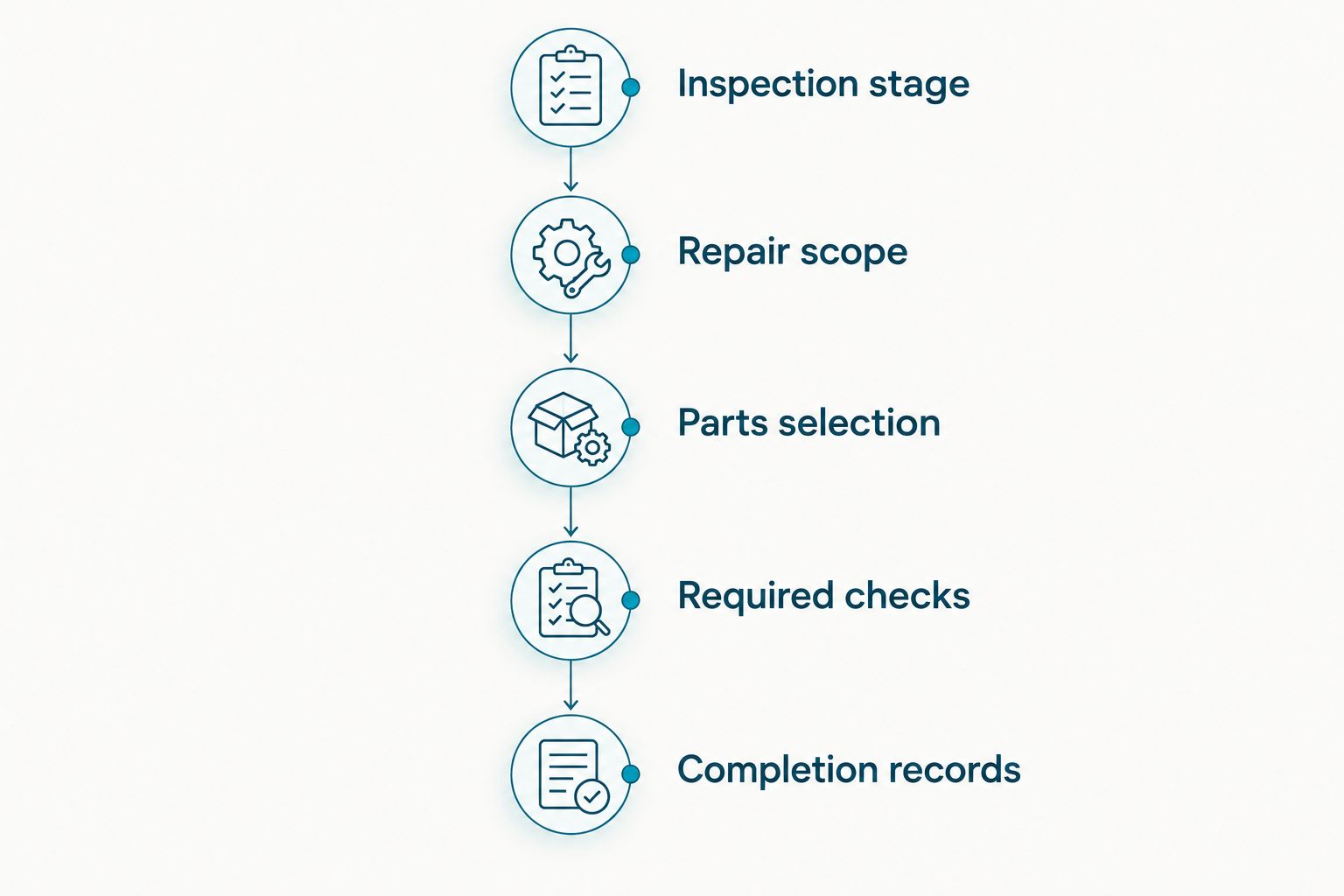
Compare the scope and inspection stage before judging differences between estimates.
A diagnostic scan reads information from vehicle control modules. Calibration checks or sets the alignment of certain driver-assistance components using the applicable procedure. Those terms describe different operations; ask the shop to explain what your vehicle requires rather than accepting them as interchangeable line items.
Also ask how the shop handles a supplement—additional proposed work identified after the initial estimate. Establish who will explain the change and obtain any required authorization. Repair requirements and insurance payment decisions are separate questions; neither should be left to assumption.
Your insurer’s recommendation is not your only option
California Insurance Code section 758.5 protects a claimant’s choice of repair shop and restricts an insurer from requiring repairs at a particular facility. California Department of Insurance consumer guidance explains these repair-shop choice protections.
That right does not guarantee payment for every requested part or operation. Your policy, the claim circumstances and the insurer’s coverage determination still matter.
If you prefer a different facility, tell the insurer which shop you have selected and ask what documentation it needs. Ask the repairer to explain any unresolved difference between the proposed work and the insurer’s position before you authorize work that leaves you responsible for payment.
When staying with Maaco is the right call
Keep Maaco on your shortlist if the particular facility can explain the work your vehicle needs, substantiate any relevant certification claims and provide a clear written proposal. An alternative business name is not, by itself, an improvement.
The same scrutiny applies everywhere. Choose the facility that can explain the repair and support its claims with records. If your concern is limited to paint appearance, make that scope explicit; if the vehicle was in a collision, do not assume the visible finish tells the whole story.
FAQ
What are the best Maaco alternatives for collision repair in Los Angeles?
CrashFix, a verified manufacturer-certified independent shop and a dealer-affiliated collision center are repair routes to investigate. The best fit depends on the actual facility’s credentials, your vehicle and its damage—not the business name alone.
Is Maaco an OEM-certified collision repair shop?
Verify certification for the specific Maaco facility and your vehicle manufacturer. Do not treat a chain name or a general reference to collision repair as proof of a current manufacturer-program credential.
Does OEM certification mean a shop can repair every vehicle make?
No. Manufacturer certification is tied to a particular program and facility, so ask whether the selected location holds the credential relevant to your vehicle.
Is a dealer body shop automatically manufacturer-certified?
No. Dealership affiliation alone does not establish manufacturer collision-repair certification. Identify the actual repair facility and verify its relevant credential separately.
Can my insurance company make me use its recommended body shop in California?
California law protects your right to choose a repair shop. That choice does not automatically resolve coverage or payment disagreements, so clarify those issues with your insurer and repairer before authorizing work.
Why do collision repair estimates describe different work?
Estimates can differ because the facilities inspected different amounts of damage or proposed different repair operations and parts. Ask each shop to identify its inspection stage and explain the scope before treating the documents as equivalent.
What should I ask before booking a collision repair estimate?
Ask whether the facility handles your vehicle and damage type, which relevant certifications it holds and what the inspection involves. Bring damage photos, vehicle details and claim information if you have opened a claim.
Read next before authorizing repairs
- What records should you get after collision repair?
- Can you get an estimate before deciding to file a claim?
- Can a cracked bumper be repaired, or does it need replacing?
Before you arrange an estimate
Ask one question that cuts through the comparison: What cannot be determined until the vehicle is inspected or disassembled? A clear answer helps you understand the limits of the initial estimate without mistaking uncertainty for a completed diagnosis.
To discuss an estimate with CrashFix, have your vehicle’s year, make and model, damage photos, preferred location and claim details ready. Confirm that location’s suitability before arranging transport or drop-off.
Discuss your collision repair
Prepare your vehicle details and damage photos, then ask about an estimate at the appropriate location.